Europe 2000 (Part 2)

December 20

The gentle reader will never, never know what a consummate ass he can become until he goes abroad. I speak now, of course, in the supposition that the gentle reader has not been abroad, and therefore is not already a consummate ass. ~  Mark Twain

To the best of my knowledge (or anyone else’s for that matter), this completes the blogging of all trips taken over the last several decades. In order to amuse myself for the remaining time in pandemic quarantine, I plan to take up whittling . . . ~ Me

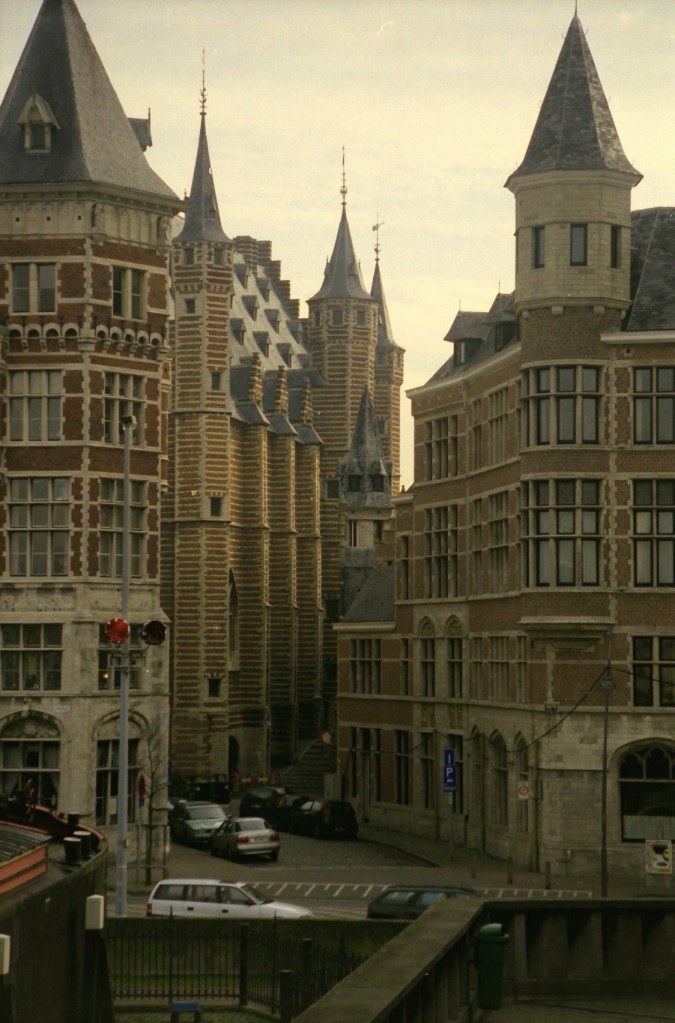
Antwerp

[We’re still in Antwerp, Belgium – the locale for Professor T., the best thing on TV since The Daily Show . . . ]

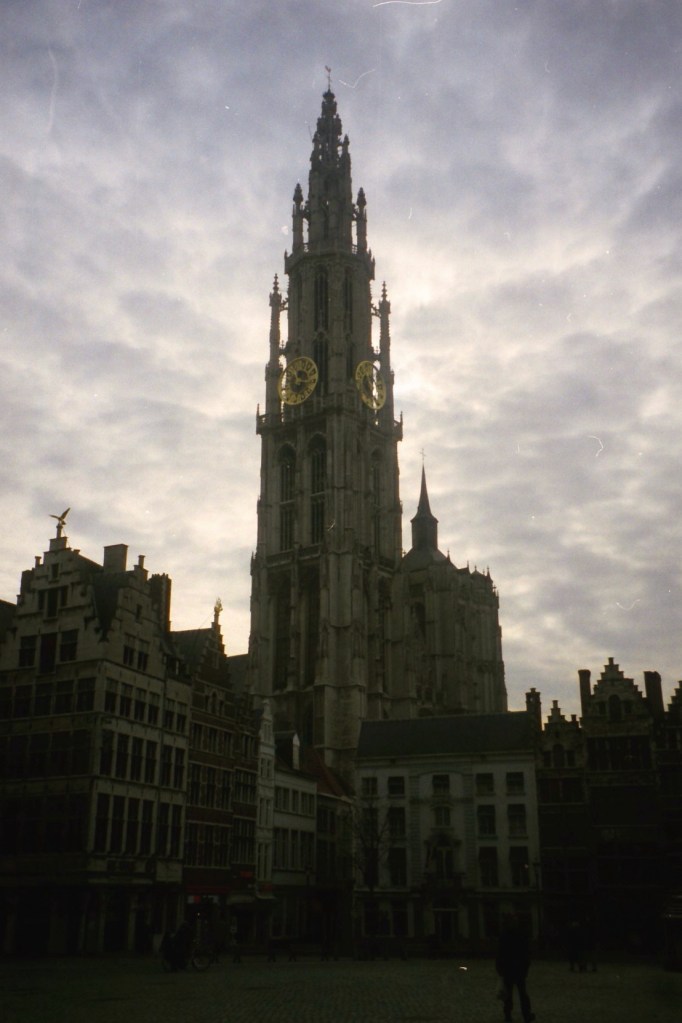
[If you are a fan of Professor T., you will recognize the Antwerp skyline . . . ]

[The backside of the Het Steen Castle. There are backsides; and then there are backsides . . . ]
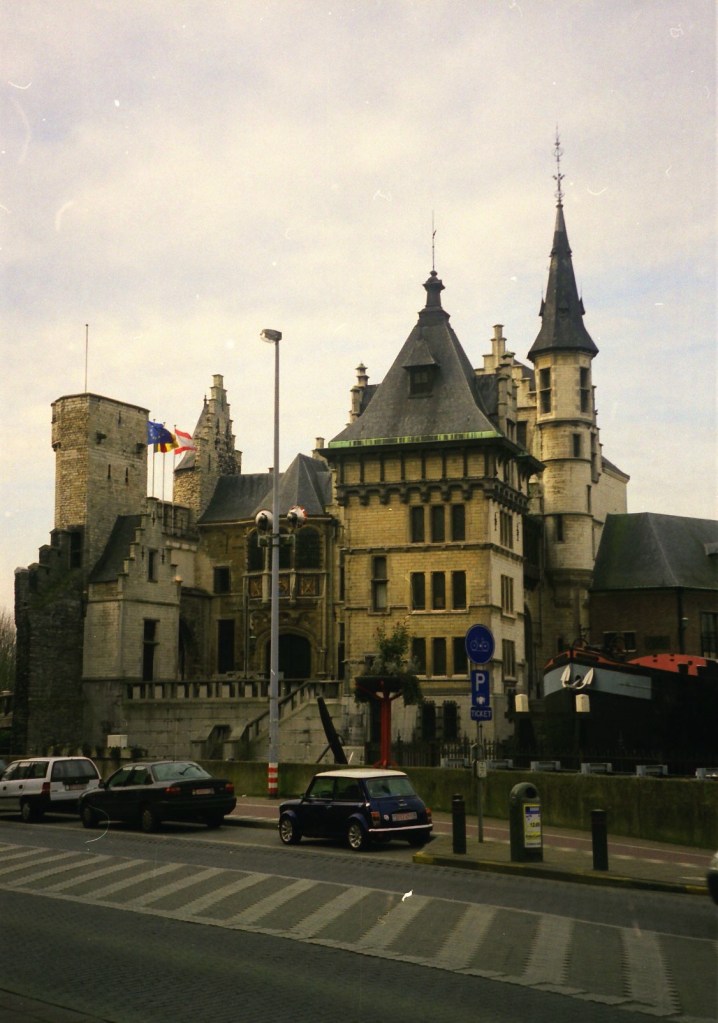
In Paris they just simply opened their eyes and stared when we spoke to them in French! We never did succeed in making those idiots understand their own language. ~  Mark Twain
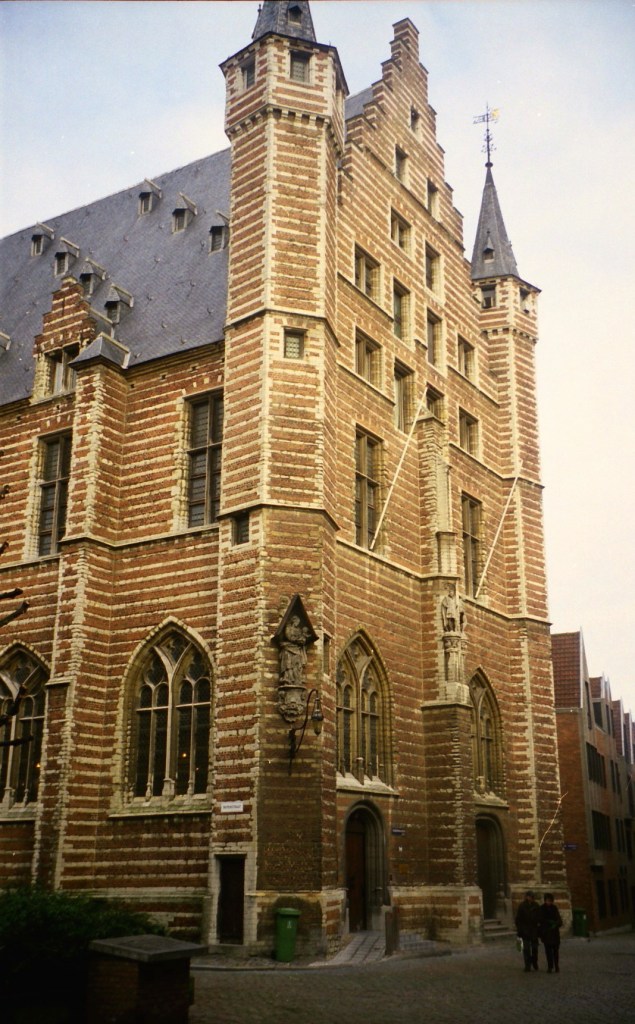
It is the right of a traveler to vent their frustration at every minor inconvenience by writing of it to their friends. ~  Susanna Clarke
[The Stadhuis (City Hall) of Antwerp stands on the western side of Antwerp’s Grote Markt (Great Market Square). Erected between 1561 and 1565, this Renaissance building incorporates both Flemish and Italian influences. The Stadhuis is inscribed on UNESCO’s World Hertage List along with the belfries of Belgium and France (Wikipedia).]

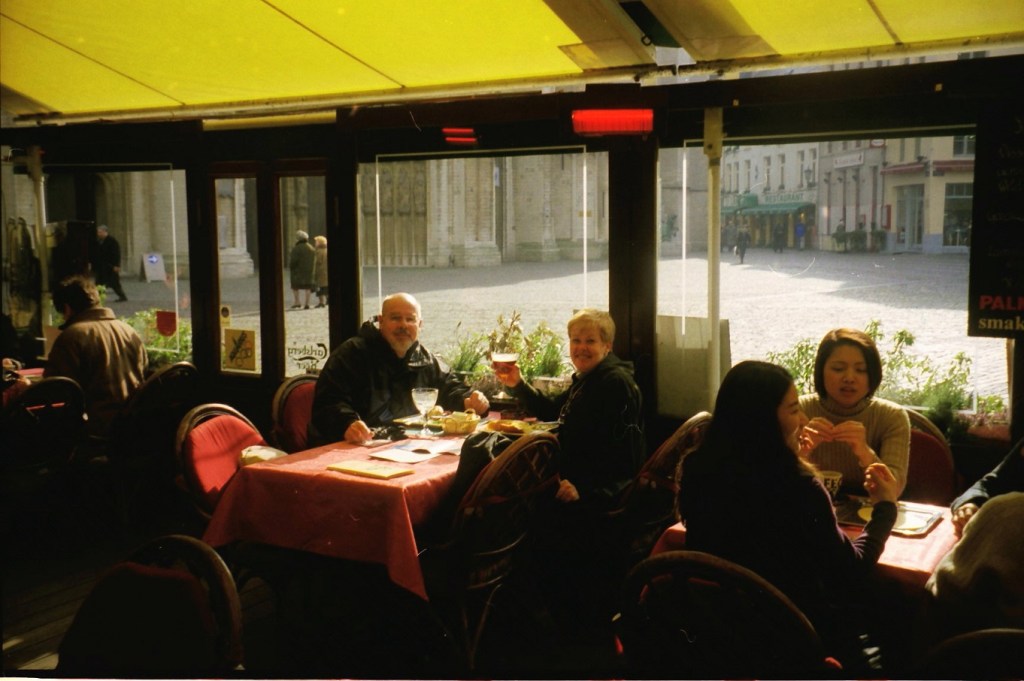
[Appears to be exterior dining in Downtown Square . . . ]
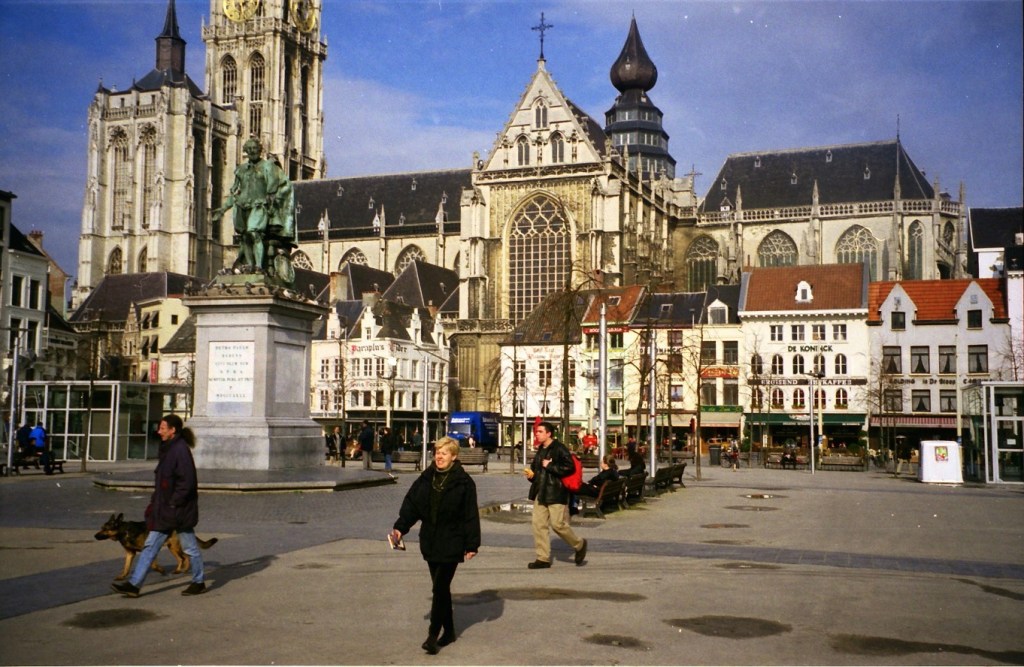
[Antwerp Cathedral fronted by Pieter Paul Rubens statue . . . ]

[And the Super fronting the Pieter Paul Rubens statue and the Antwerp Cathedral . . . ]
One time we played a concert in Antwerp, Belgium. At least I thought it was Antwerp, Belgium. Turns out it was a Stop ‘n Shop in Wisconsin somewhere, but it was fun man. ~ Slash

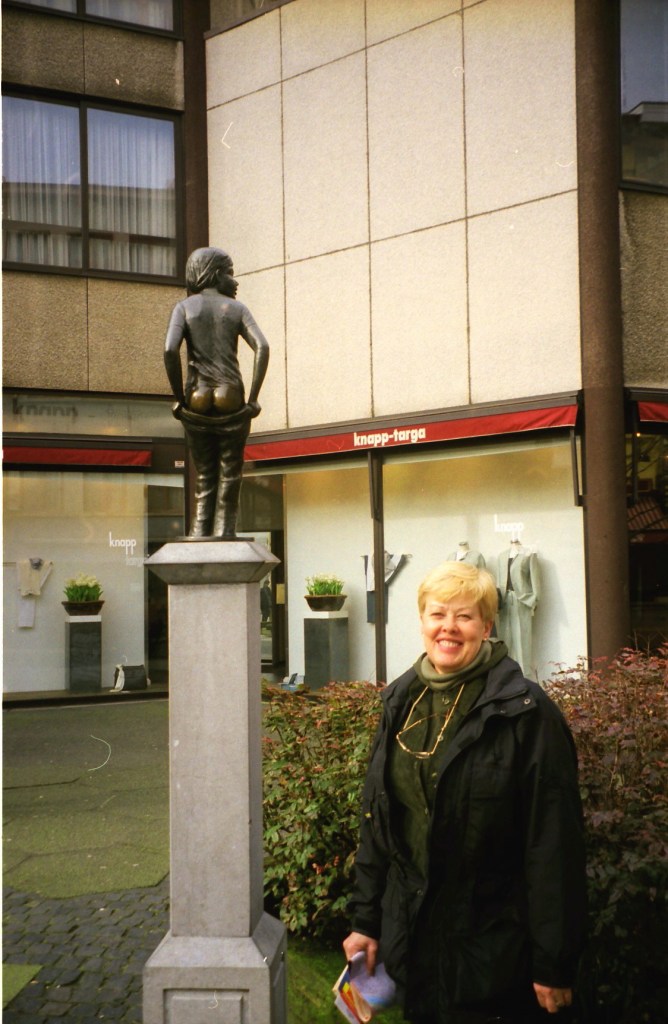
[‘Den Deugniet‘ – The Rascal . . . ]
[A building of some import – import of what, I have no idea . . . ]
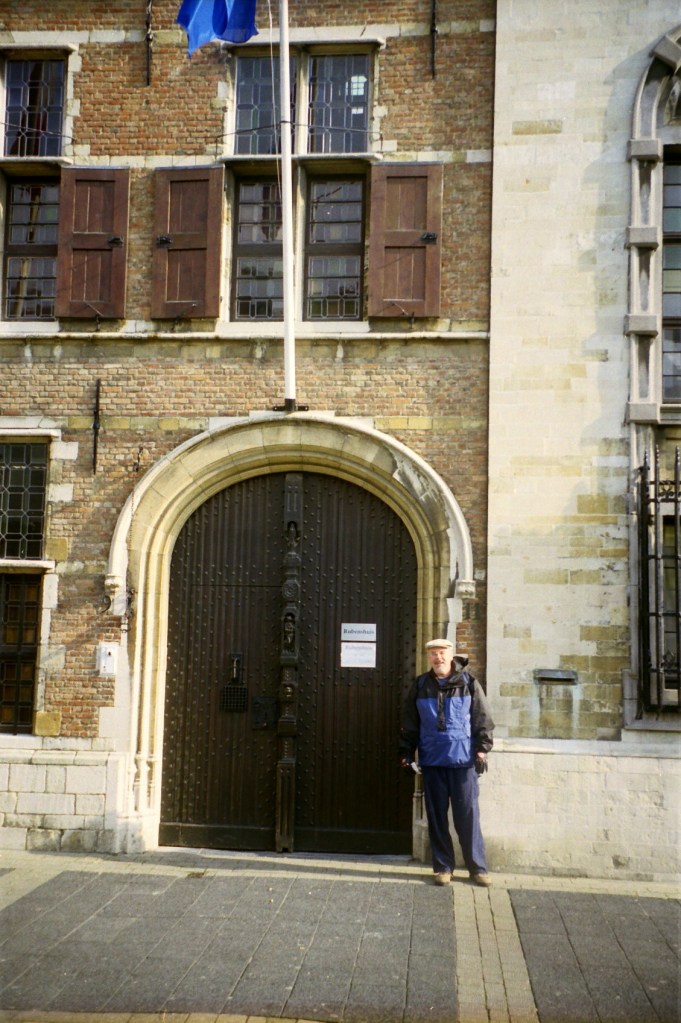
[The Super at the entrance to something else likely of import . . . ]
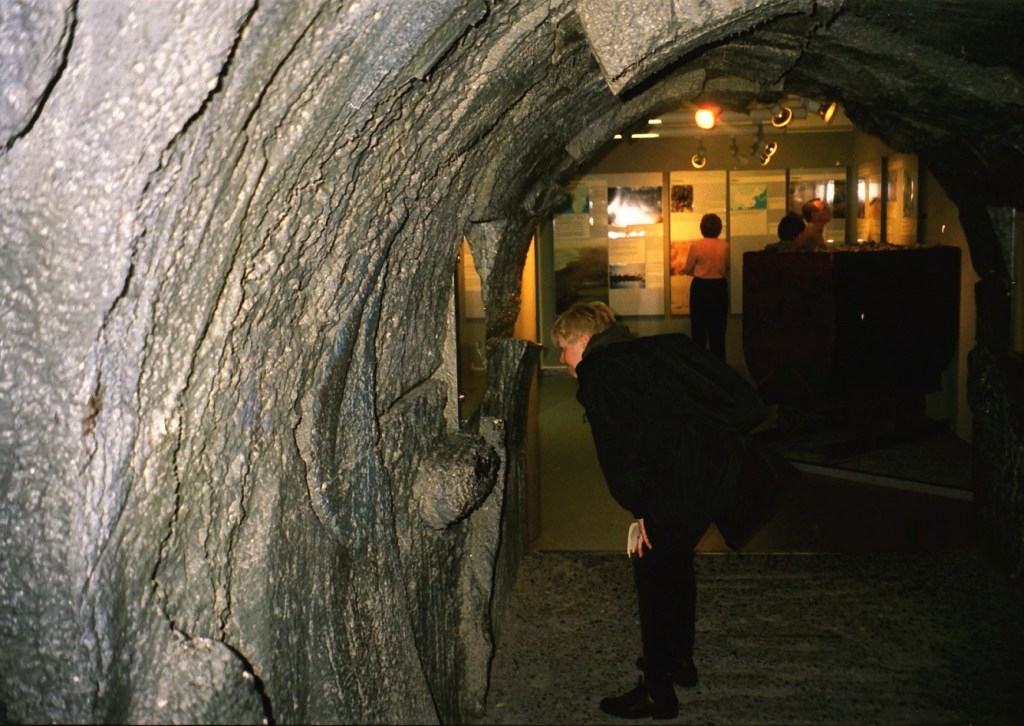
Eupen

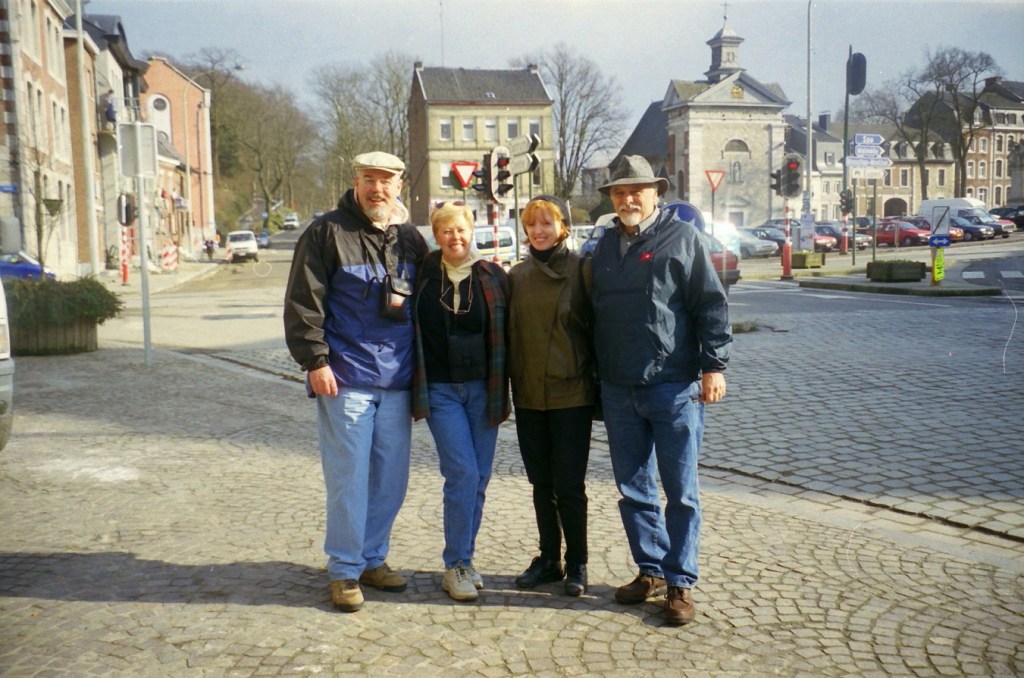
[I finally captured our fellow travelers, Rose & Dick McMullen (also guests of the Steiners in Brussels). The four of us were all bureaucrats in D.C., the McMullens subsequently retired to Salem, Massachusetts, and snowbirded to Sarasota, Florida . . . ]
[St. Nicholas Church: This baroque church on the Marktplatz, that incorporates part of a 14th century church, dates mainly from the 1720s. The two spires, added in the 1890s, have become symbols for Eupen. The contrasting styles of the interior and exterior reflect Eupen’s location between Wallonia (French Belgium) and Germany. Eupen is the primary city in Belgium’s German area. Eupen is in the Belgian German-speaking Community (stnicholascenter.org/).]
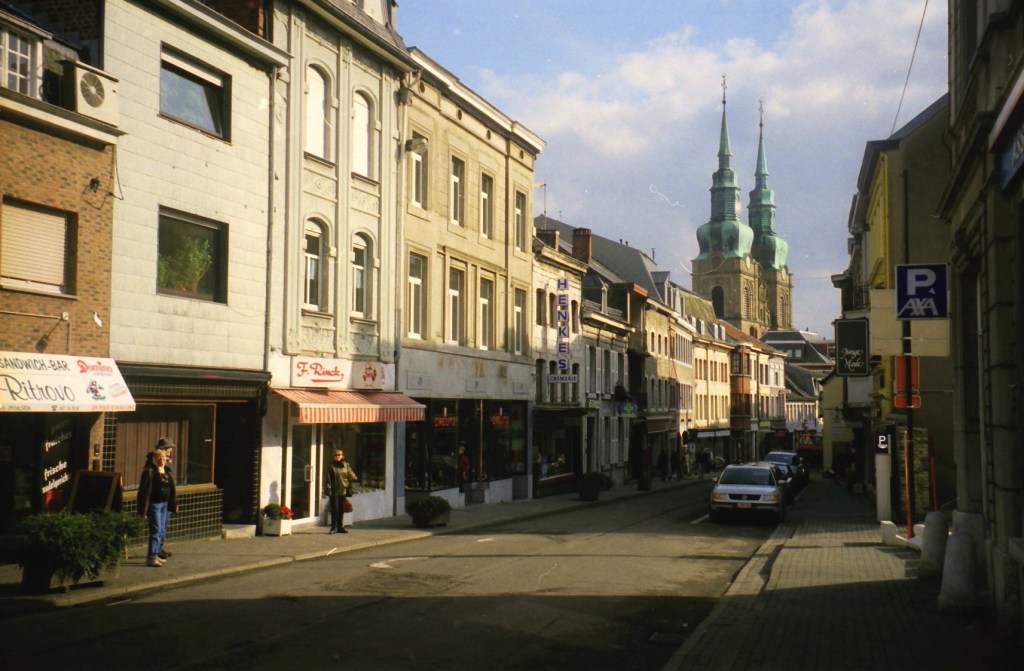
[Eupen is about 90 miles SE of Antwerp, and about 90 east of Brussels, our core and next destination city . . . ]
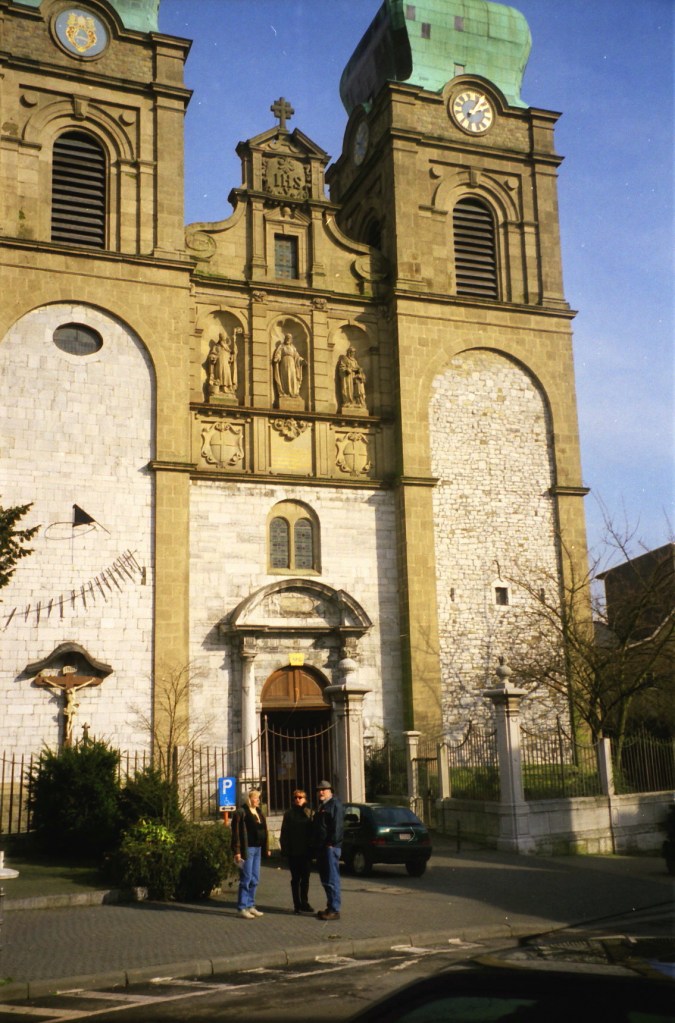
Just to interpret the Flemish for all at the patisserie, the yellow sign says “Snowballs”, one piece for 22BF (Belgian francs) and five for 100BF! Just thought that you’d want to know that you were there before the Euro took over…. Well, those were the days! ~ Walt Steiner, our Brussels host

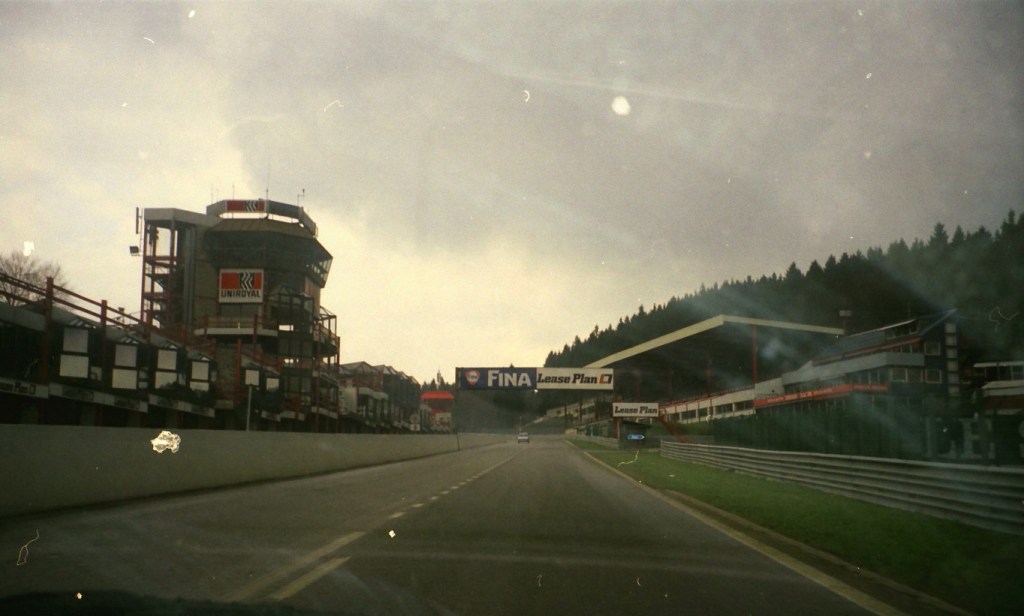
[Route of the Dutch Grand Prix?]
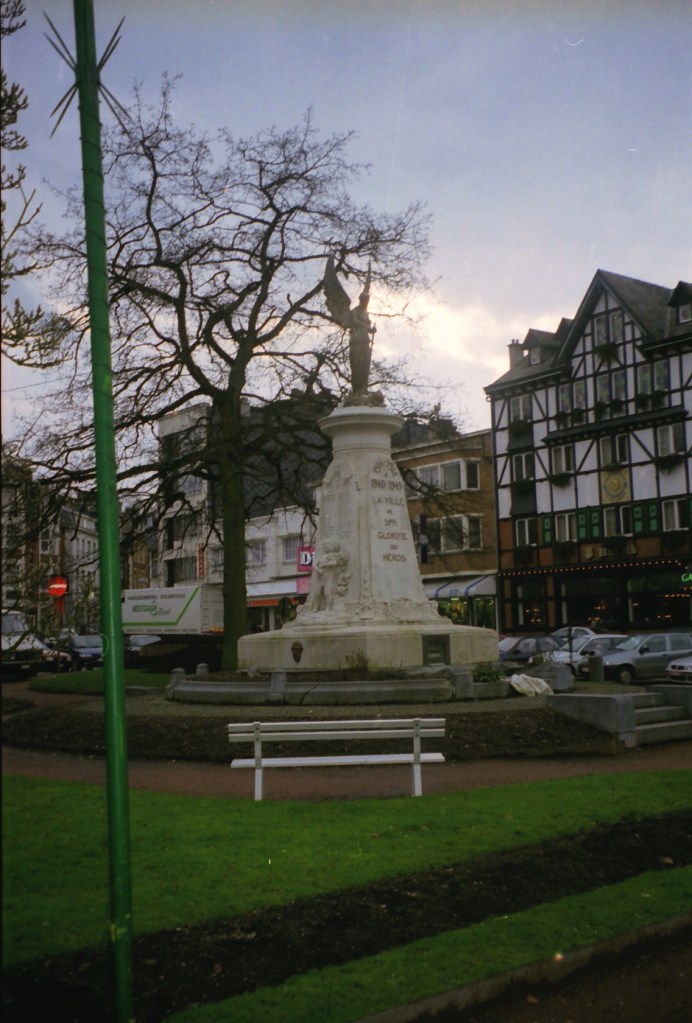
[WWII heroes monument in Spa, Belgium (about 15 SW of Eupen) . . . ]
Brussels

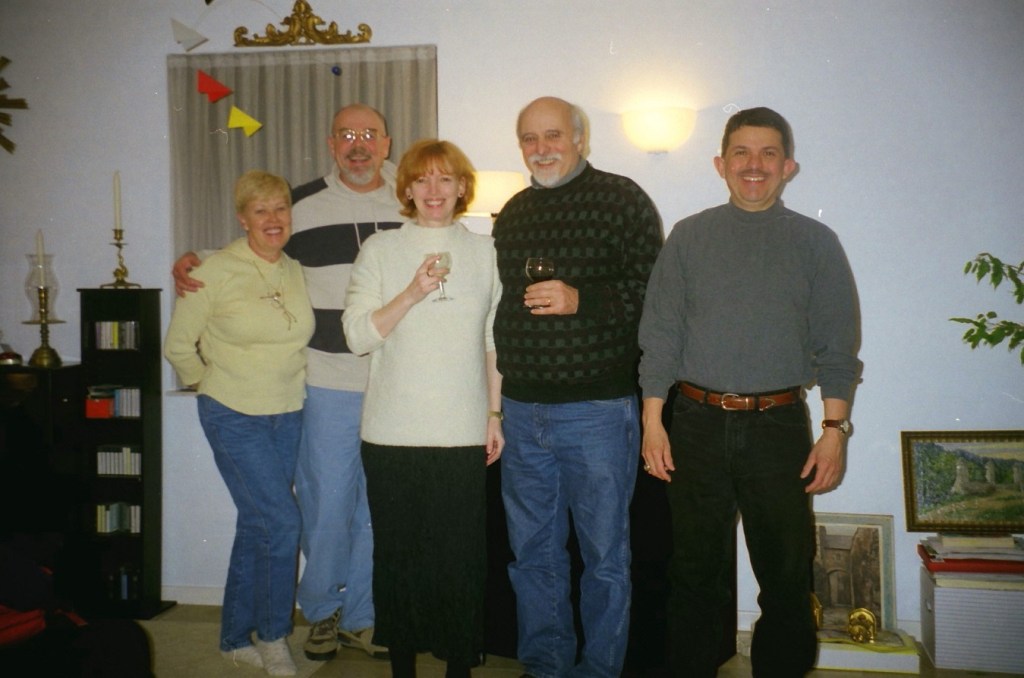
[We have arrived at the Steiner’s in Kraainem just in time for Happy Hour . . . ]
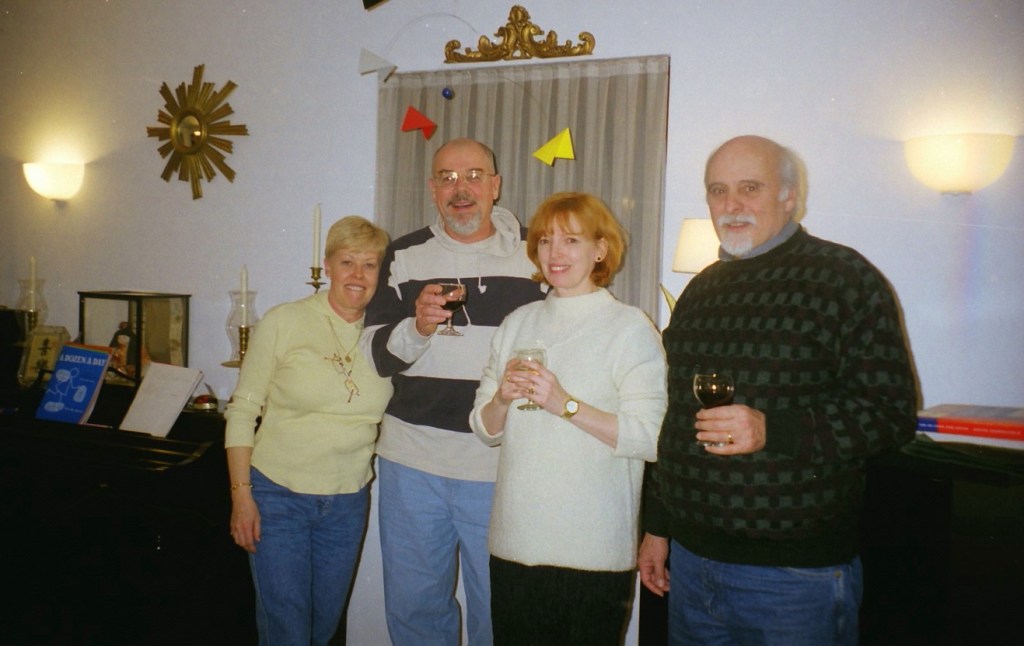
[And Roy Gorena, our fellow traveler during the 1997 trip, is also here . . . ]
[D’Arcy, a Steiner offspring . . . ]
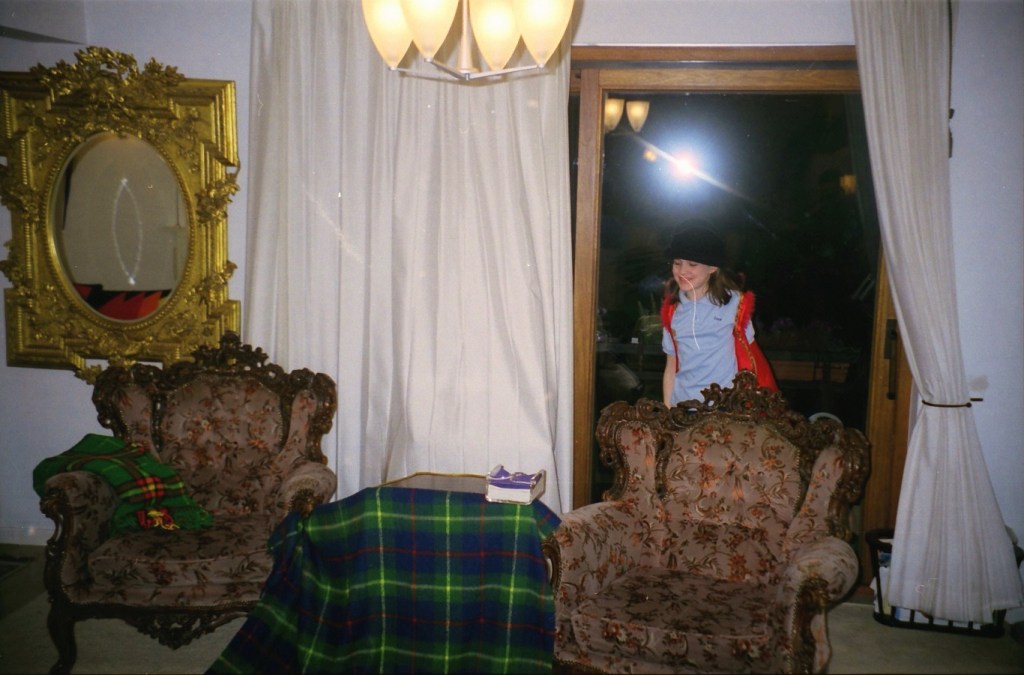
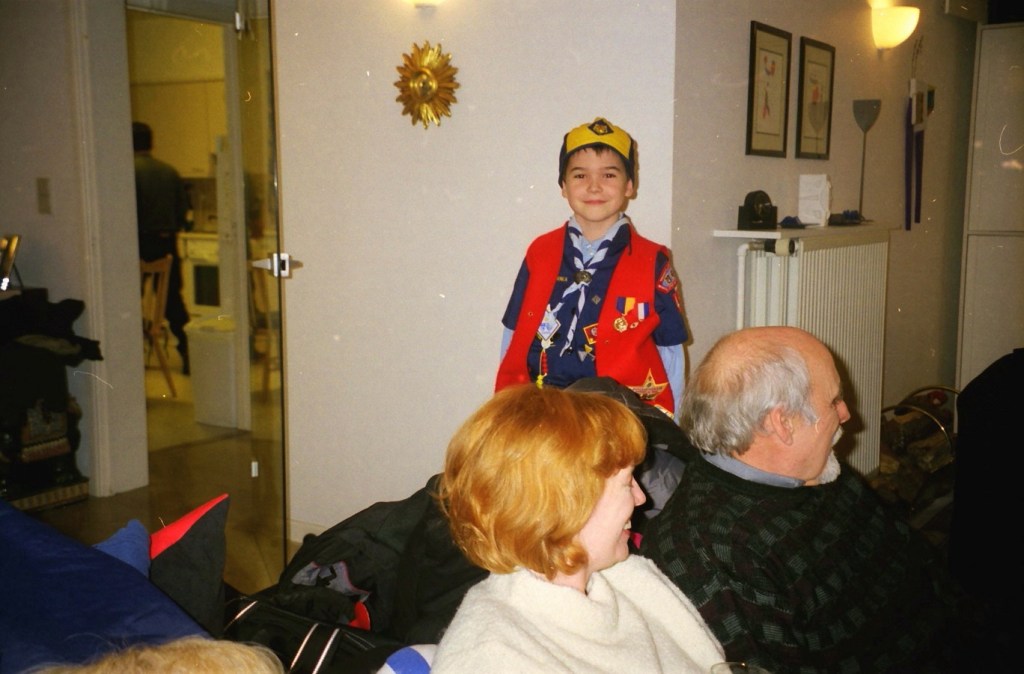
[D’Arcy, and her little brother Eric (below), are all growed up now, and traveling the world to an extent not imagined by their parents . . . ]

There are two kinds of travel: first class and with children. ~  Robert Benchley
Amsterdam

[First, check out the map to find out if we are indeed in Amsterdam . . . ]
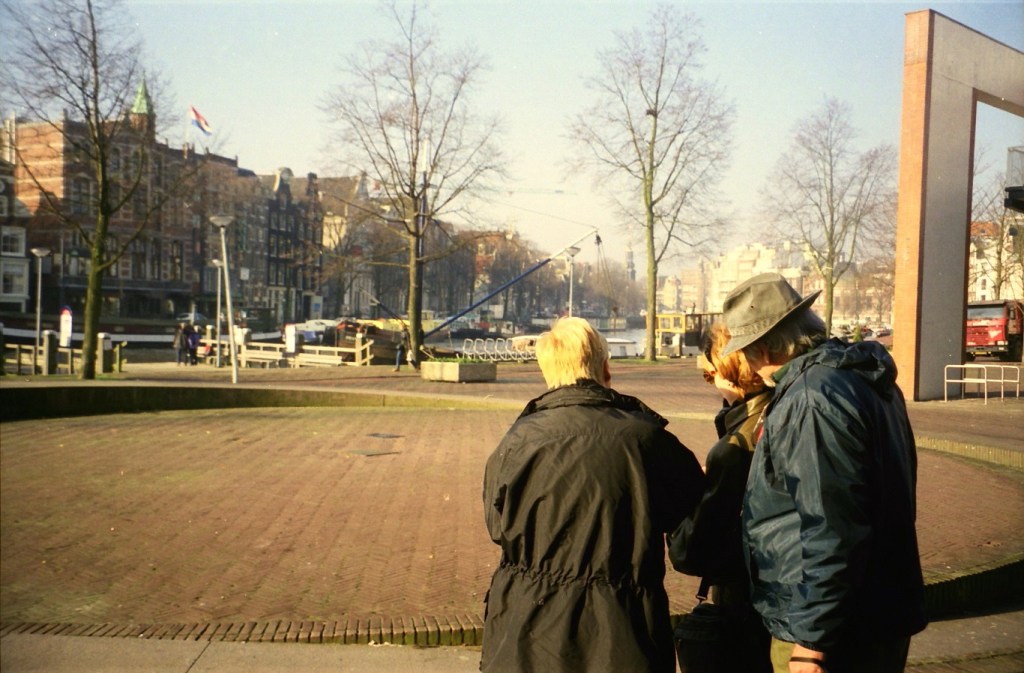
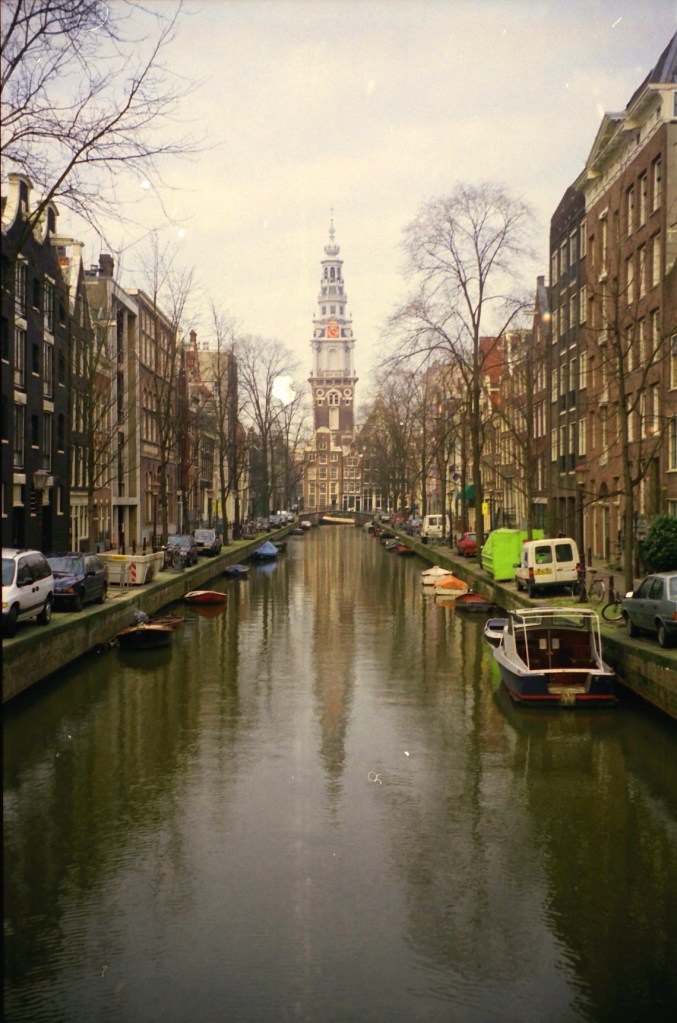
[The Westerkerk is a Reformed church within Dutch Protestant Calvinism in central Amsterdam. It lies in the most western part of the Grachtengordel neighborhood, next to the Jordaan. The tower, called the Westertoren (“Western tower”), is the highest church tower in Amsterdam, at 87 meters (±286 feet). The crown topping the spire is the Imperial Crown f Austria of Maximilian (Wikipedia).]
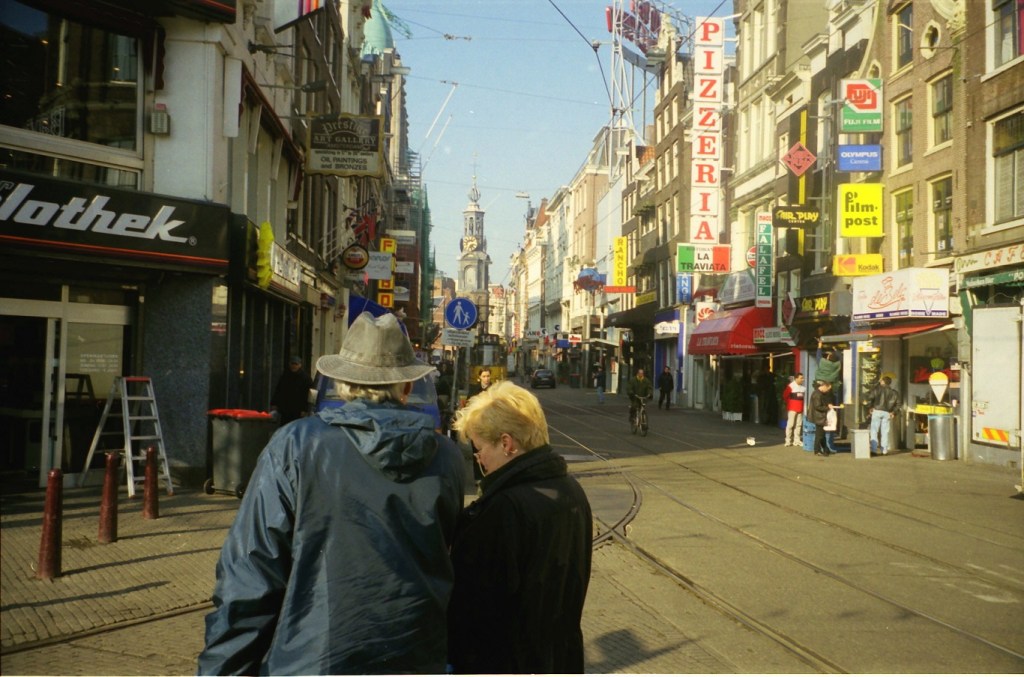
[Rembrandtplein (Rembrandt Square) is a major square in central Amsterdam, named after Rembrandt van Rijn who owned a house nearby from 1639 to 1656. The statue of Rembrandt was made in 1852 by sculptor Louis Royer and is of cast iron. It was cast in one piece and it is Amsterdam’s oldest surviving statue in a public space (Wikipedia).]
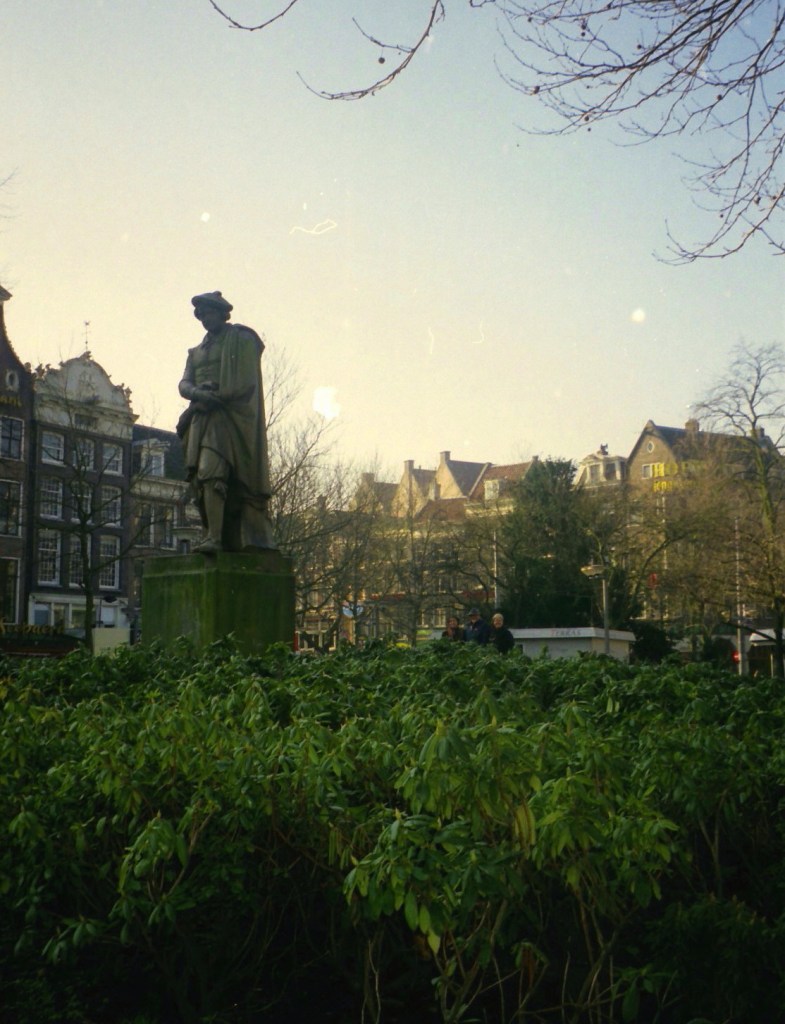
[After standing as the backdrop above, Rose, Dick, and the Super head for our ultimate goal – the Rijksmuseum. The Rijksmuseum is a Dutch national museum dedicated to arts and history in Amsterdam. The museum is located at the Museum Square, close to the Van Gogh Museum, the Stedelijk Museum Amsterdam, and the Concertgebouw. The Rijksmuseum was founded in The Hague on 19 November 1798 and moved to Amsterdam in 1808, where it was first located in the Royal Palace and later in the Trippenhuis. The museum has on display 8,000 objects of art and history, from their total collection of 1 million objects from the years 1200–2000, among which are some masterpieces by Rembrandt, Frans Hals, and Johannes Vermeer (Wikipedia).]
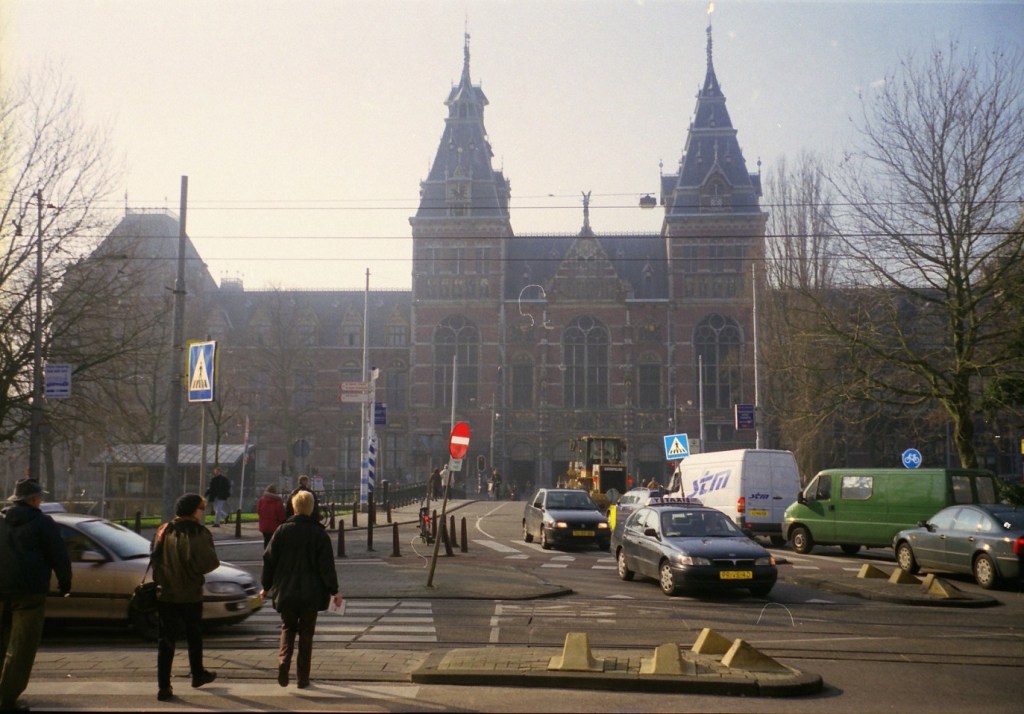
[The Super scrapbooked this as “Young Lovers.” Hmmmmm . . . ]
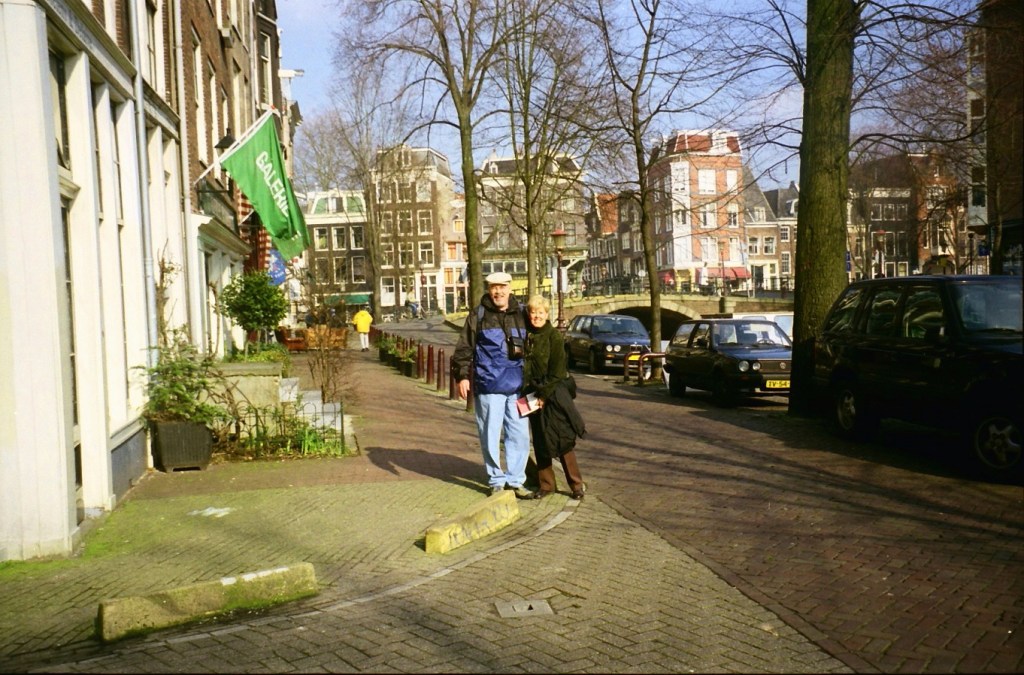
[Something to the affect that “diamonds are a girl’s best friend” . . .
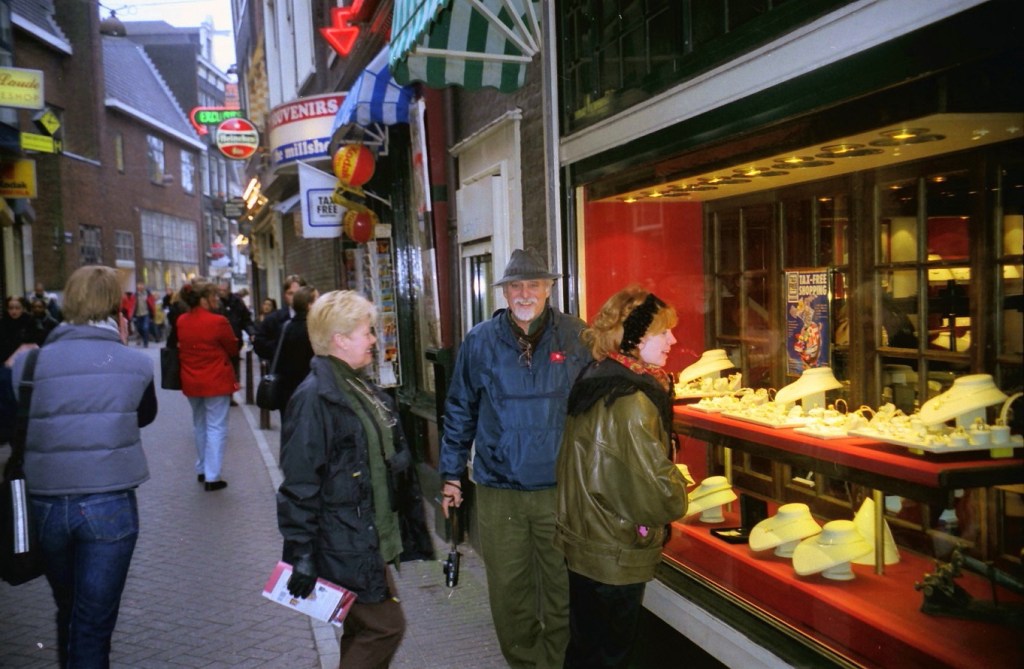
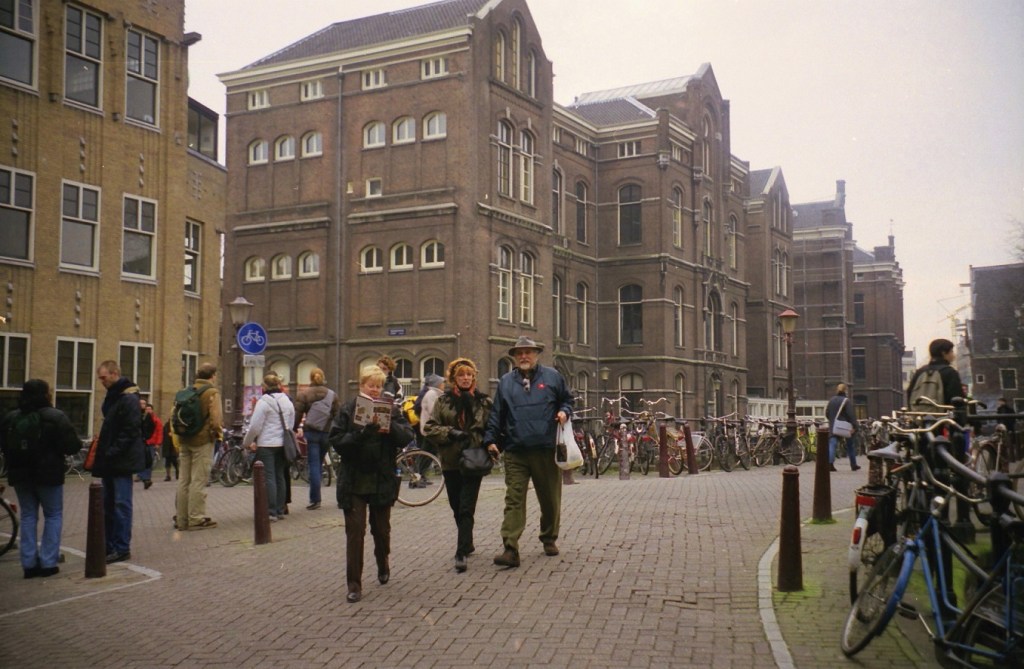
[Dick wasn’t carrying a shopping bag before we visited the diamond store?]
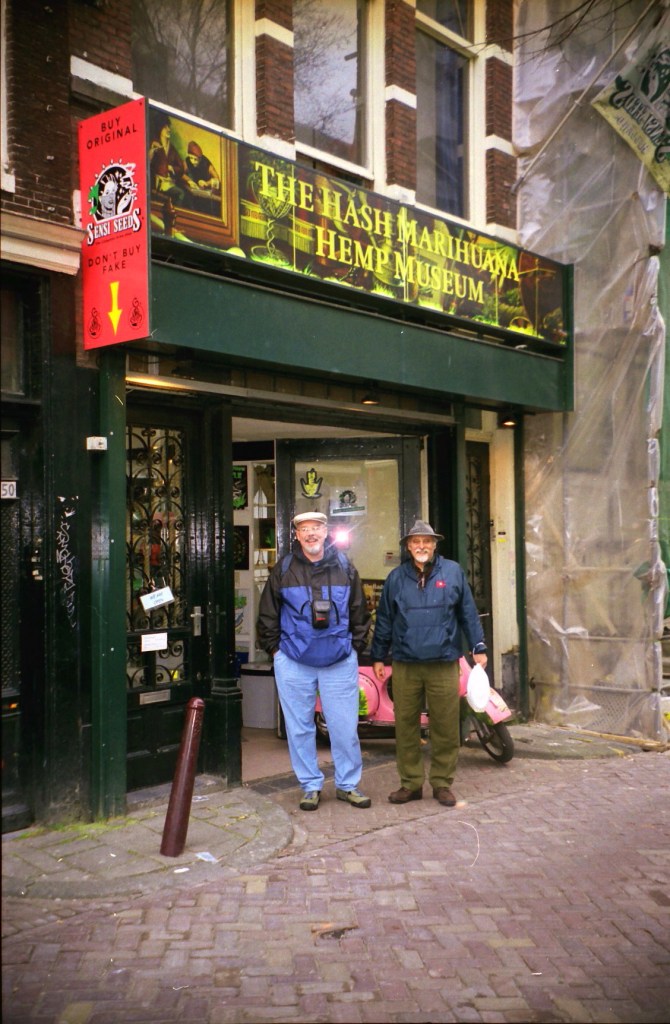
[Better check these guys for additional shopping bags after visiting here . . . ]
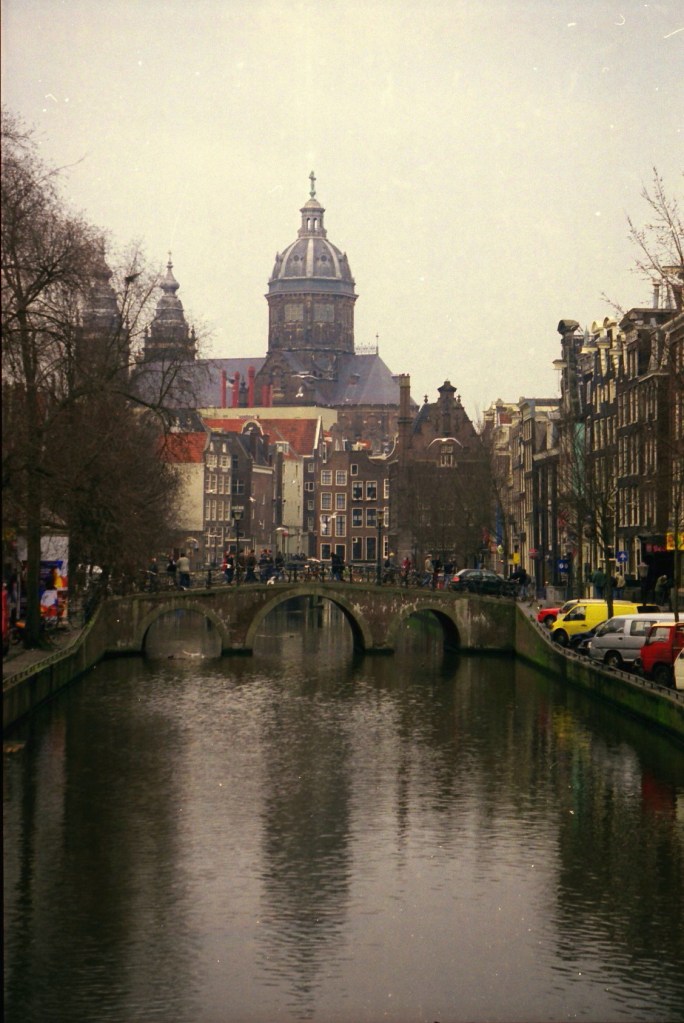
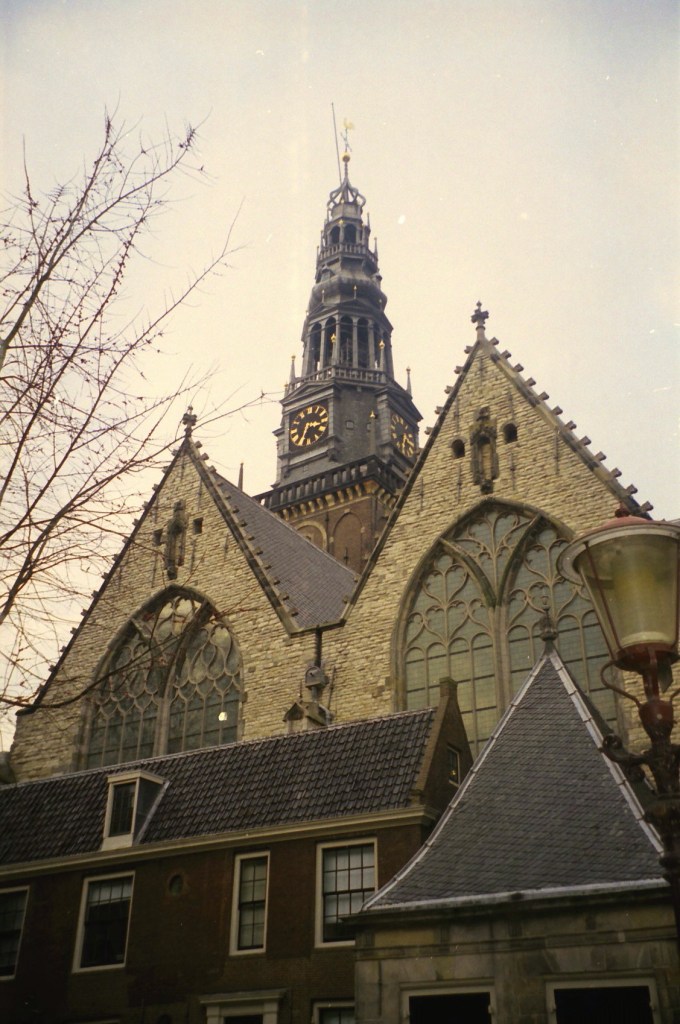
[The Basilica of Saint Nicholas is located in the Old Centre district in Amsterdam, very close to Amsterdam’s main railway station and the canal, Oudezijds Kolk. It is the city’s primary Roman Catholic church was completed in 1887 (Wikipedia).]
[Amsterdam Western Church Clock Tower . . . ]
[Westerkirk Clock Tower . . . ]
Ostend

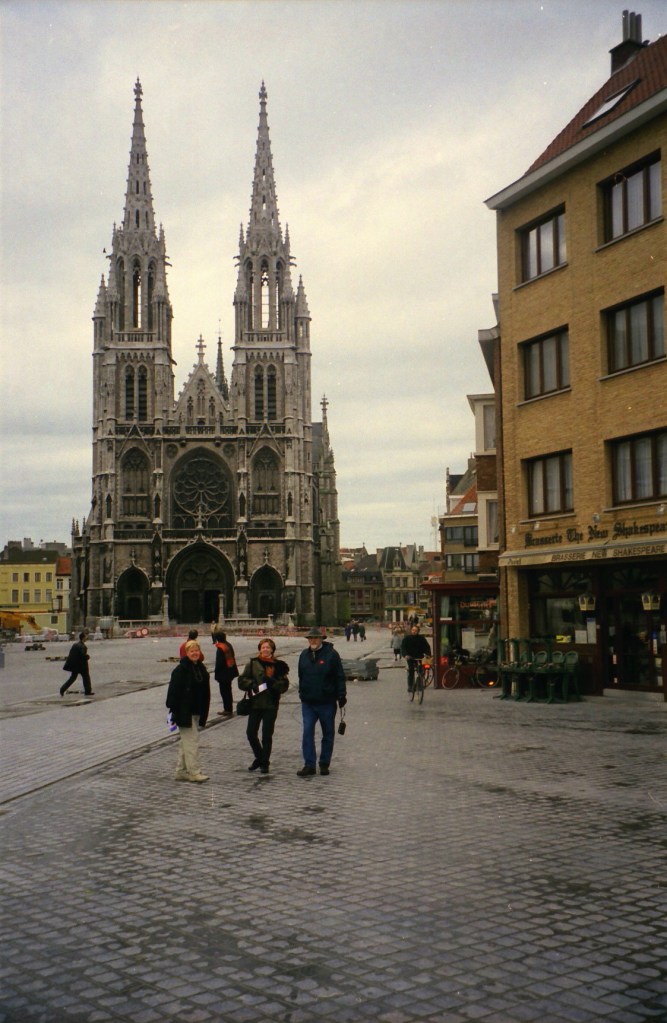
[Rose & Dick searching for a fine dining experience in the largest city on Belgium’s coast, about 170 miles SW of Amsterdam . . . ]

[Sint-Petrus-en-Pauluskerk (Church of Saint Peter and Saint Paul), the main church of Ostend, is a Roman Catholic Neo-Gothic church. It is built on the ashes of a previous church that occupied the site. Construction started in 1899 and was completed and consecrated on August 31, 1908. Its stained glass windows were destroyed during the two World Wars and were replaced. The church is 70 meters long and 30 meters wide. Its spires are 72 meters high (Wikipedia).]
Bruges

[Simon Stevin (a Belgian mathematician) Square in Bruges (20 miles west of Ostend) with the Church of our Lady. Having visited here twice now, Bruges is one of our all-time favorite cities . . . ]
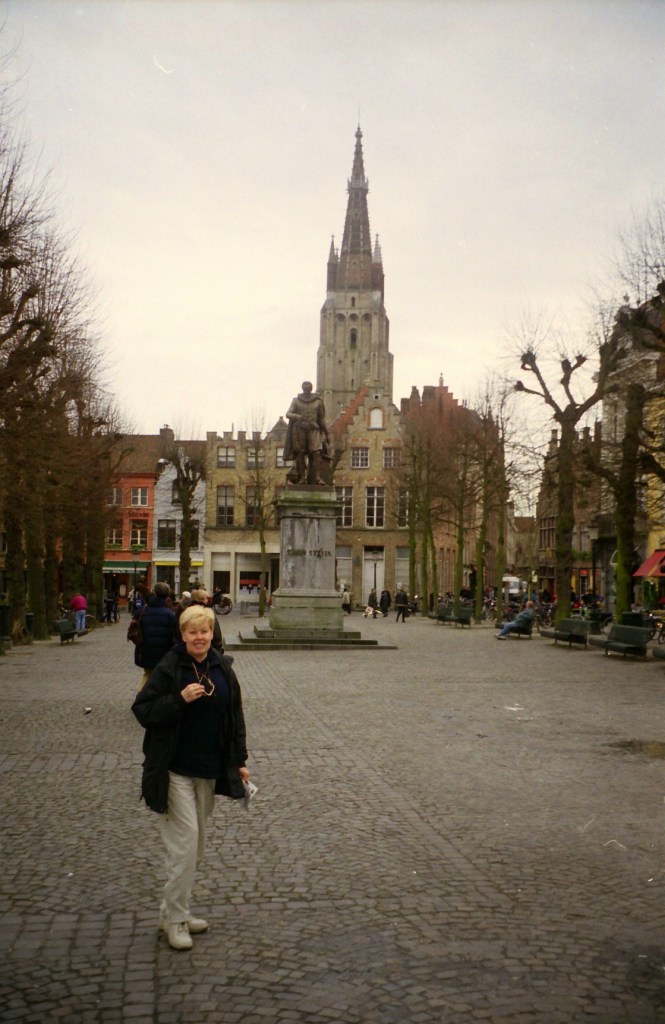
[The Markt (“Market Square”) of Bruges is located in the heart of the city and covers an area of about 1 hectare. Some historical highlights around the square include the 12th-century belfry and the West Flanders Provincial Court (originally the Waterhall, which in 1787 was demolished and replaced by a classicist building that from 1850 served as provincial court and after a fire in 1878 was rebuilt in a neo-Gothic style in 1887. In the center of the market stands the statue of Jan Breydel and Pieter de Coninck (Wikipedia).]
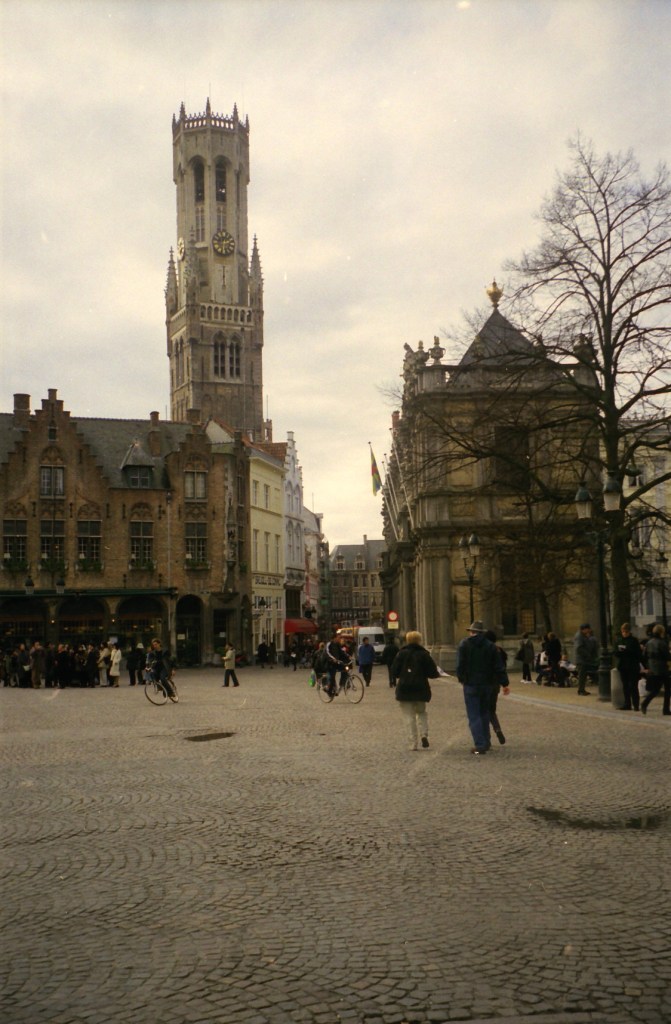
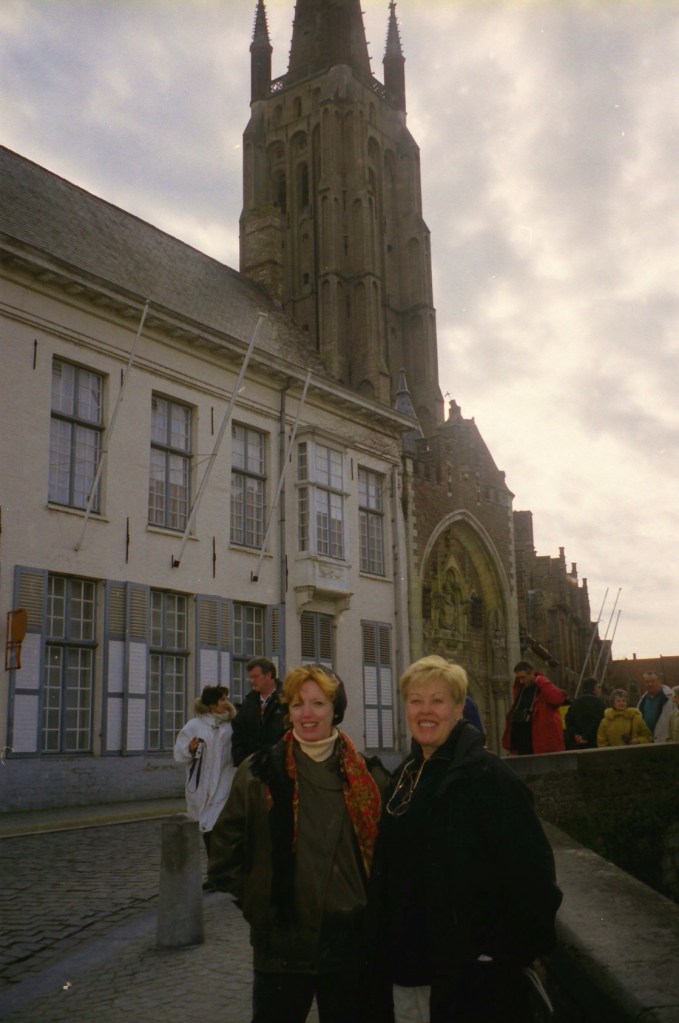
I could sooner reconcile all Europe than two women. ~ Louis XIV
[The Arendts Garden has modern sculpture representing the Four Horsemen of the Apocalypse, which are described in the Book of Revelations, the last book in the New Testament of the Bible. Though some interpretations vary, the four riders are seen as symbolizing Conquest, War, Famine, and Death (luxeadventuretraveler.com).]

[The Church of Our Lady in Bruges, dates mainly from the 13th, 14th and 15th centuries. This church is essentially “…a monument to the wealth, sophistication, taste, and devotion of this most Catholic city, whose history and faith stand today celebrated in this wonderful building.”  Its tower, at 115.6 metres (379 ft) in height, remains the tallest structure in the city and the second tallest brickwork tower in the world (after St. Martin’s Church in Landshut, Germany) (Wikipedia).]
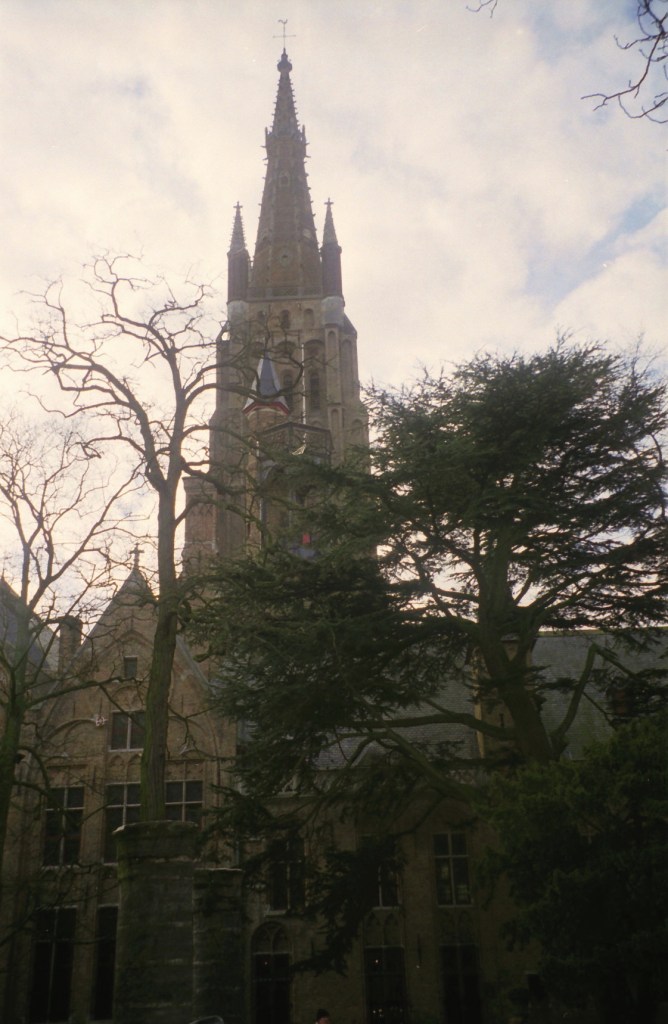
The white people should go back to Europe, and the country should be returned to the American Indians. This is the future I would like to see for the so-called United States. ~ Bobby Fischer
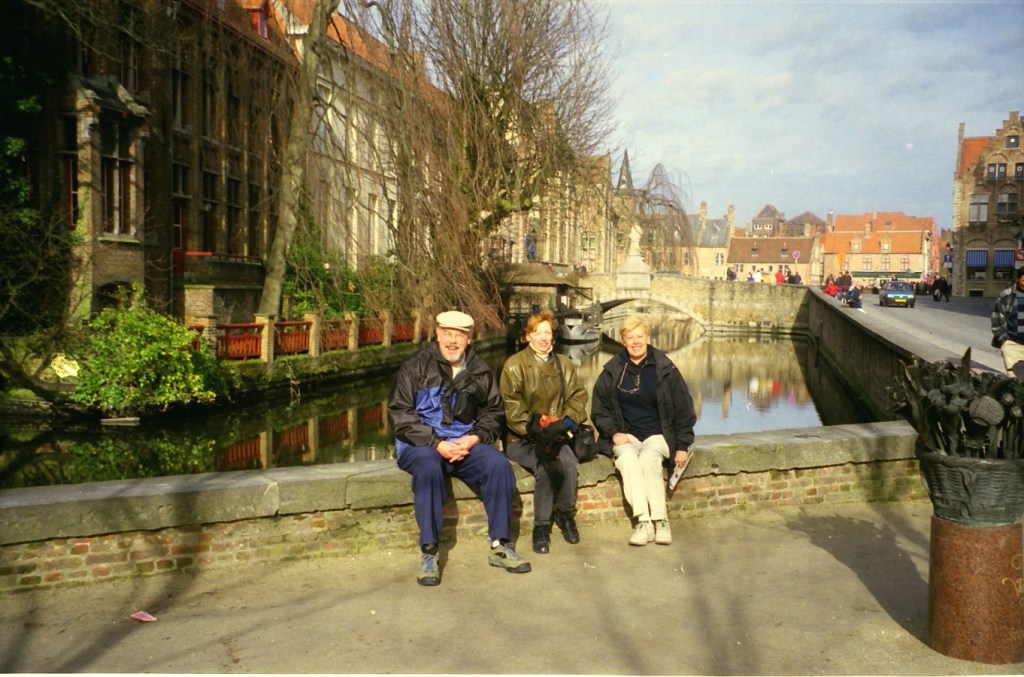
[Literally, a Rose between two Oberts . . . ]

It is easier for women to succeed in business, the arts, and politics in America than in Europe. ~ Hedy Lamarr

I don’t really have a type. Men in general are a good thing. ~ Jennifer Aniston
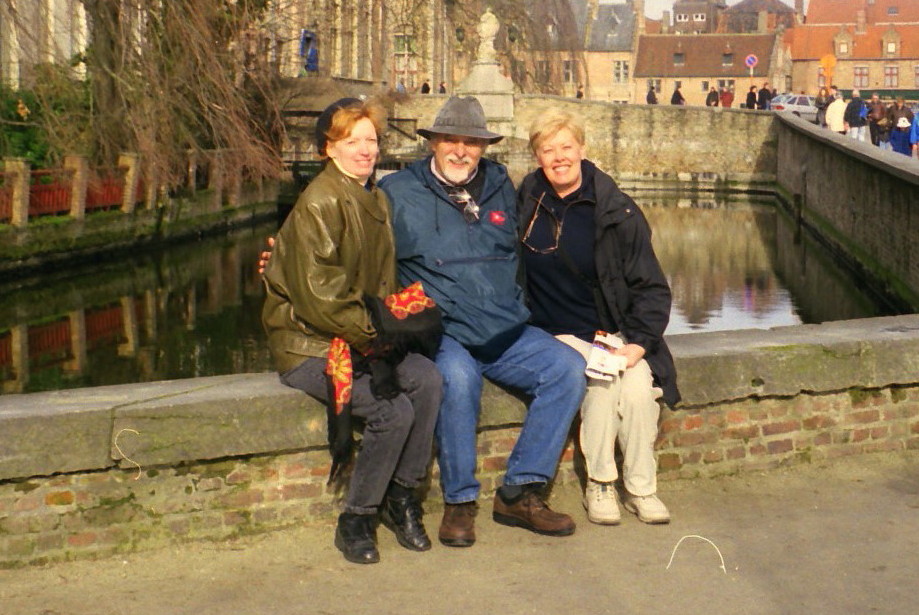
Even phantoms don’t inhabit Bruges any more. It’s as though the living are the ghouls now, the zombies. It’s so uncannily empty, silent, lifeless… ! ~ Cathy Dobson
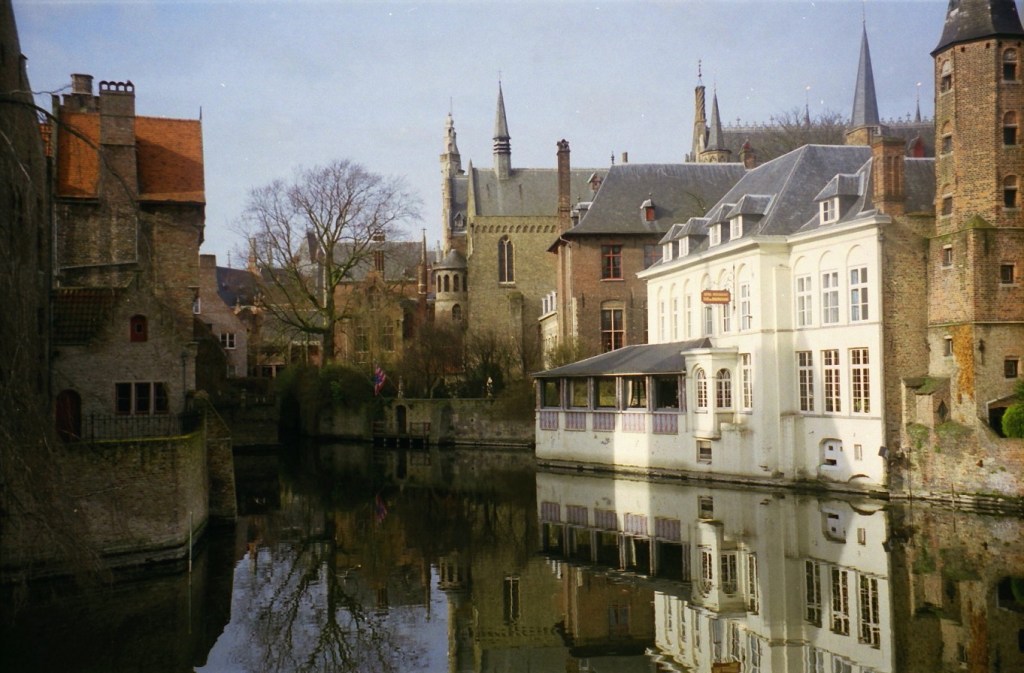
[Rose crossing a canal bridge . . . ]
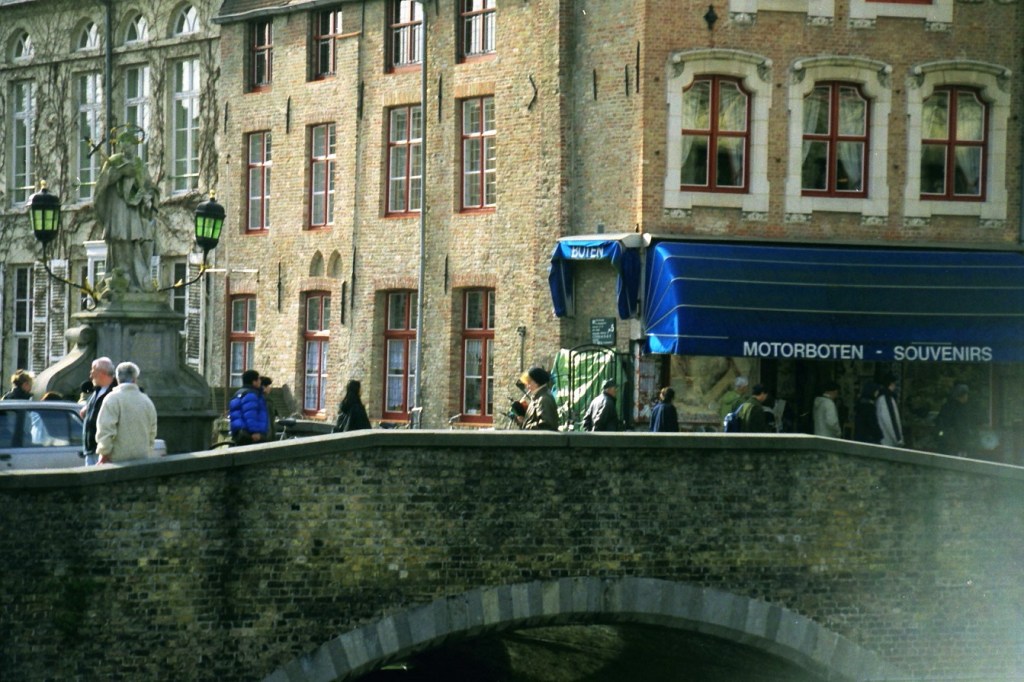
On a New York subway you get fined for spitting, but you can throw up for nothing. ~ Lewis Grizzard

[Enjoy a carriage ride through the heart of the city of Bruges, along the canals, and historical small bridges, relaxing to the gentle sound of the hoof beat of the horse. The coach-driver explains the city to you, and halfway the trip, the horse is getting a rest at the Beguinage where you can descend (visit-bruges.be).]
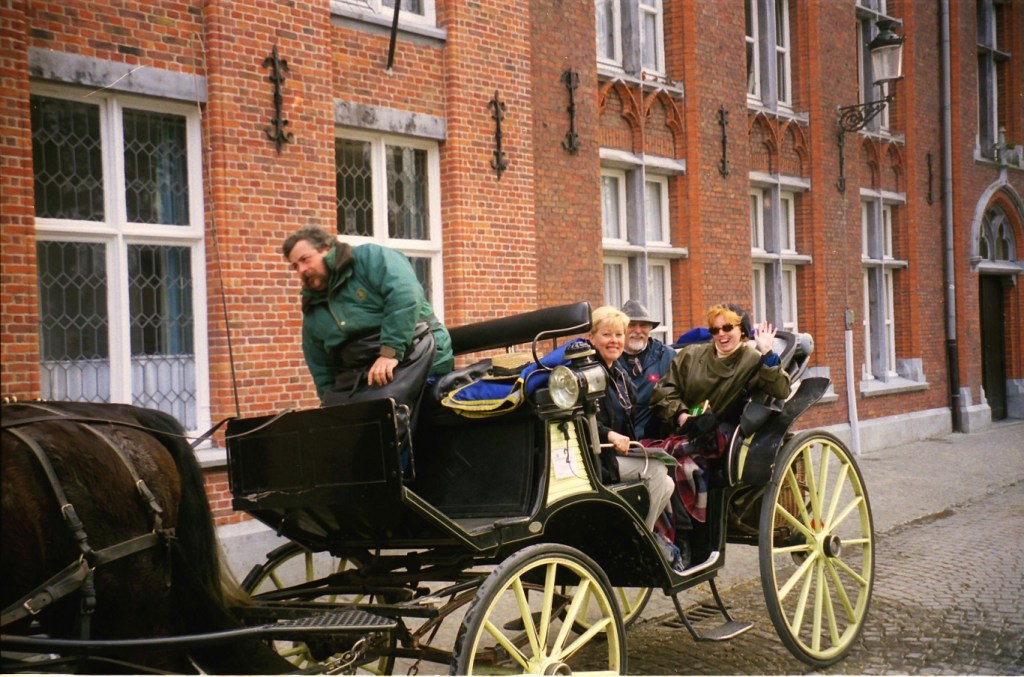
Go to Heaven for the climate, Hell for the company. ~ Mark Twain
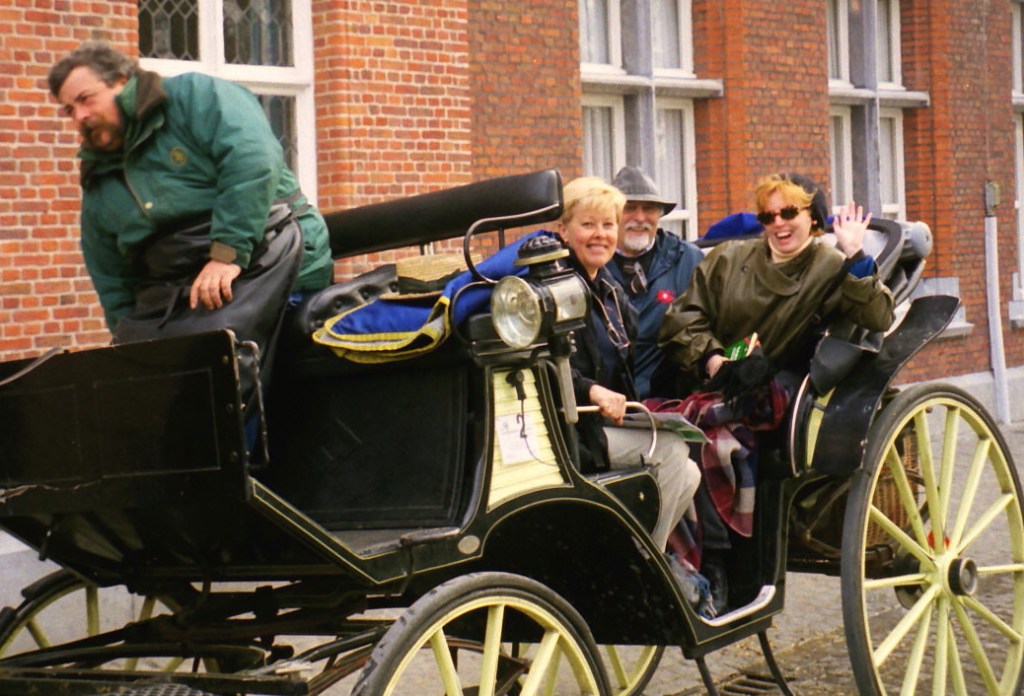
[Three-time winners of the Tourists of the Year award!]
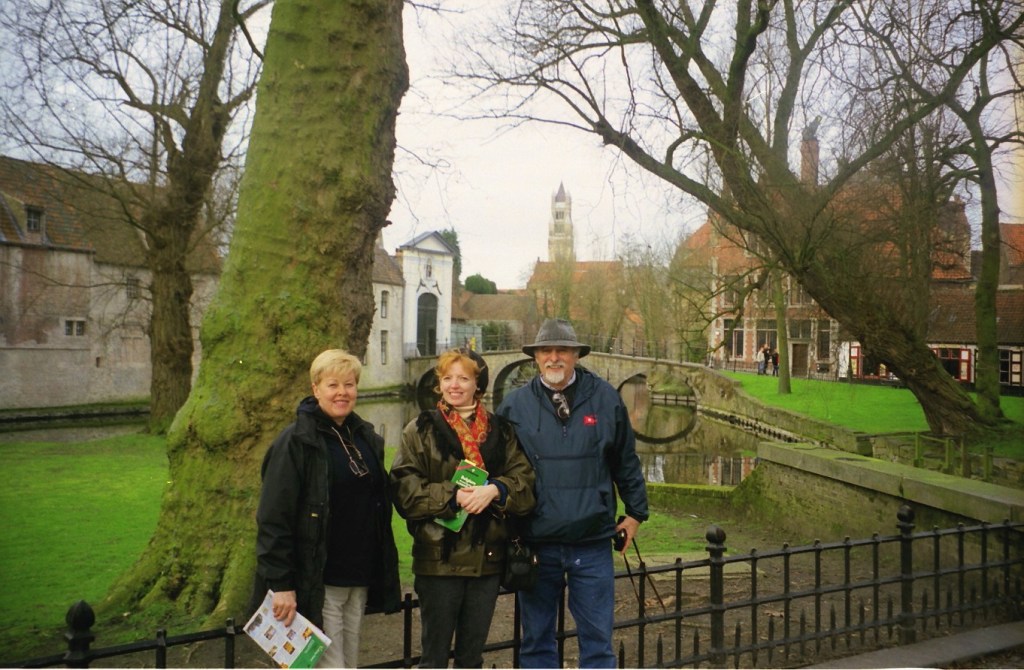
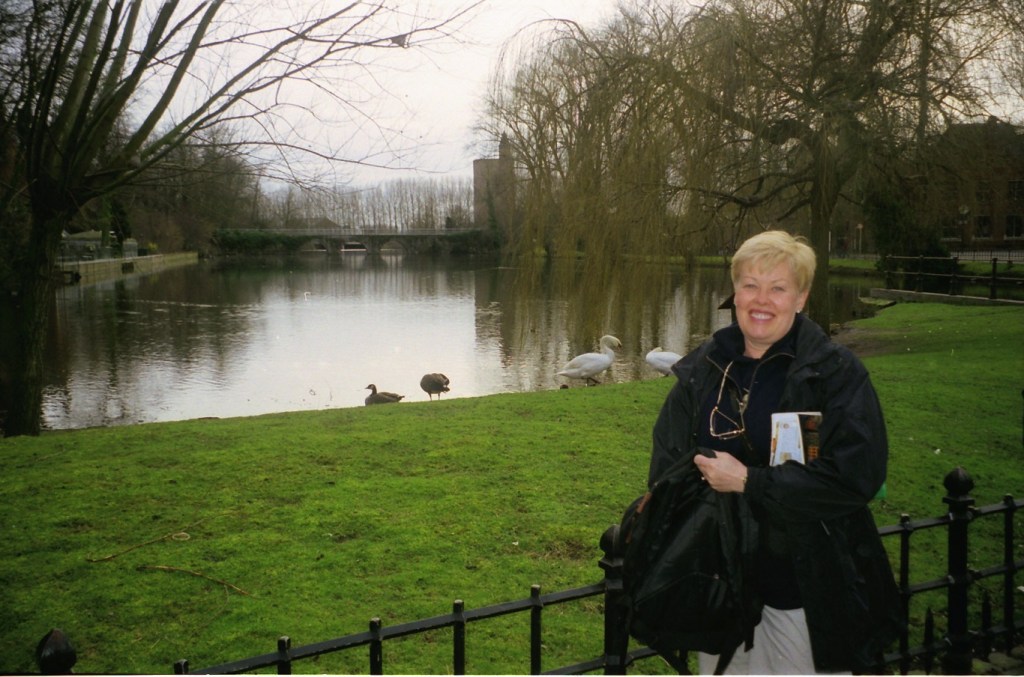
Facebook just sounds like a drag, in my day seeing pictures of peoples vacations was considered a punishment. ~ Betty White
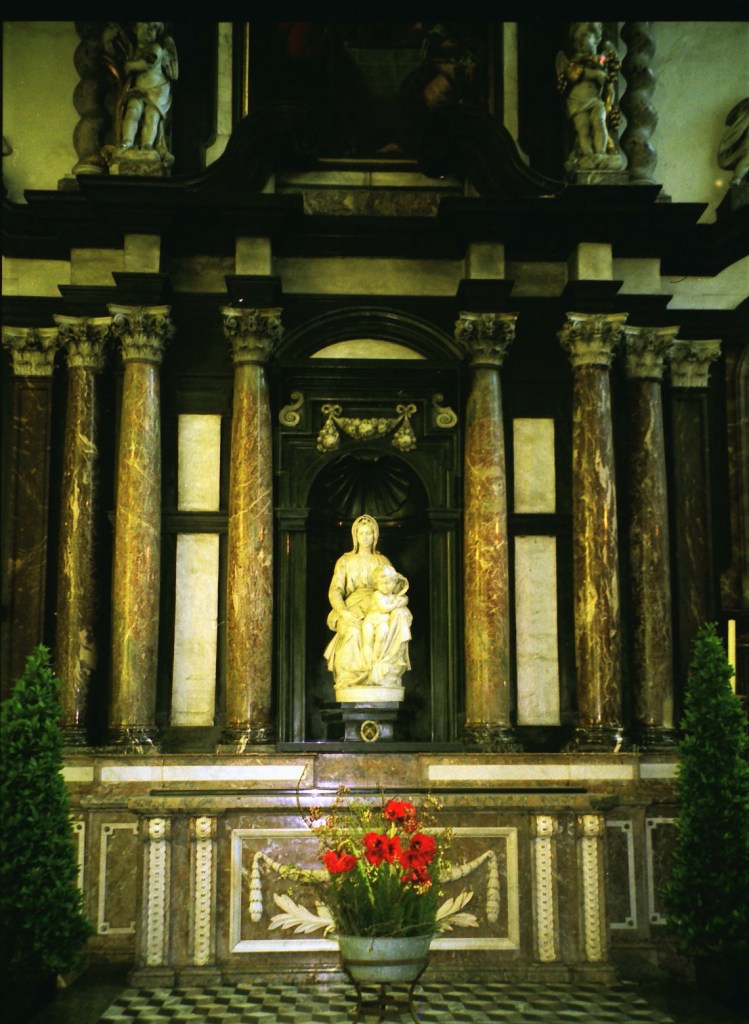
[The Church of Our Lady, who brick spire reaches an astounding 122 meters, houses the Madonna and Child from 1504. It is one of only a few of Michelangelo’s works to ever leave Italy within his lifetime. The sculpture was originally meant for the Siena Cathedral in Italy but was purchased in Italy by two Brugean merchants and brothers, Jan and Alexander Mouscron, and donated to the Church of Our Lady in 1514 (luxeadventuretraveler.com).]
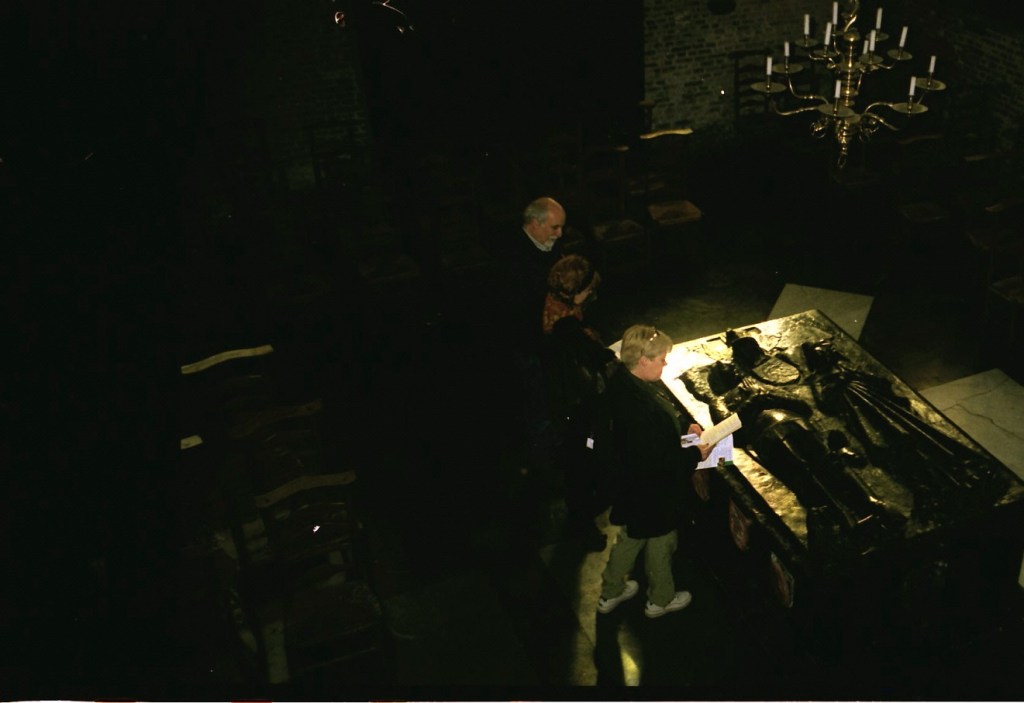
[In the same church, the body of Charles the Bold in Onze-Lieve-Vrouwe Kerk in Bruges next to his daughter Mary of Burgundy (1457-1482).]
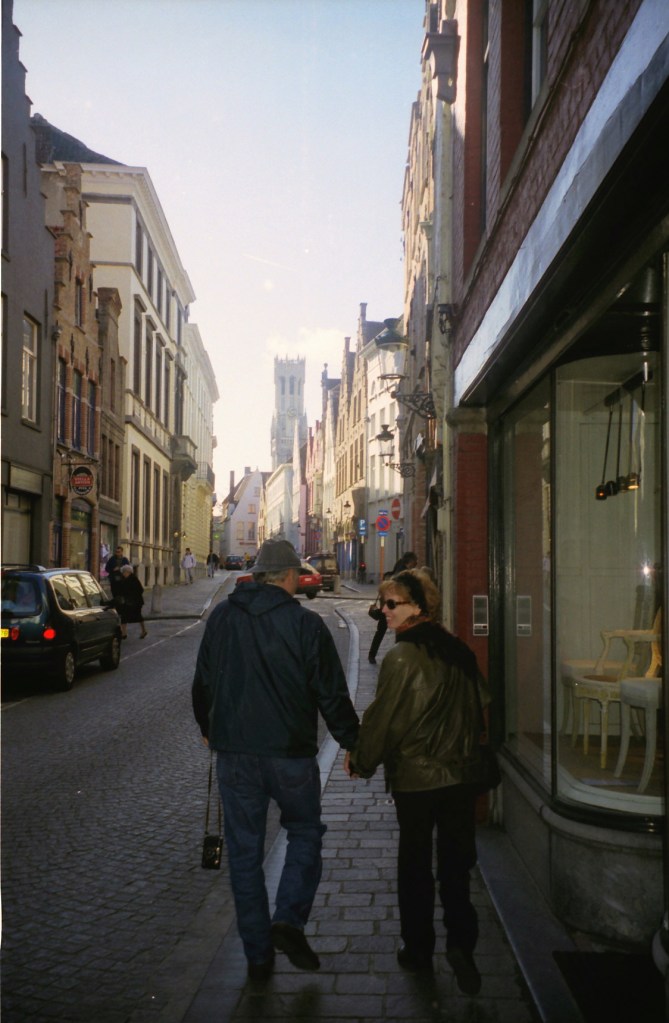
What’s not to love about Bruges? ~ Rose & Dick
A memory: Brussels is 60 miles SE of Bruges. About halfway between them is Ghent. We stopped at a restaurant in Ghent on the way back to Brussels. There was one other couple in the restaurant sitting some distance from us. On their way out, they stopped at our table and asked if we were Americans. We asked them how they knew. They said after we cut our meat, we put our knife down and transferred the fork to our right hand before eating. Apparently only Americans do that. Who knew? And isn’t it silly?

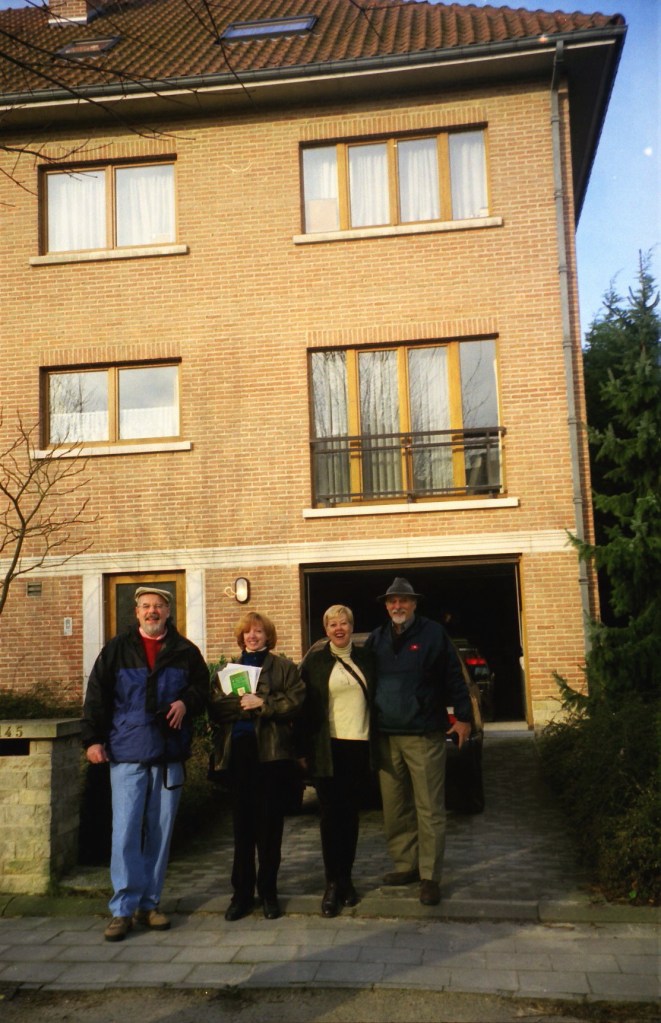
[Saying adieu and merci to our hosts in Kraainem . . . ]

The only way to learn a language properly, in fact, is to marry a man of that nationality. You get what they call in Europe a ‘sleeping dictionary.’ Of course, I have only been married five times, and I speak seven languages. I’m still trying to remember where I picked up the other two. ~ Zsa Zsa Gabor
London

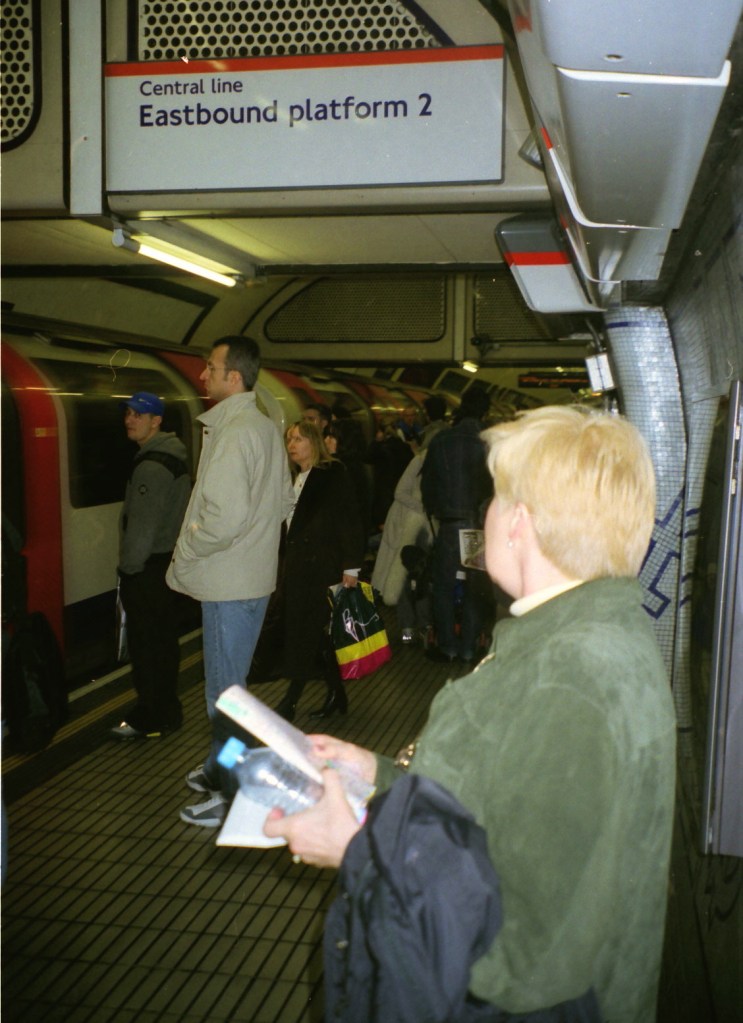
[The London Underground (also known simply as the Underground, or by its nickname the Tube) is a rapid transit system serving Greater London and some parts of the adjacent counties. The Underground has its origins in the Metropolitan Railway, the world’s first underground passenger railway. Opened in January 1863, it is the first line to operate underground electric traction trains. The network has expanded to 11 lines, and in 2017/18 was used for 1.357 billion passenger journeys, making it the world’s 12th busiest metro system. The 11 lines collectively handle up to 5 million passenger journeys a day (Wikipedia).]
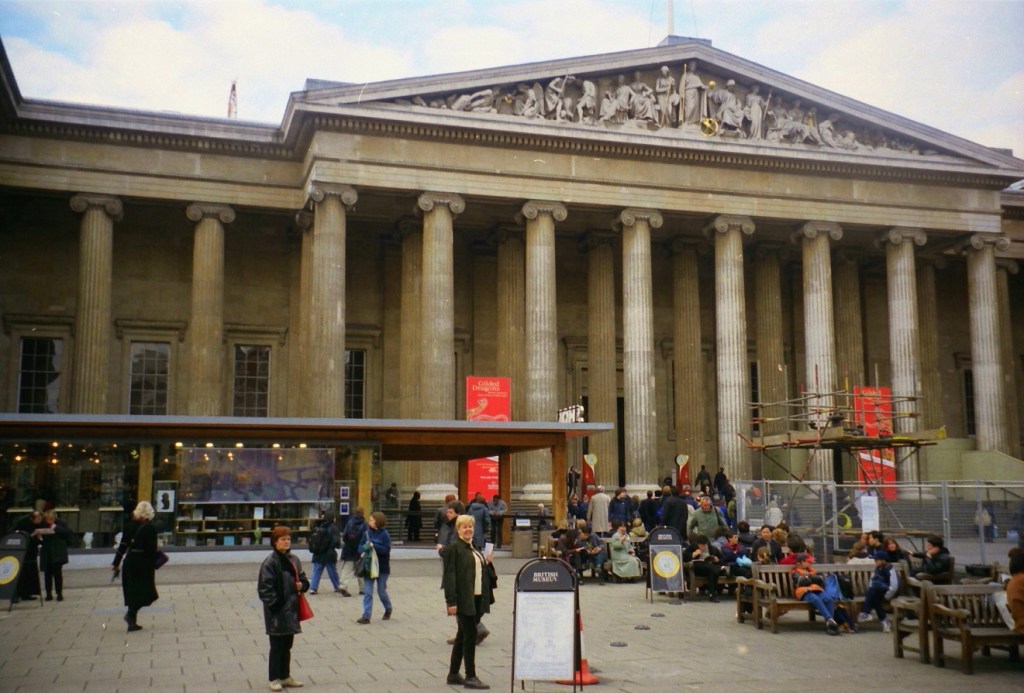
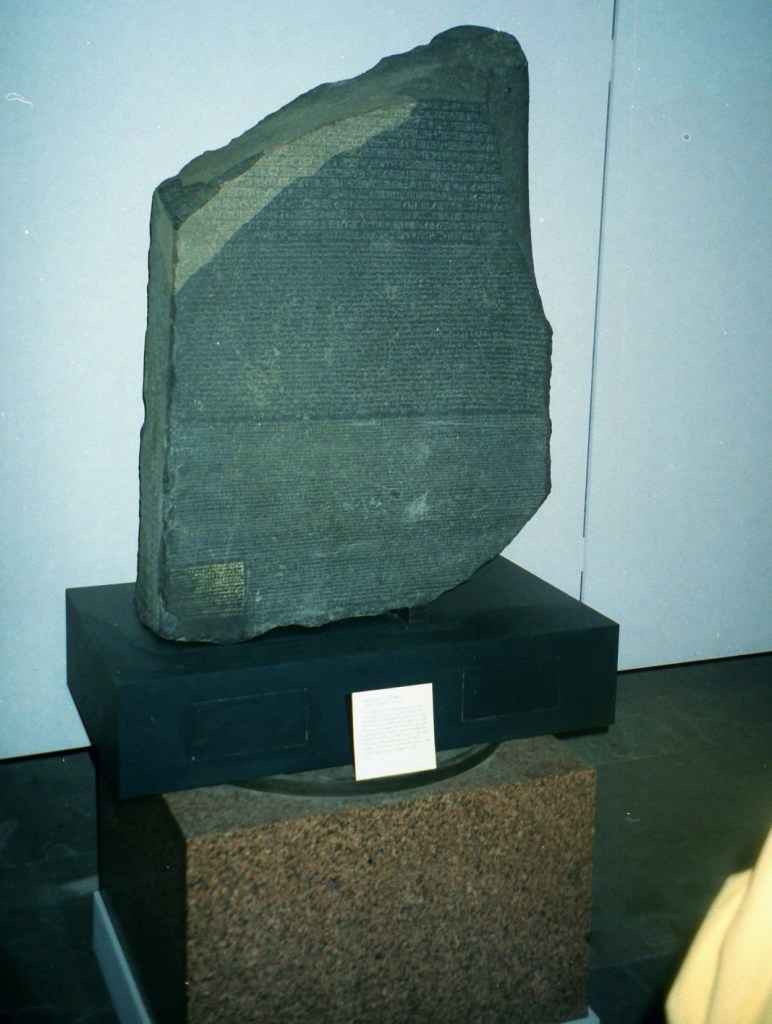
[The British Museum, in the Bloomsbury area of London, England, is a public institution dedicated to human history, art, and culture. Its permanent collection of some eight million works is among the largest and most comprehensive in existence, having been widely collected during the era of the British Empire. It documents the story of human culture from its beginnings to the present. It was the first public national in the world. The British Museum was established in 1753, largely based on the collections of Sir Hans Sloane.  It first opened to the public in 1759 on the site of the current building. Its expansion over the following 250 years was largely a result of expanding British colonisation and has resulted in the creation of several branch institutions, the first being the Natural History Museum in 1881. Its ownership of some of its most famous objects originating in other countries is disputed and remains the subject of international controversy, most notably in the case of the Elgin Marbles of Greece and the Rosetta Stone of Egypt (Wikipedia).]
[The Rosetta Stone . . . ]
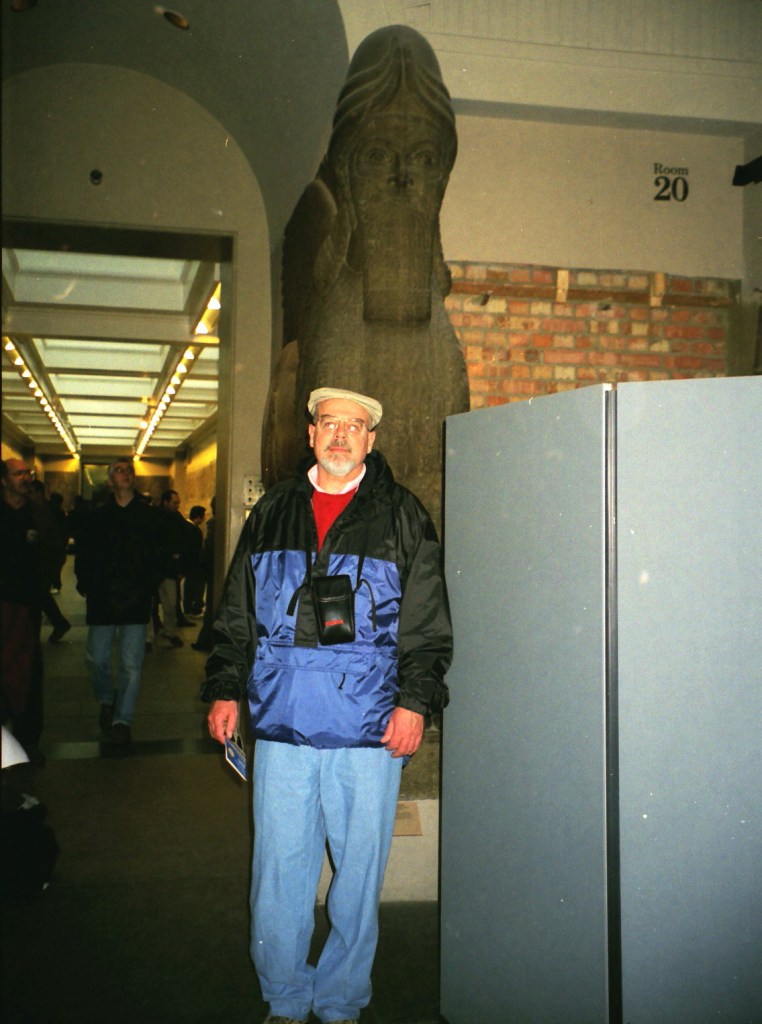
[The guy in the pork pie hat is the one from the ancient civilization . . . ]
[It’s OK. We all see it. We all see it . . . ]
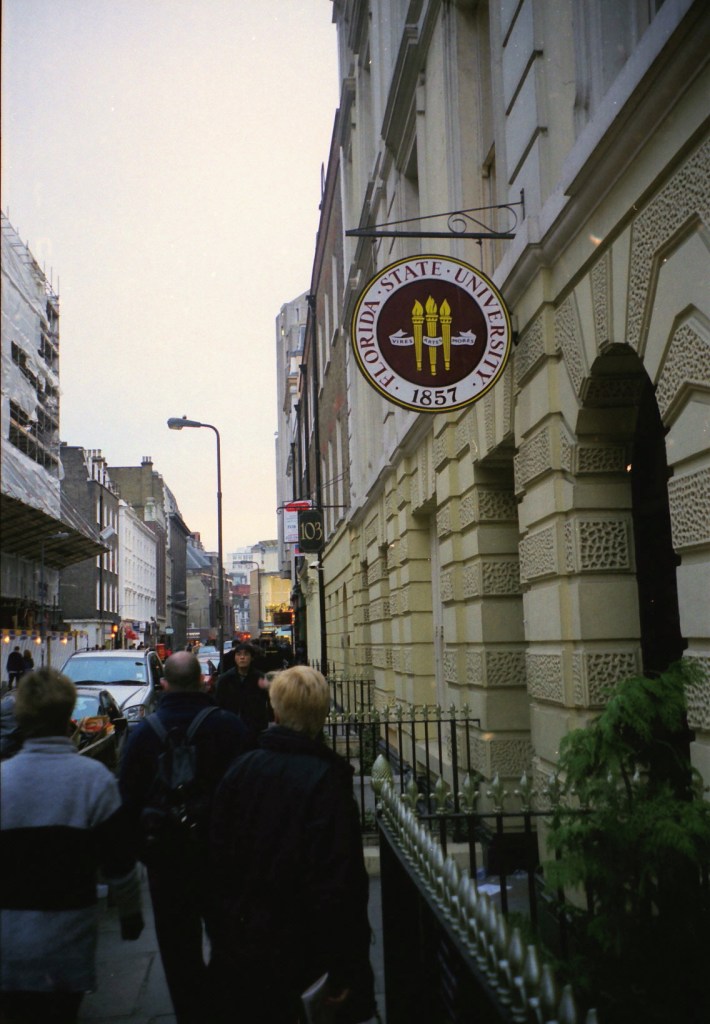
The streets of London have their map, but our passions are uncharted. What are you going to meet if you turn this corner? ~ Virginia Woolf
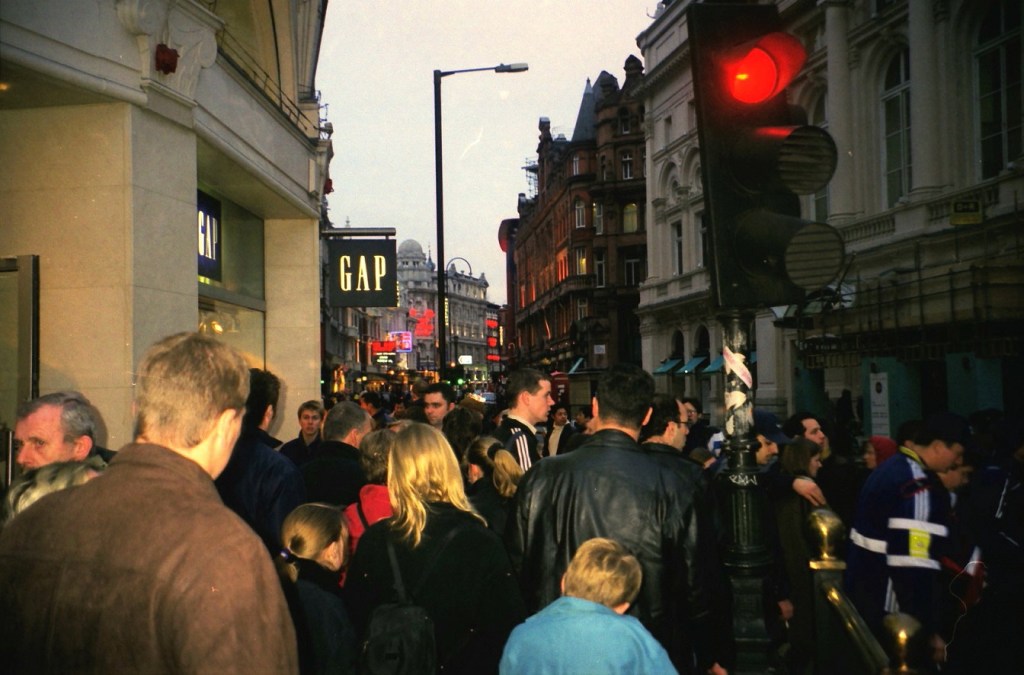
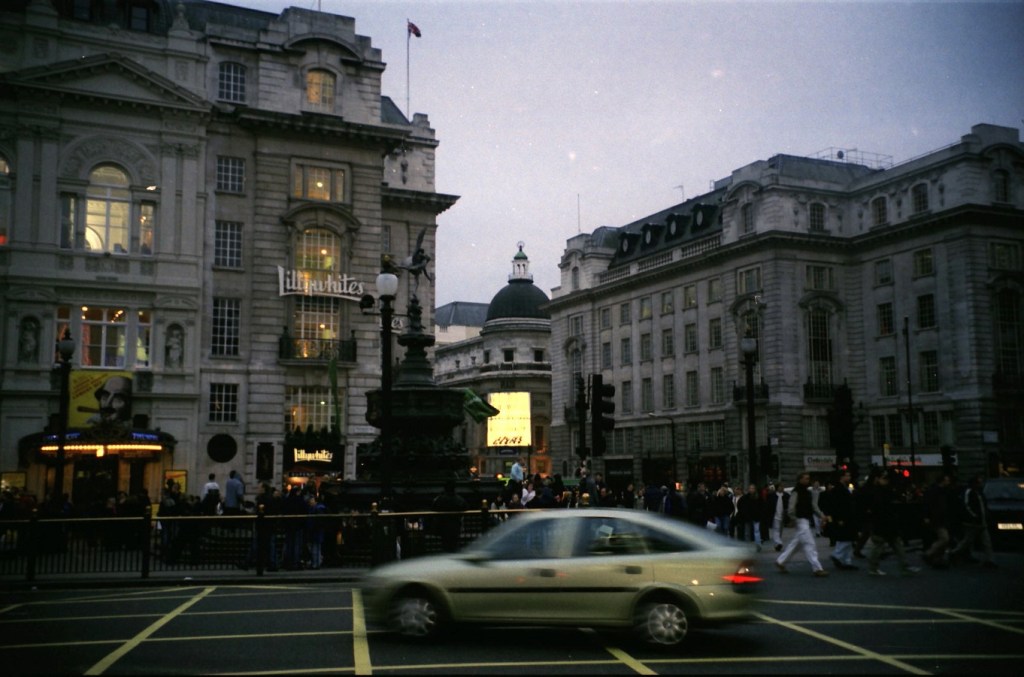
[Piccadilly Circus is a road junction and public space of London’s West End in the City of Westminster. It was built in 1819 to connect Regent Street with Piccadilly. In this context, a circus, from the Latin word meaning “circle”, is a round open space at a street junction (Wikipedia).]
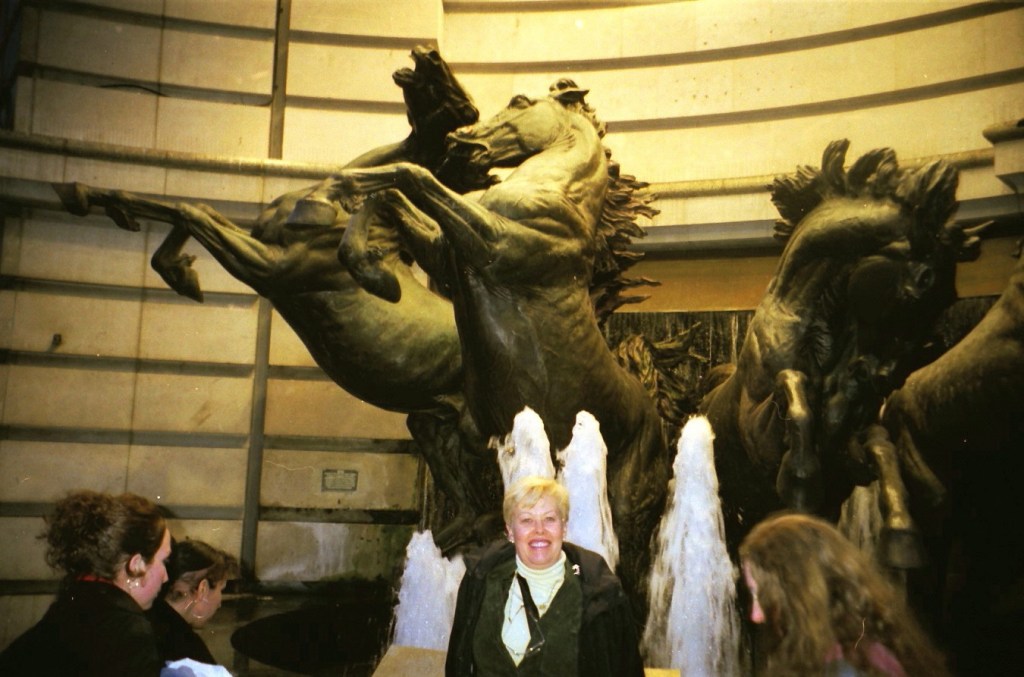
[The Horses of Helios (and the Super), also known as The Four Bronze Horses of Helios, is a bronze sculpture of four horses by Rudy Weller. The sculpture was installed in 1992 in a fountain under a canopy at the base of the building at 1 Jermyn Street, on the corner where Piccadilly meets Haymarket, near Piccadilly Circus in London (Wikipedia).]
Her Majesty’s a pretty nice girl, But she doesn’t have a lot to say, Her Majesty’s a pretty nice girl,
But she changes from day to day . . .
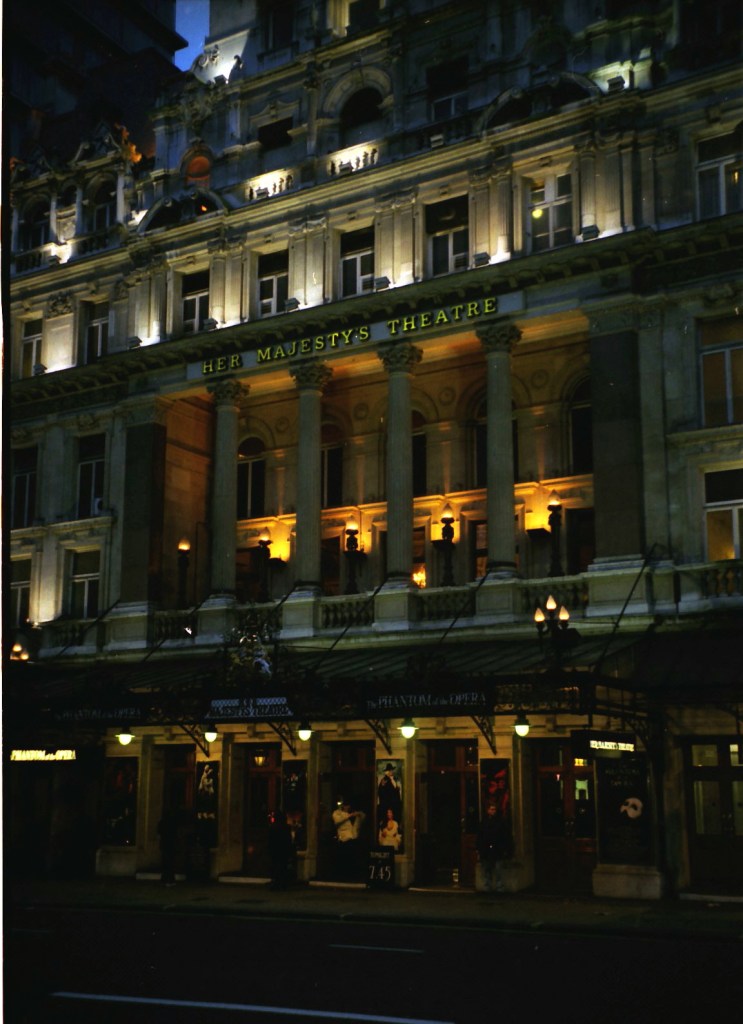
I want to tell her that I love her a lot, But I gotta get a belly full of wine, Her Majesty’s a pretty nice girl, Someday I’m going to make her mine, oh yeah, Someday I’m going to make her mine!
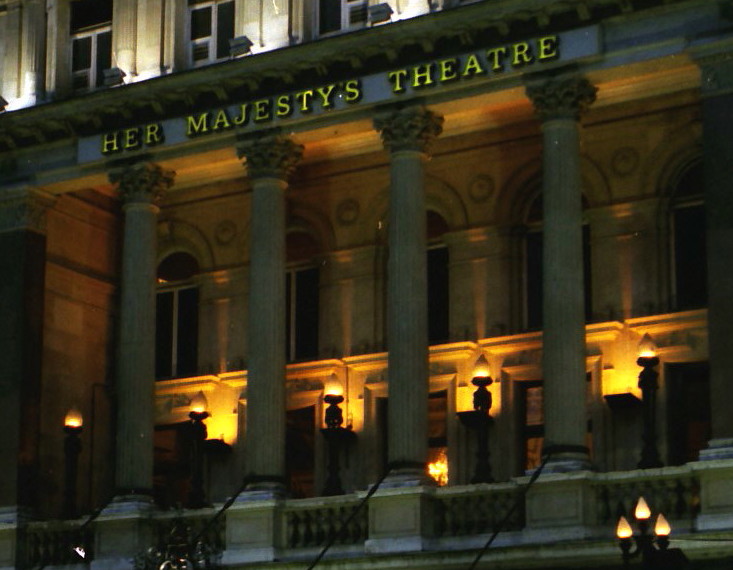
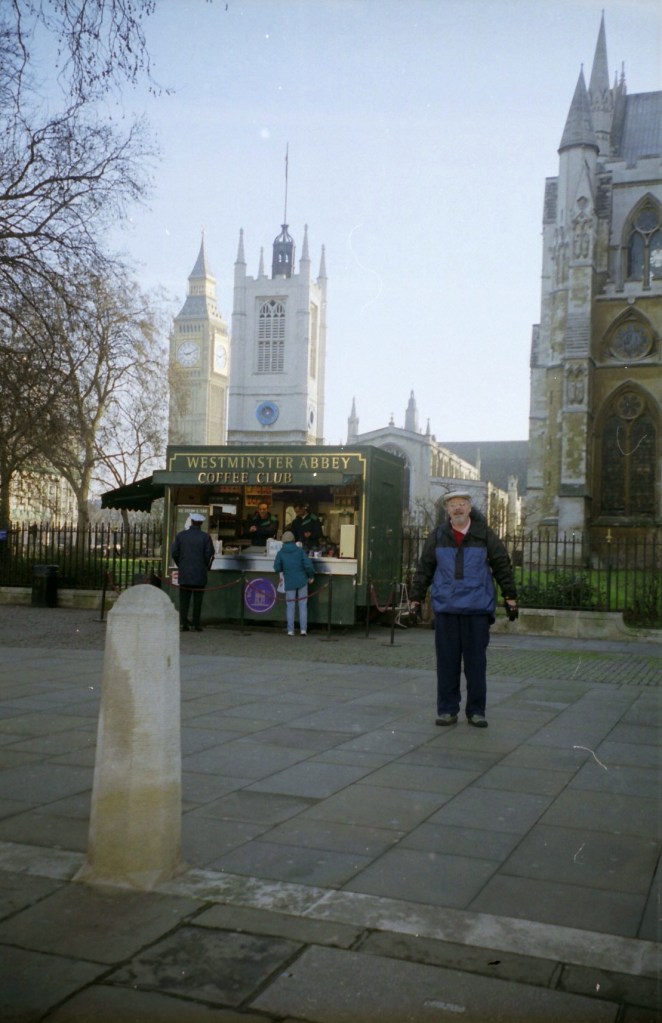
[So, toodle-oo from Westminster Abbey.]

If I were the president, I could stop terrorist attacks against the United States in a few days. Permanently. I would first apologize to all the widows and orphans, the tortured and impoverished, and all the many millions of other victims of American imperialism. Then I would announce, in all sincerity, to every corner of the world, that America’s global interventions have come to an end, and inform Israel that it is no longer the 51st state of the USA but now — oddly enough — a foreign country. I would then reduce the military budget by at least 90% and use the savings to pay reparations to the victims. There would be more than enough money. One year’s military budget of 330 billion dollars is equal to more than $18,000 an hour for every hour since Jesus Christ was born. That’s what I’d do on my first three days in the White House. On the fourth day, I’d be assassinated. ~ William Blum
Europe 2000 (Part 1)

December 15

I would like to visit the country which adopts the groundhog as its mascot, somewhere peaceful, some place that curls against the secrets of the earth, a little Belgium of the imagination, tables piled high with cakes, the Sunday bells ringing (not too loudly), the light falling on rolling hillocks studded with salad greens.  ~ David Brendan Hopes
So indeed this was our second visit to Belgium (I previously reported on our first trip in 1997) to stay with friends Walt and Michelle Steiner in Kraainem on the outskirts of Brussels. Walt was there on a 4-year mission to NATO where he was obviously successful as we’re still all here.  The Super and I took a different route this time – a 3 or 4 day stopover in London first (my first visit there) before taking the Chunnel (because it’s there) train to Brussels . . .
London 

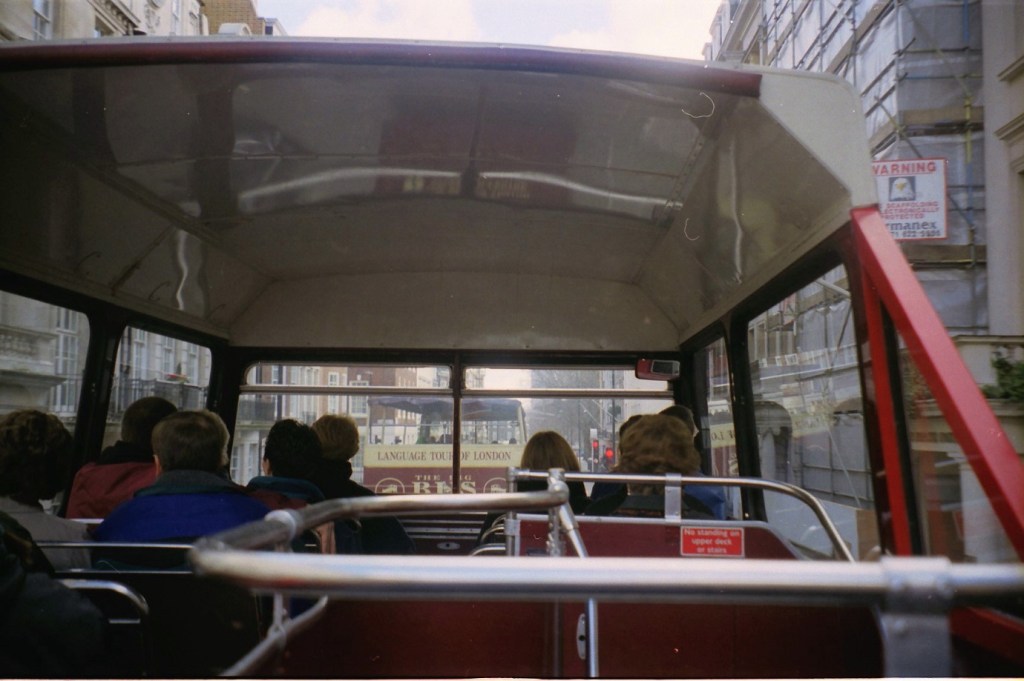
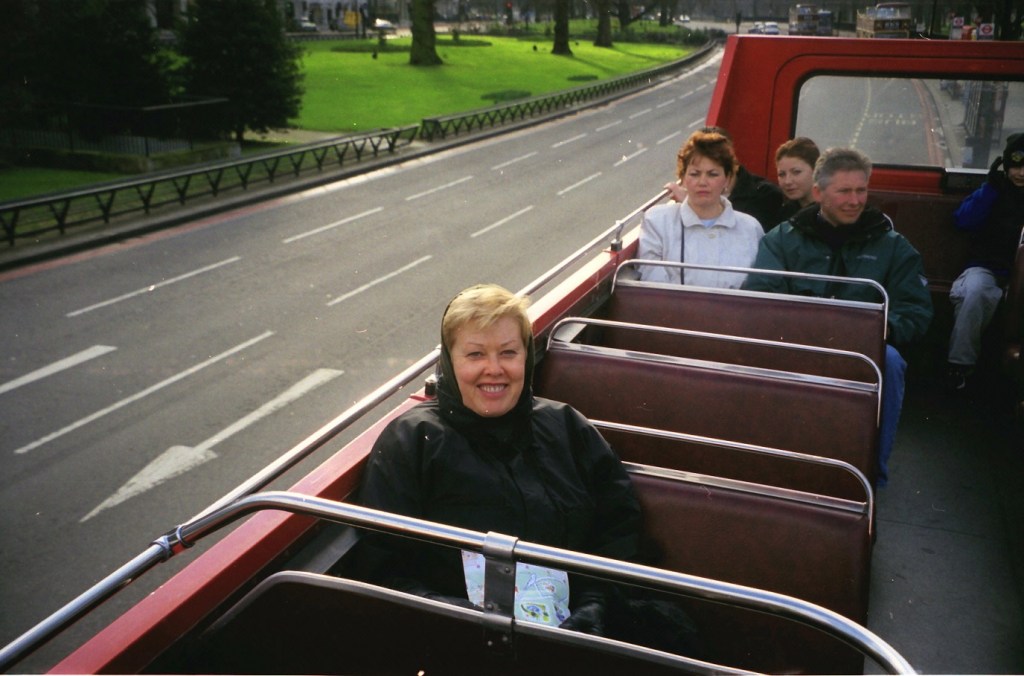
[We arrived at Heathrow at 7:00 am on February 19. So, what’s the first thing you do in London? Hop on a hop on-hop off double-decker bus for an overview of this giant city. The woman seated behind us didn’t appear to be having as much fun as the Super . . . ]

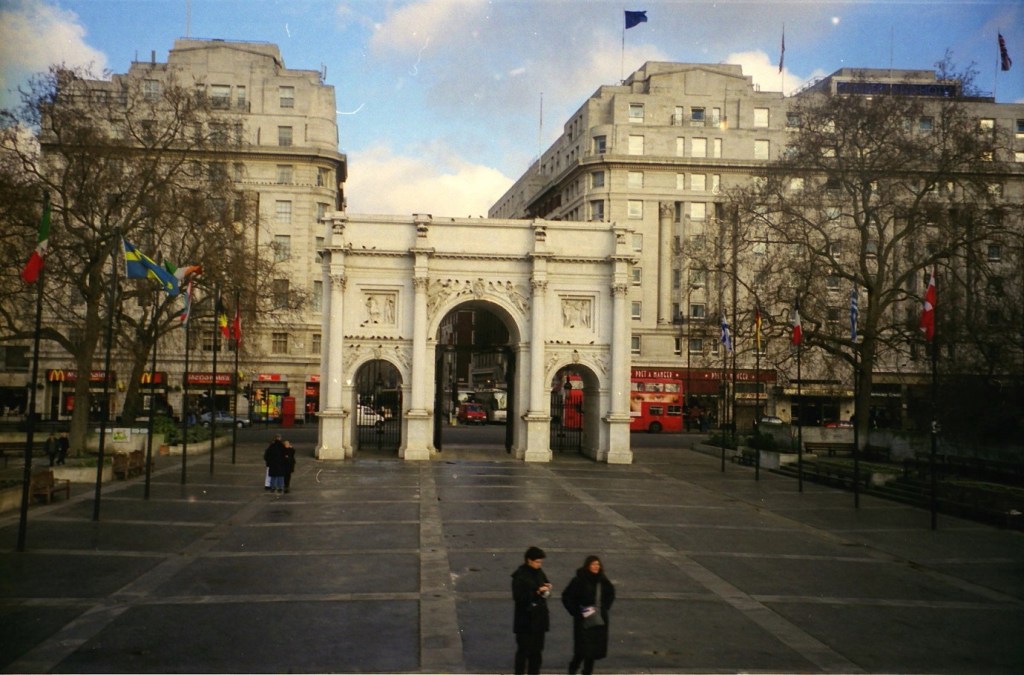
[Marble Arch is a 19th-century white marble-faced  triumphal arch. The structure was designed in 1827 to be the state entrance to the cour d’honneur of Buckingham Palace; it stood near the site of what is today the three-bayed, central projection of the palace containing the well-known balcony. In 1851, it was relocated to its current site. Following the widening of Park Lane in the early 1960s, the site became a large traffic island at the junction of Oxford Street, Park Lane and Edgware Road, isolating the arch.  Only members of the Royal Family and the King’s Troop. Royal Horse Artillery are said to be permitted to pass through the arch; this happens in ceremonial processions (Wikipedia).]

[A language tour bus was ahead of us. Fortunately, the England English on our bus came with subtitles . . . ]

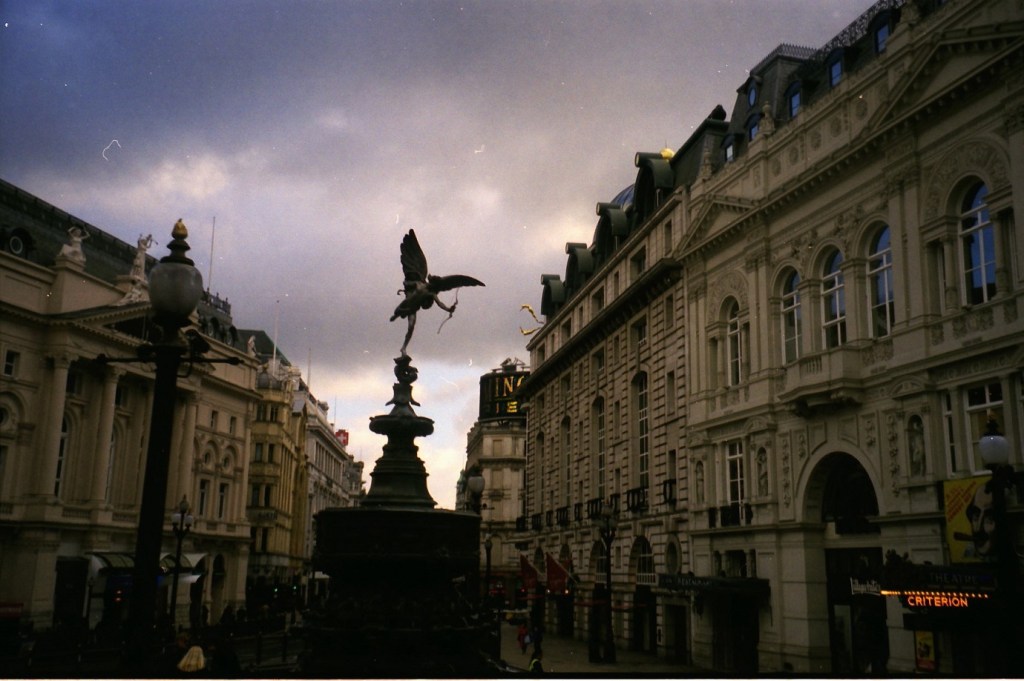
[The Shaftesbury Memorial Fountain, popularly but incorrectly known as “Eros”, is a fountain surmounted by a winged statue of Anteros, located at the southeastern side of Piccadilly Circus in London, England. Moved after World War II from its original position in the centre of the circus, it was erected in 1892–93 to commemorate the philanthropic works of Anthony Ashley Cooper, 7th Earl of Shaftesbury, who was a famous Victorian politician and philanthropist, and his achievement in replacing child labour with school education (Wikipedia).]

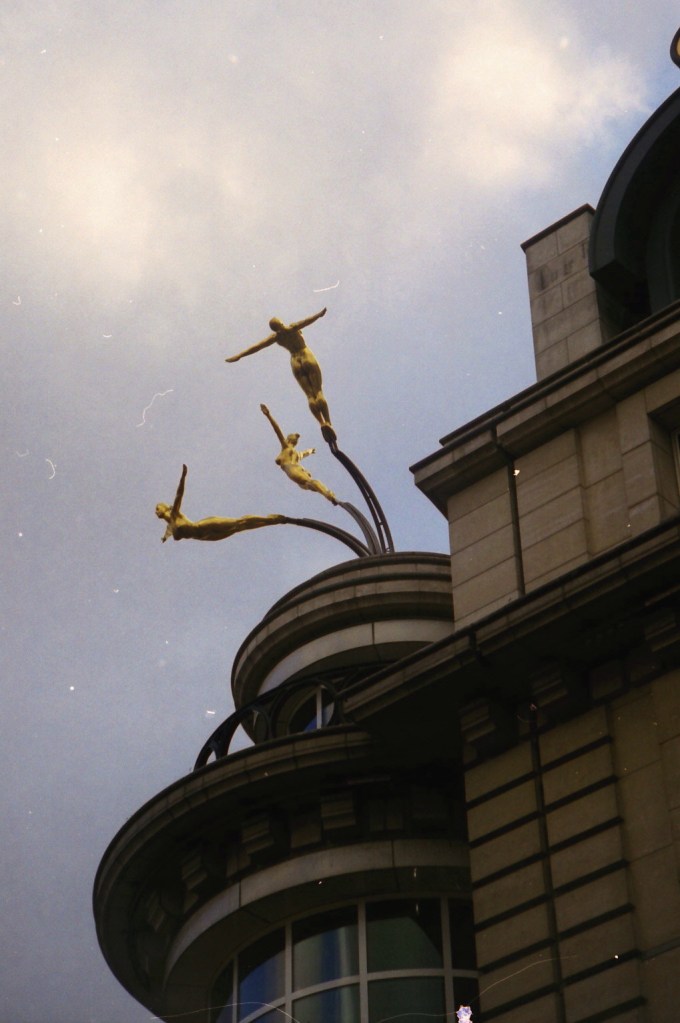
[Rooftop sculpture by Rudy Weller three gold nude woman diving off roof of Criterion building into Coventry Street & Haymarket . . . ]

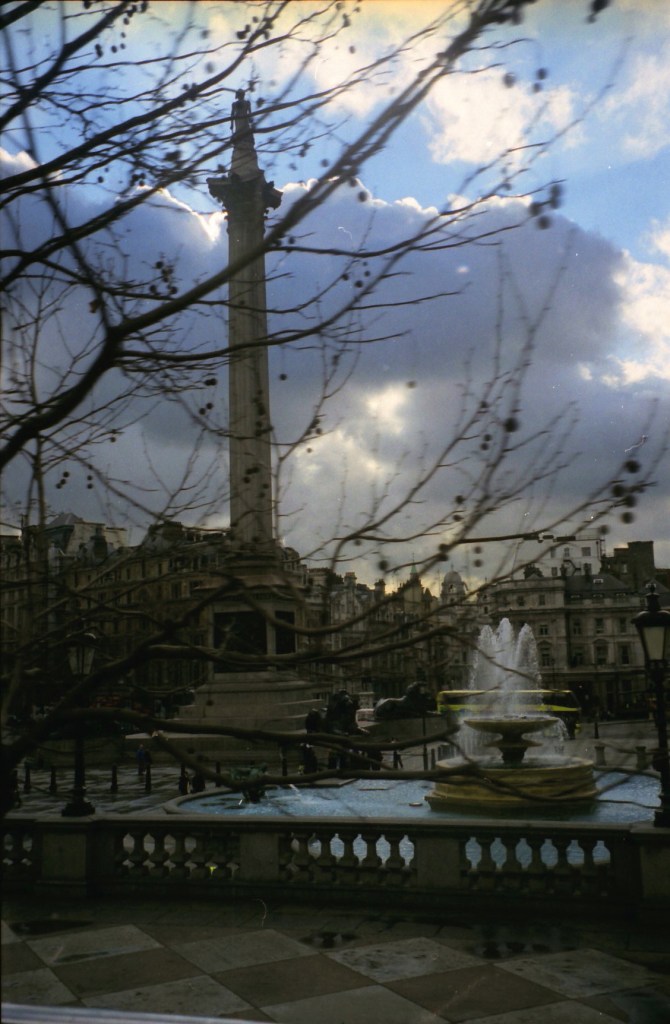
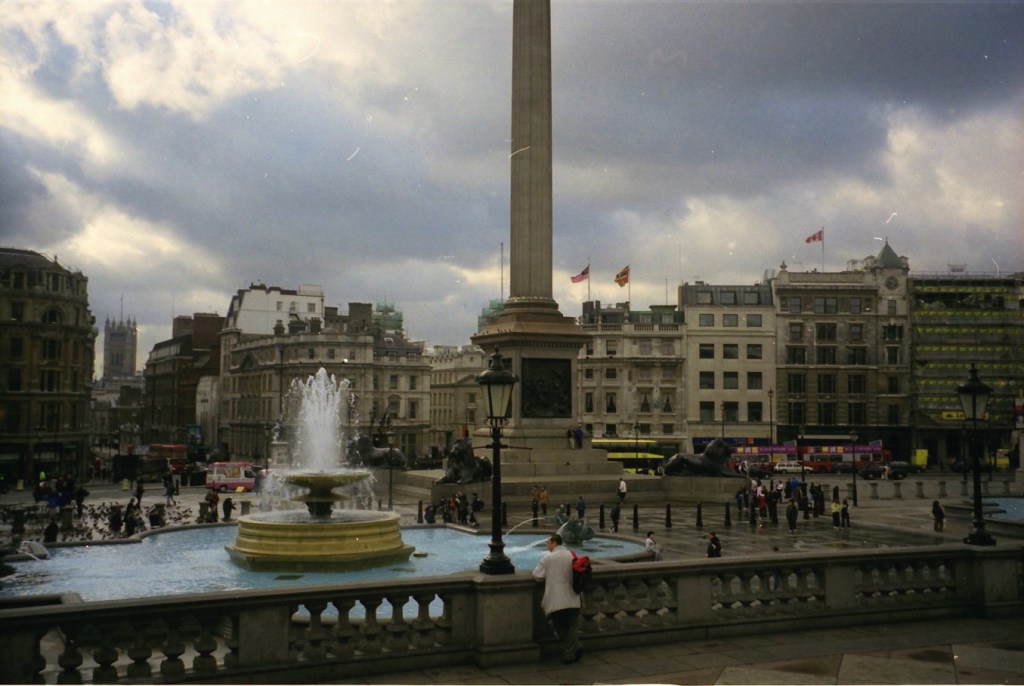
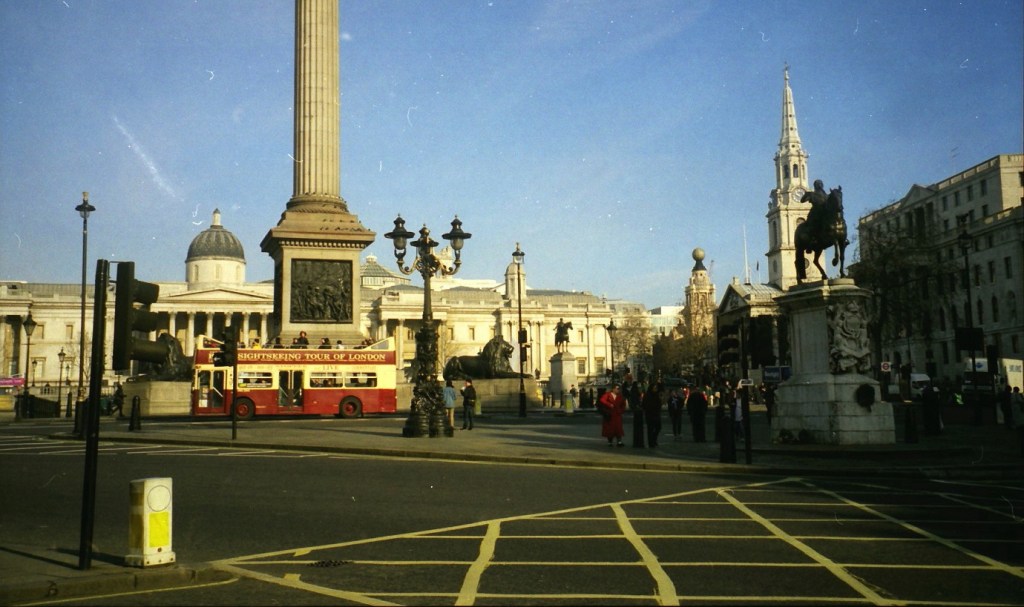
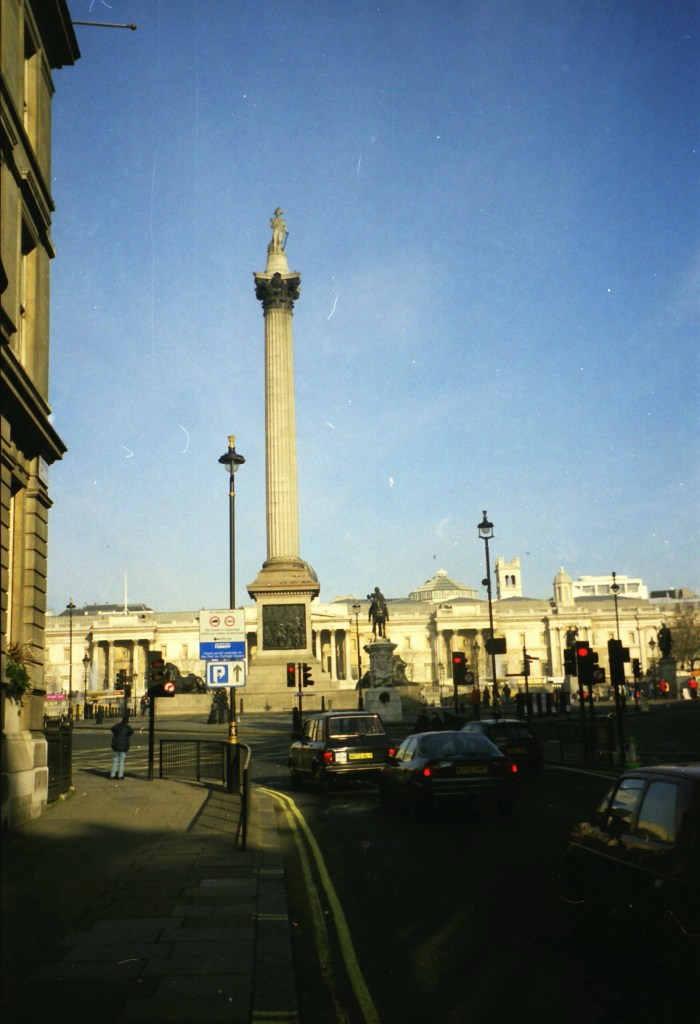
[Nelson’s Column is a monument in Trafalgar Square in the City of Westminster, Central London, built to commemorate Admiral Horatio Nelson, who died at the Battle of Trafalgar in 1805. The monument was constructed between 1840 and 1843 at a cost of £47,000 (equivalent to £4,648,142 in 2019). It is a column of the Corinthian order. The statue of Nelson was carved from Graigleigh sandstone. The four bronze lions around its base were added in 1867. The pedestal is decorated with four bronze relief panels, each 18 feet (5.5 m) square, cast from captured French guns. It was refurbished in 2006 at a cost of £420,000 (equivalent to £612,163 in 2019), at which time it was surveyed and found to be 14 feet 6 inches (4.42 m) shorter than previously supposed.  The whole monument is 169 feet 3 inches (51.59 m) tall from the bottom of the pedestal to the top of Nelson’s hat (Wikipedia).]

[Trafalgar Square . . . ]

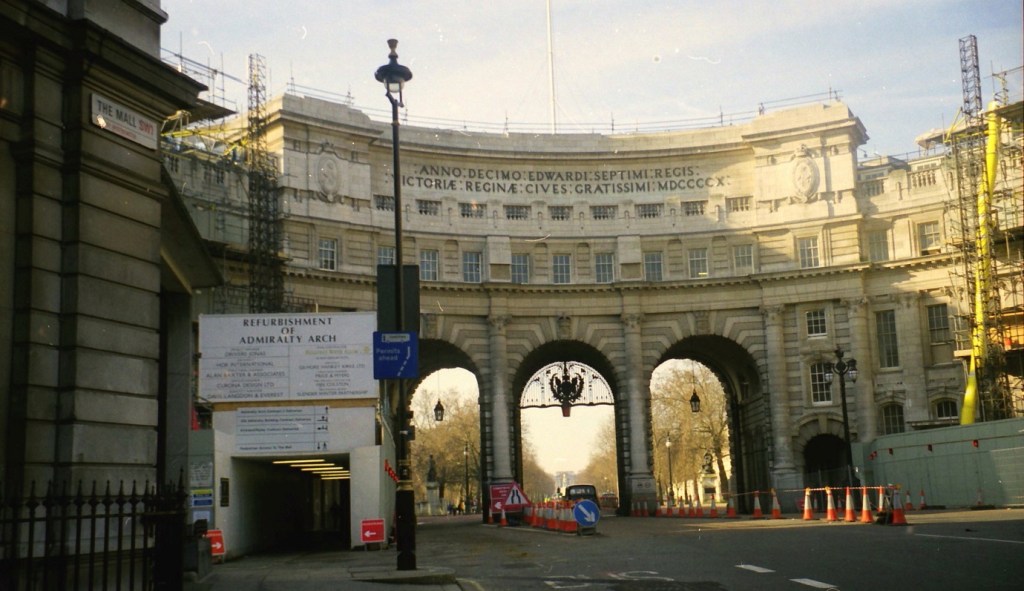
[Admiralty Arch is a landmark building providing road and pedestrian access between The Mall, which extends to the southwest, and Trafalgar Square to the northeast. Admiralty Arch, commissioned by King Edward VII in memory of his mother, Queen Victoria, is now a Grade I listed building. In the past, it served as residence of the First Sea Lord and was used by the Admiralty. Until 2011, the building housed government offices. In 2012, the government sold the building on a 125-year lease for £60m for a proposed redevelopment into a Waldorf Astoria luxury hotel and four apartments (Wikipedia).]

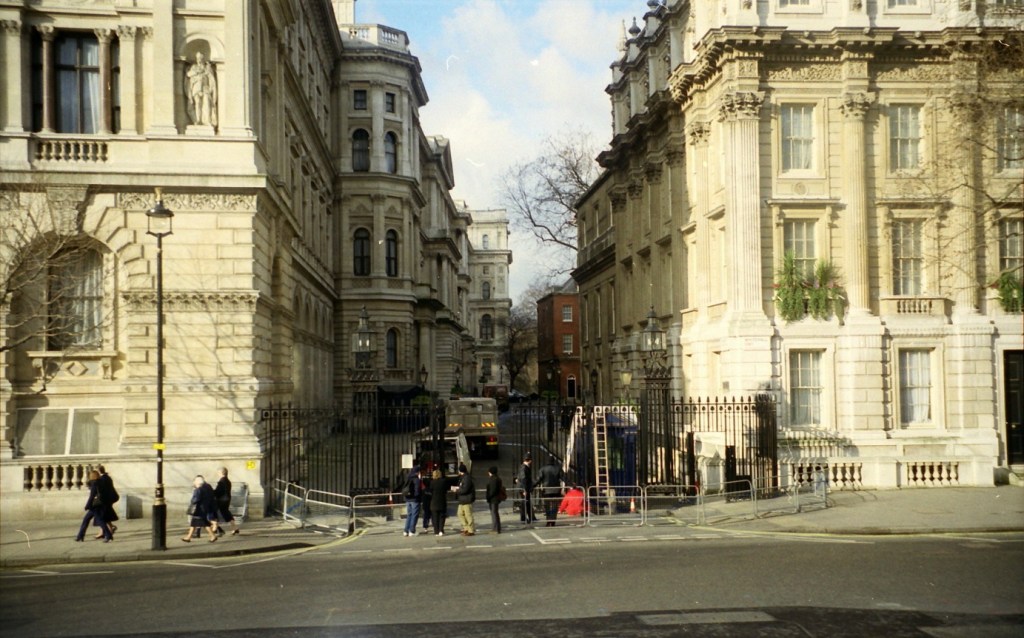
[10 Downing Street, also known colloquially in the United Kingdom as Number 10, is (along with the adjoining Cabinet Office at 70 Whitehall) the headquarters of the Government of the United Kingdom and the official residence and office since 1905 by the Prime Minister of the United Kingdom. The term “10 Downing Street”, or just “Downing Street”, is also used as a metonym for the Prime Minister’s office (Wikipedia).]

Westminster Abbey . . .

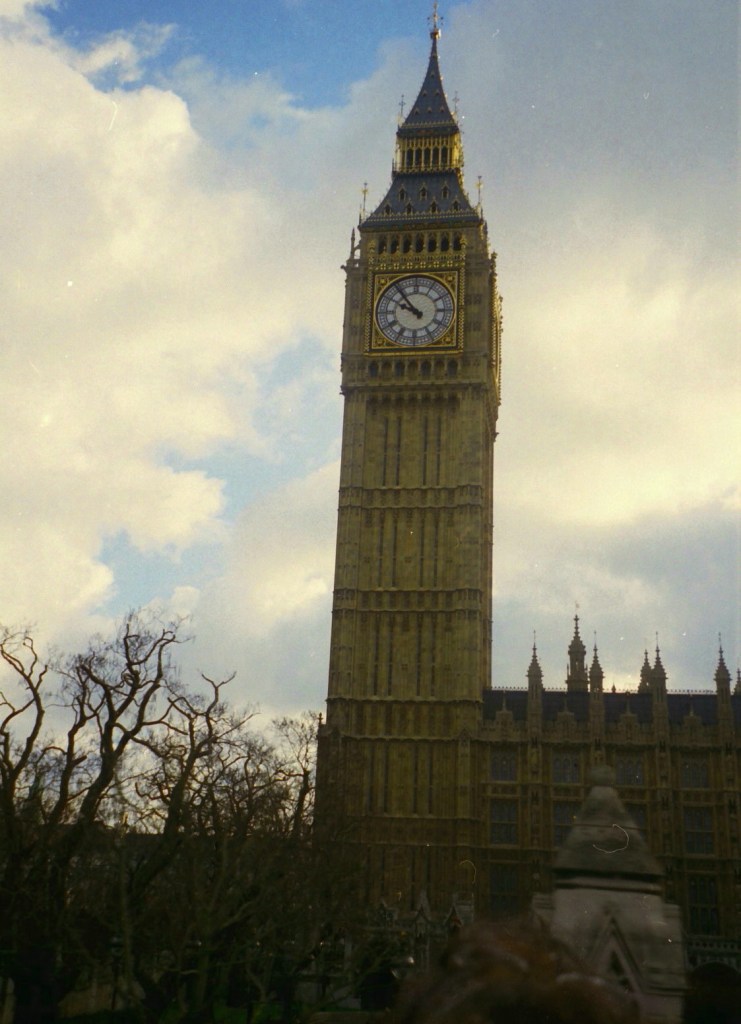
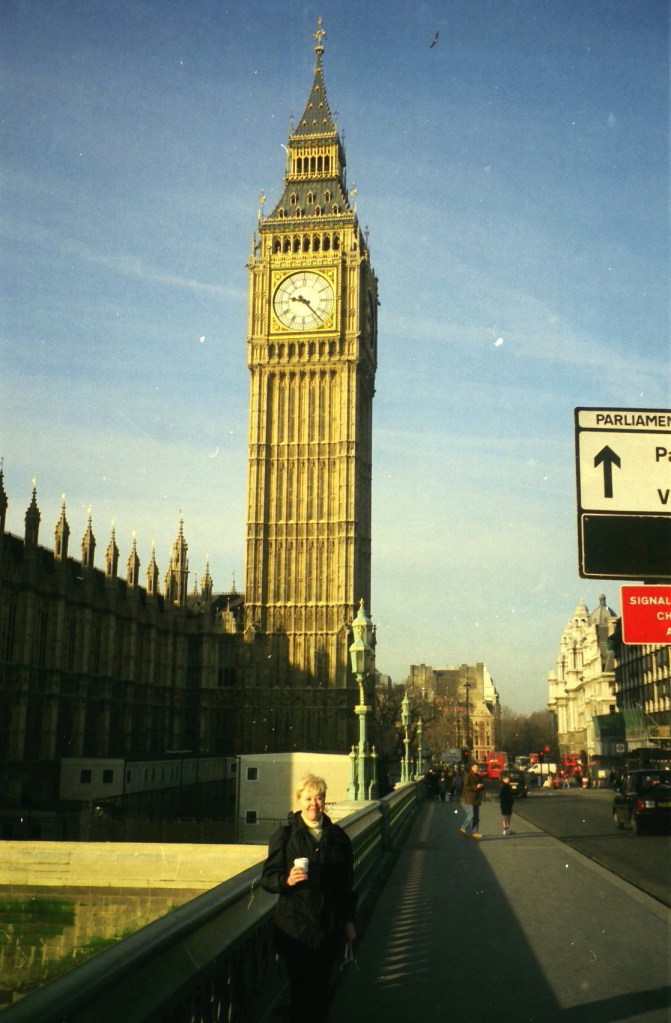
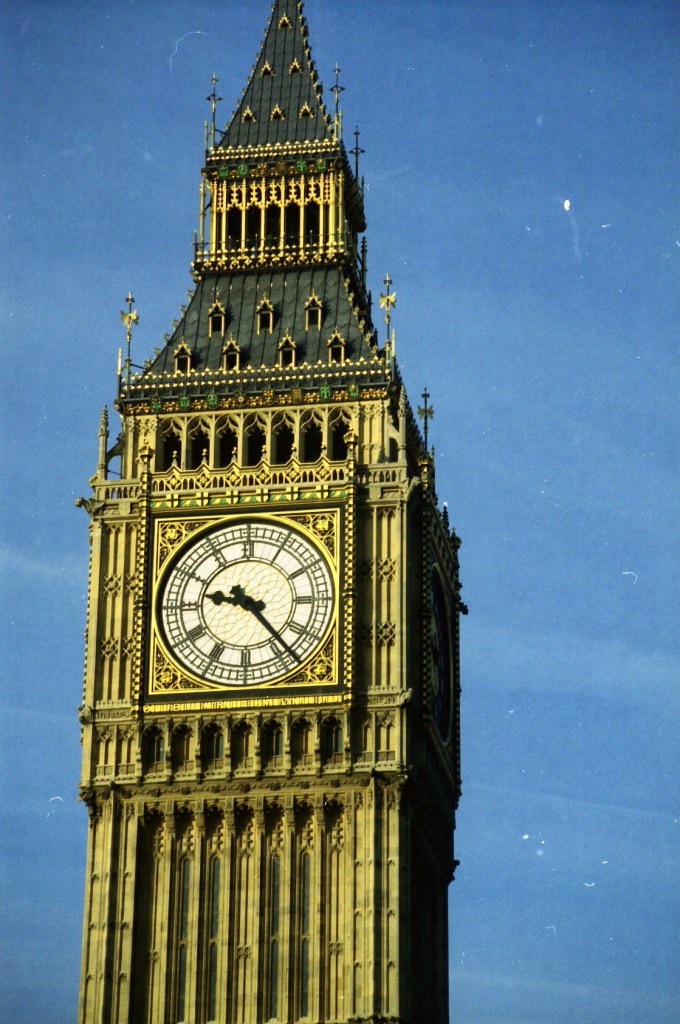
The Tower Big Ben . . .

The rosy-red cheeks of the little children . . .

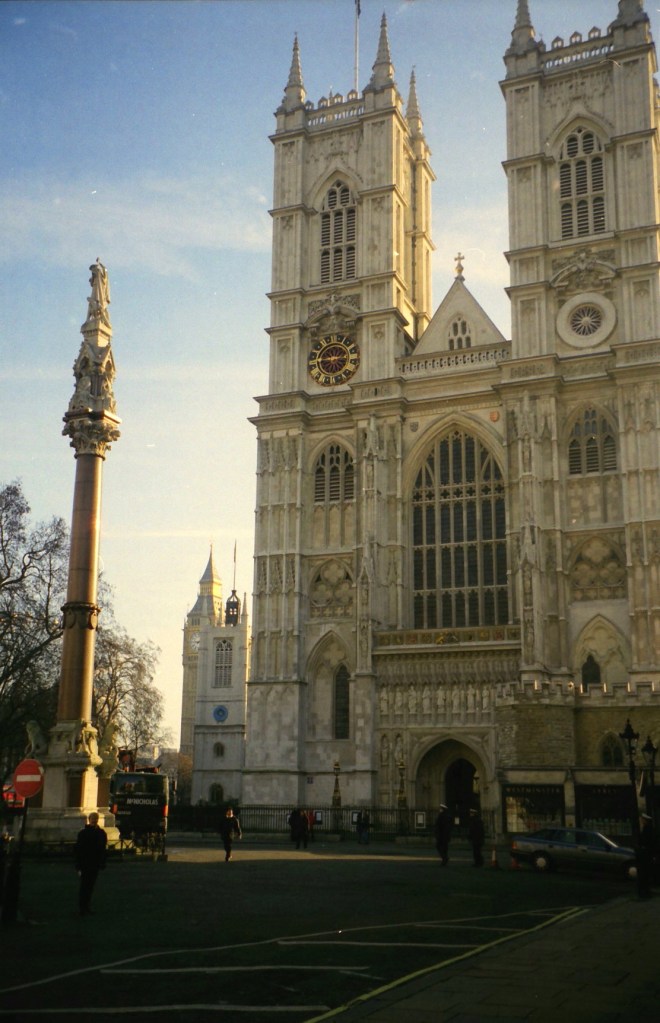
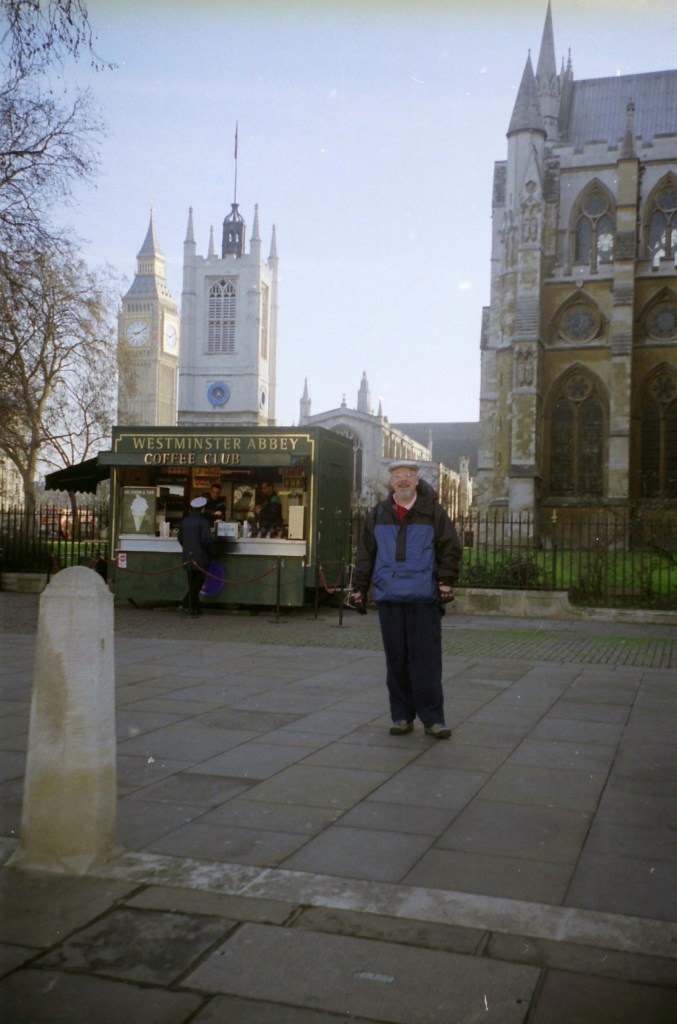
[Westminster Abbey, formally titled the Collegiate Church of Saint Peter at Westminster, is a large, mainly Gothic abbey church in the City of Westminster, London, just to the west of the Palace of Westminster. It is one of the United Kingdom’s most notable religious buildings and the traditional place of coronation and burial site for English and, later, British monarchs. The building itself was a Benedictine monastic church until the monastery was dissolved in 1539. Between 1540 and 1556, the abbey had the status of a cathedral. Since 1560, the building is no longer an abbey or a cathedral, having instead the status of a Church of England “Royal Peculiar”—a church responsible directly to the sovereign (Wikipedia).]

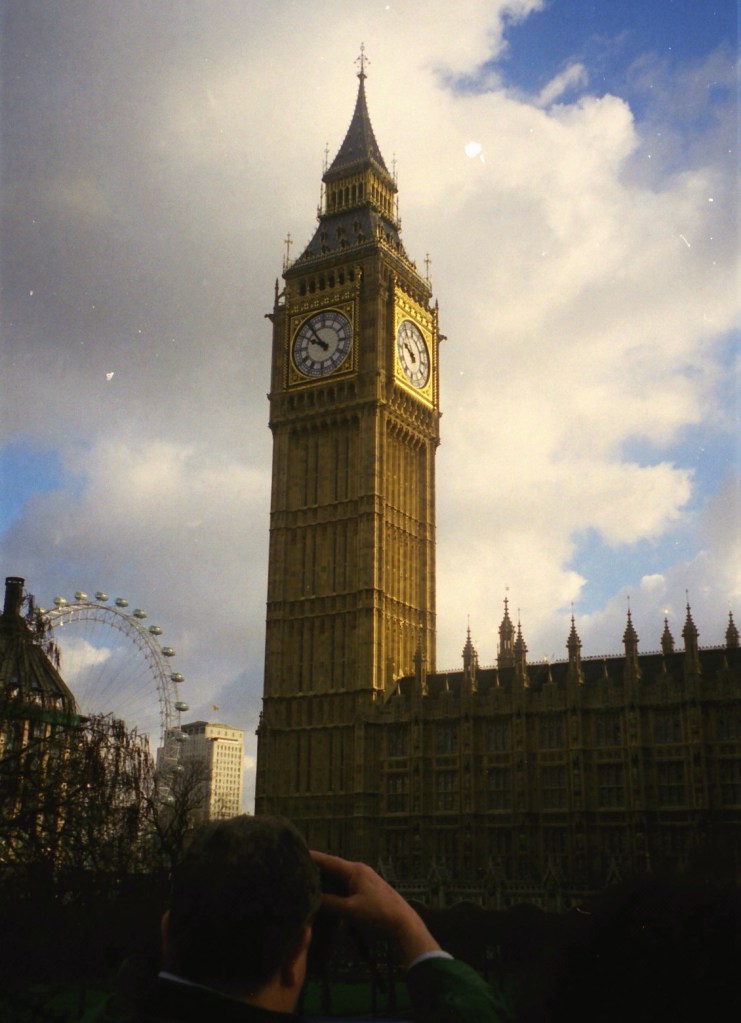
[The London Eye, or the Millennium Wheel, is a cantilevered observation wheel on the South Bank of the River Thames. It is Europe’s tallest cantilevered observation wheel, and is the most popular paid tourist attraction in the United Kingdom with over 3 million visitors annually. The structure is 135 metres (443 ft) tall and the wheel has a diameter of 120 metres (394 ft). When it opened to the public in 2000 it was the world’s tallest Ferris wheel. Its height was subsequently surpassed by three others. Supported by an A-frame on one side only the Eye is described by its operators as “the world’s tallest cantilevered observation wheel.” The London Eye used to offer the highest public viewing point in London until it was superseded by the 245-metre-high (804 ft) observation deck on the 72nd floor of The Shard, which opened to the public on 1 February 2013 (Wikipedia).]
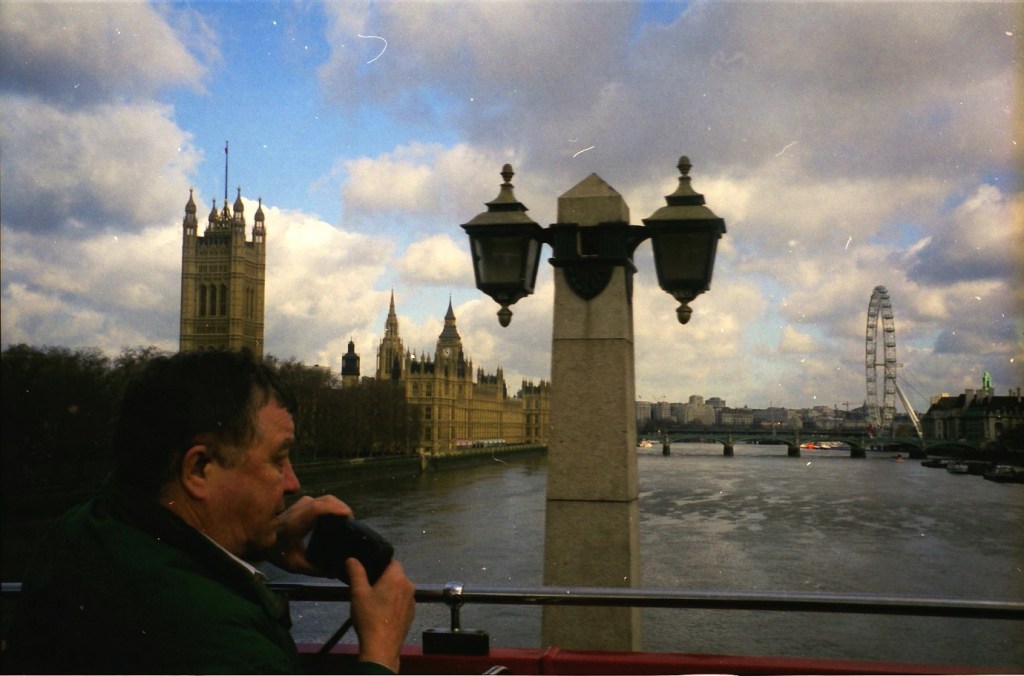
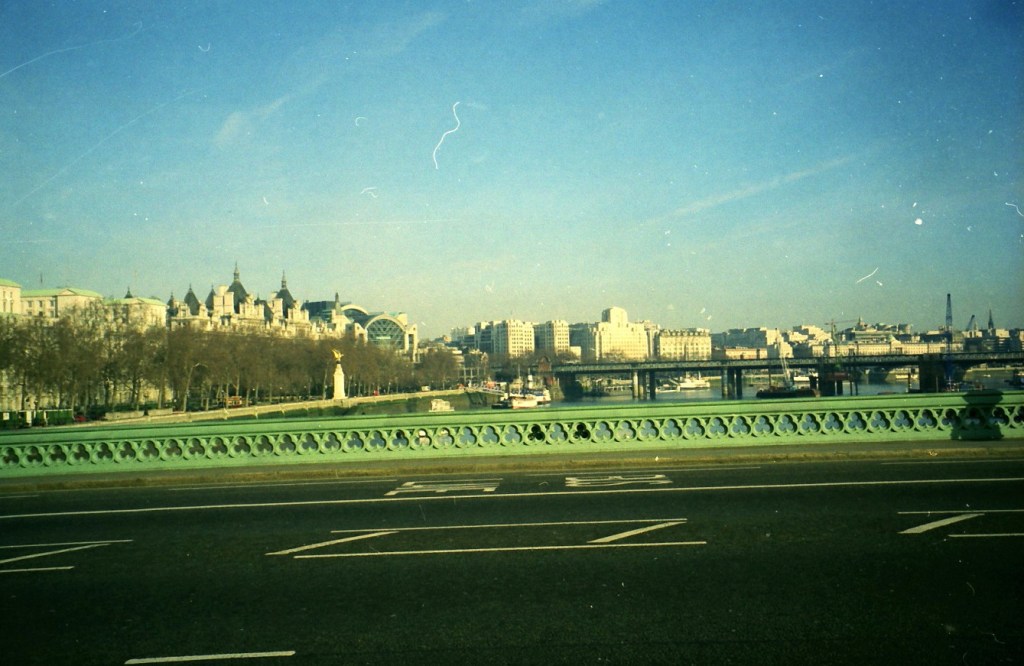
[Parliament on the left, the Eye on the right. The Eye was not yet open to the public when we were there . . . ]

Oh, I love London Society! It is entirely composed now of beautiful idiots and brilliant lunatics. Just what society should be. ~  Oscar Wilde

How can you ever be late for anything in London? They have a huge clock right in the middle of the town. ~  Jimmy Kimmel 

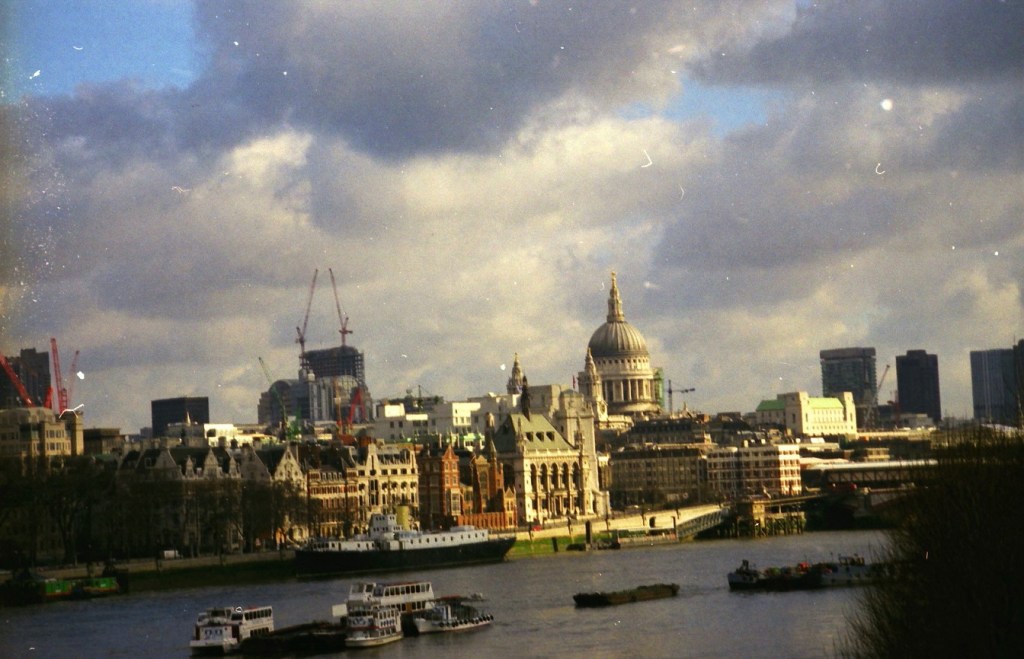
[St Paul’s Cathedral is an Anglican cathedral which serves as the mother church of the Diocese of London. It sits on Ludgate Hill at the highest point of the City of London and is a Grade I listed building. Its dedication to Paul the Apostle dates back to the original church on this site, founded in AD 604.  The present cathedral, dating from the late 17th century, was designed in the English Baroque style by Sir Christopher Wren. Its construction, completed in Wren’s lifetime, was part of a major rebuilding programme in the City after the Great Fire of London.  The earlier Gothic cathedral (Old St. Paul’s Cathedral), largely destroyed in the Great Fire, was a central focus for medieval and early modern London. Its dome, framed by the spires of Wren’s City churches, has dominated the skyline for over 300 years. At 365 feet (111 m) high, it was the tallest building in London from 1710 to 1963. The dome remains among the highest in the world. St Paul’s is the second-largest church building in area in the United Kingdom after Liverpool Cathedral (Wikipedia).]

I’m leaving because the weather is too good. I hate London when it’s not raining. ~  Groucho Marx

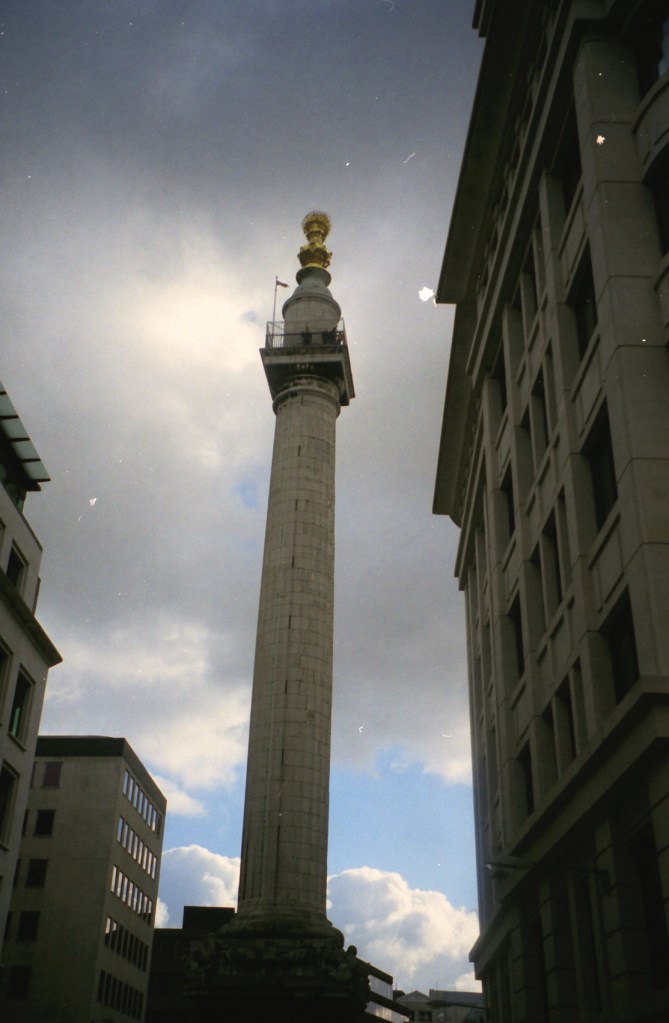
[The Monument to the Great Fire of London, more commonly known simply as the Monument, is a Doric column situated near the northern end of London Bridge. Commemorating the Great Fire of London, it stands at the junction of Monument Street and Fish Street Hill, 202 feet (62 m) in height and 202 feet west of the spot in Pudding Lane where the Great Fire started on 2 September 1666. Constructed between 1671 and 1677, it was built on the site of  St. Margaret, New Fish Street, the first church to be destroyed by the Great Fire. It is Grade I listed and is a scheduled monument (Wikipedia).]

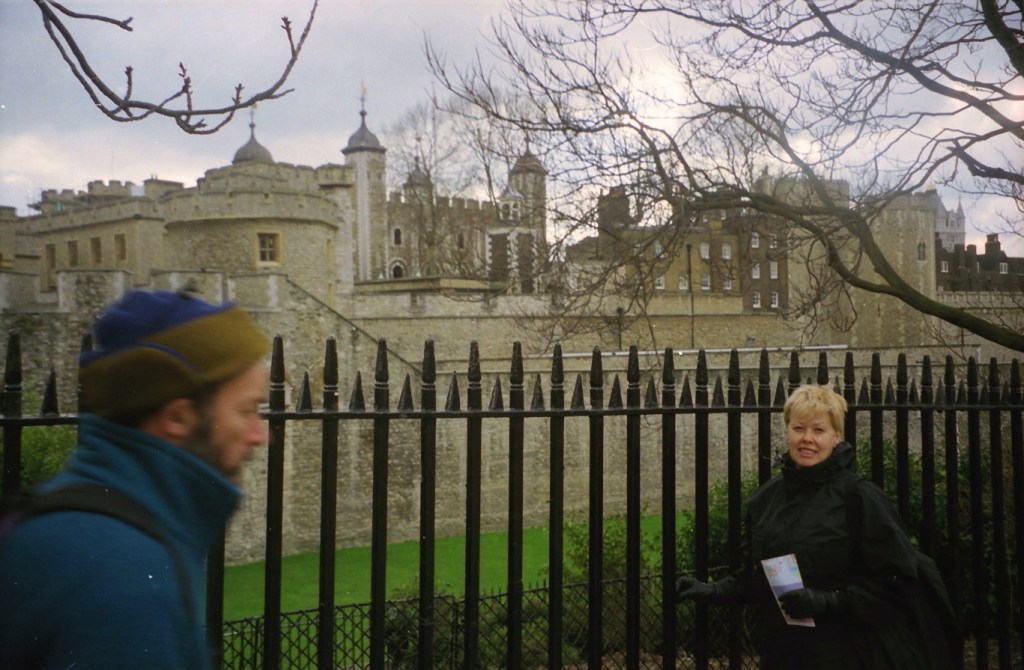
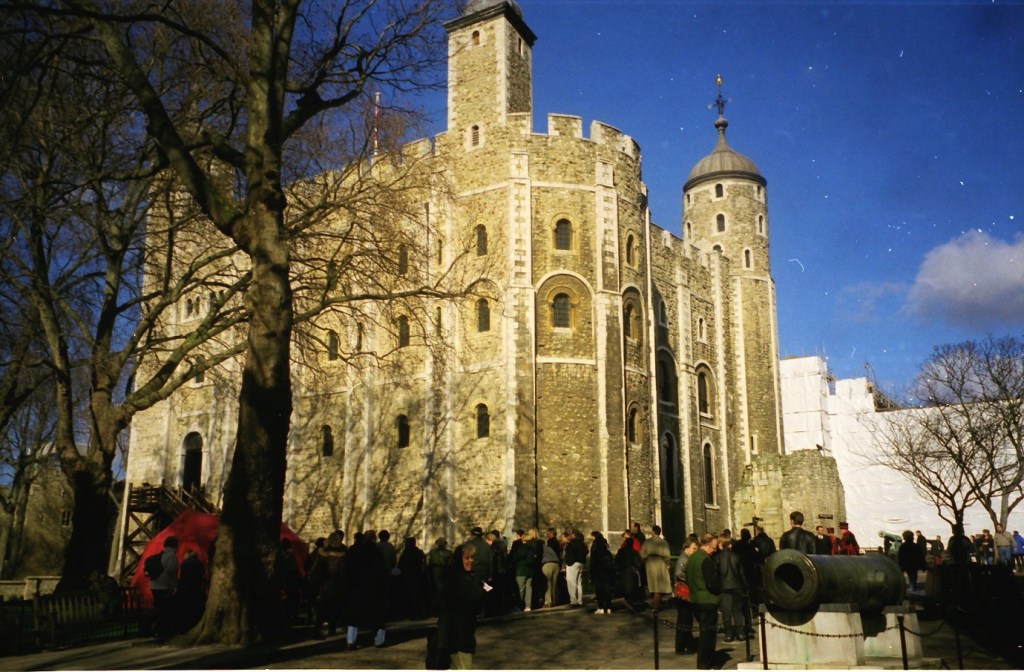
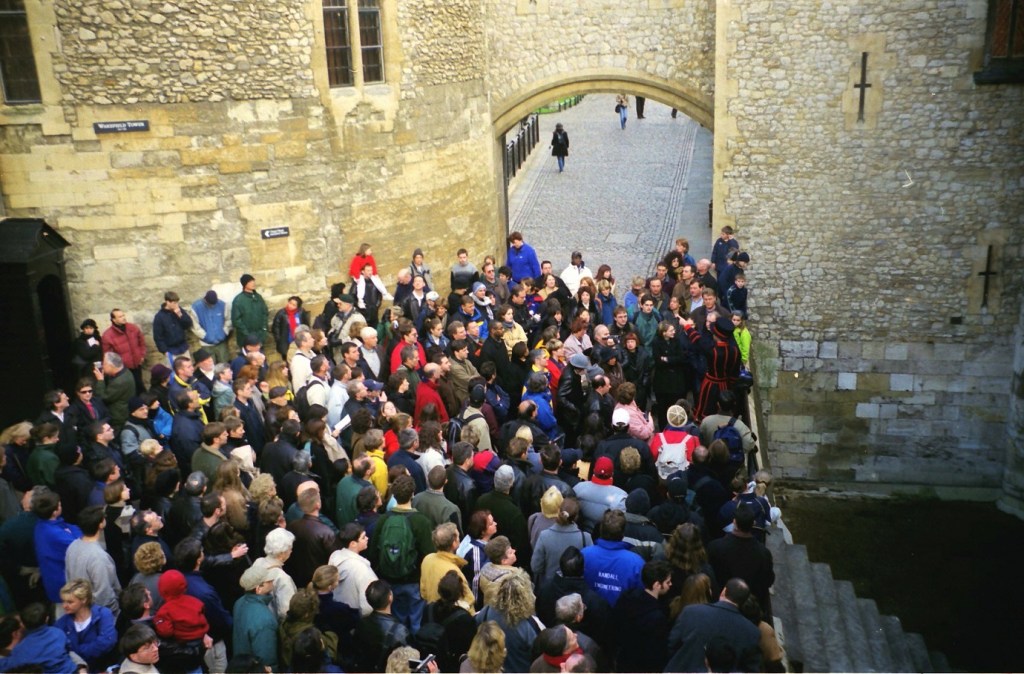
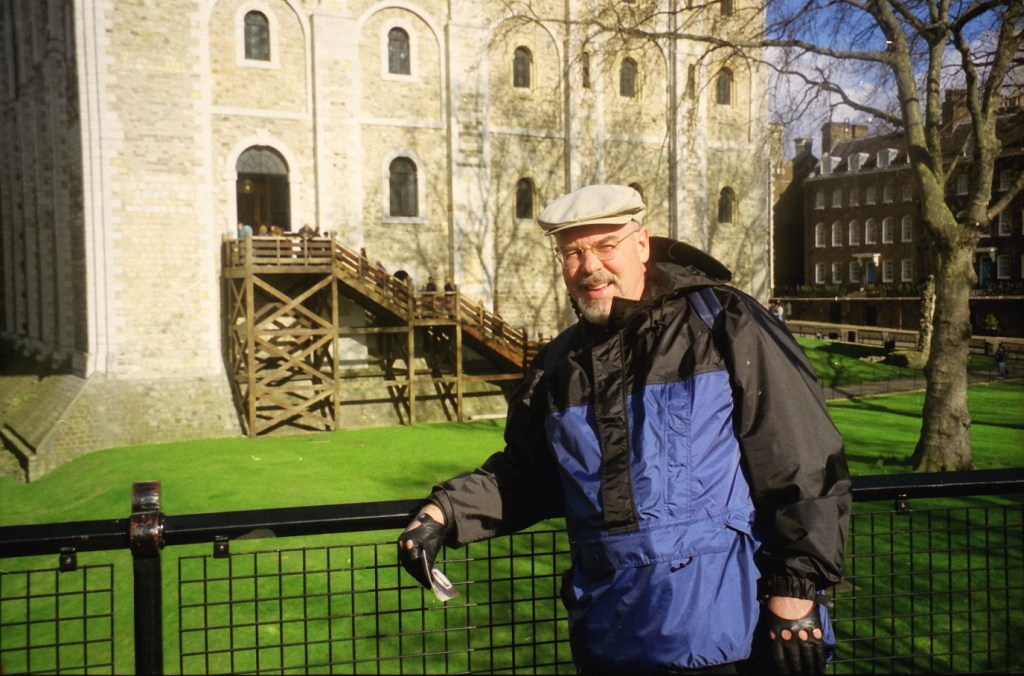
[The Tower of London, officially Her Majesty’s Royal Palace and Fortress of the Tower of London, is a historic castle on the north bank of the River Thames in central London. It was founded towards the end of 1066 as part of the Norman Conquest of England. The White Tower, which gives the entire castle its name, was built by William the Conqueror in 1078 and was a resented symbol of oppression, inflicted upon London by the new ruling elite. A grand palace early in its history, it served as a royal residence. As a whole, the Tower is a complex of several buildings set within two concentric rings of defensive walls and a moat. The general layout established by the late 13th century remains despite later activity on the site. The Tower of London has played a prominent role in English history. It was besieged several times, and controlling it has been important to controlling the country. The Tower has served variously as an armoury, a treasury, a menagerie, the home of the Royal Mint, a public record office, and the home of the Crown Jewels of England. Today, the Tower of London is one of the country’s most popular tourist attractions. Under the ceremonial charge of the Constable of the Tower, the property is cared for by the charity Historic Royal Palaces and is protected as a World Heritage Site (Wikipedia).]

[Ditto, with the Super . . . ]

[Of course, she had to see the Crown Jewels . . . ]

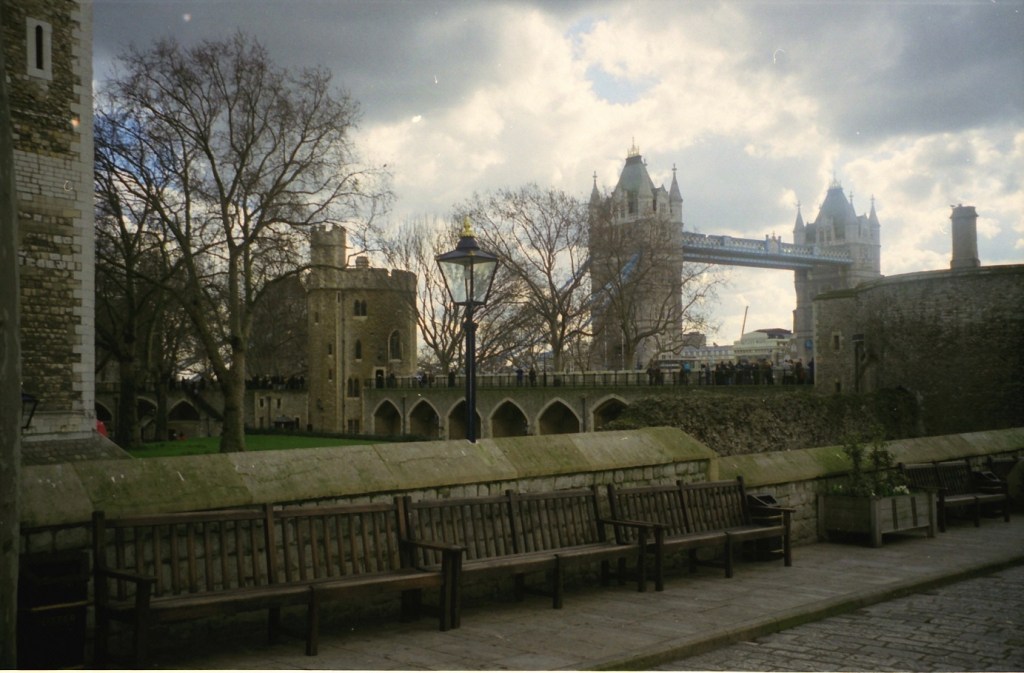
[As seen from inside the Tower of London, Tower Bridge is a combined bascule and suspension bridge, built between 1886 and 1894. The bridge crosses the River Thames close to the Tower of London and has become a world-famous symbol of London. As a result, it is sometimes confused with London Bridge, about half a mile (0.8 km) upstream. Tower Bridge is one of five London bridges owned and maintained by a charitable trust overseen by the City of London Corporation. It is the only one of the trust’s bridges not to connect the City of London directly to the Southwark bank, as its northern landfall is in Tower Hamlets. The bridge consists of two bridge towers tied together at the upper level by two horizontal walkways, designed to withstand the horizontal tension forces imposed by the suspended sections of the bridge on the landward sides of the towers Wikipedia).]

[What an early siege of the Tower may have looked like . . . ]

I journeyed to London, to the timekept City, Where the River flows, with foreign flotations. There I was told: we have too many churches, And too few chop-houses. ~ T. S. Eliot

Yes, London. You know, fish, chips, cup o tea, bad food, worse weather, Mary-fucking-Poppins. London! ~ Dennis Farina

Aesthetically, London is just beautiful; it’s a gorgeous city. The architecture, monuments, the parks, the small streets – it’s an incredible place to be. ~  Sara Bareilles

It is difficult to speak adequately or justly of London.  It is not a pleasant place; it is not agreeable, or cheerful, or easy, or exempt from reproach.  It is only magnificent. ~ Henry James

London opens to you like a novel itself… It is divided into chapters, the chapters into scenes, the scenes into sentences; it opens to you like a series of rooms, doors and passages.  Mayfair to Piccadilly to Soho to the Strand. ~  Anna Quindlen

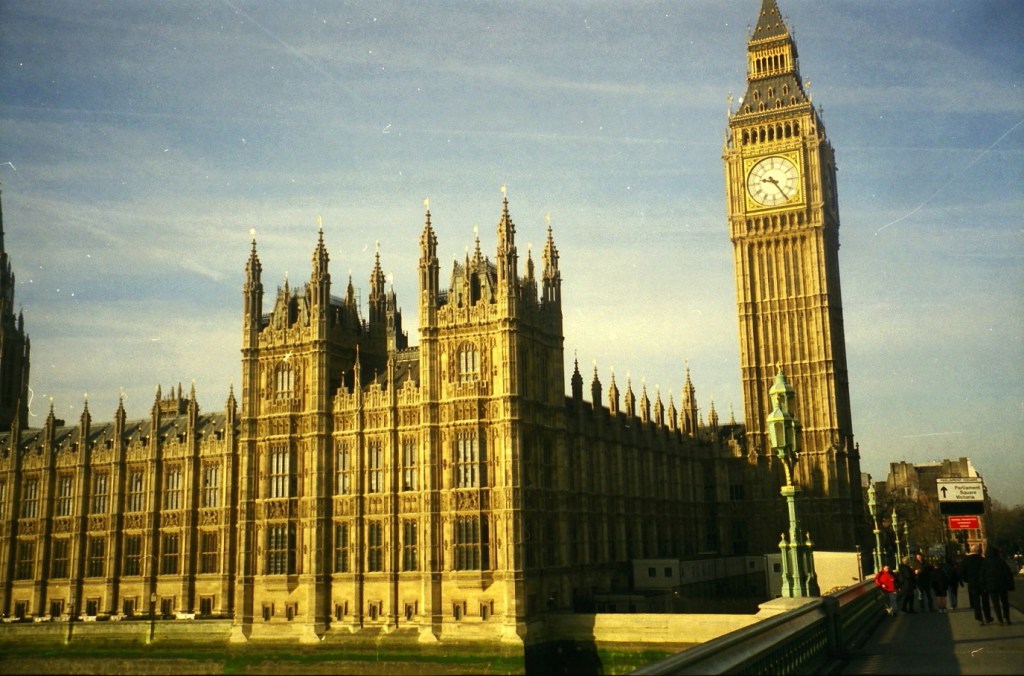
[Big Ben is the nickname for the Great Bell of the striking clock at the north end of the Palace of Westminster; the name is frequently extended to refer to both the clock and the clock tower.  The official name of the tower in which Big Ben is located was originally the Clock Tower; it was renamed Elizabeth Tower in 2012 to mark the Diamond Jubilee of Elizabeth II, Queen of the United Kingdom. When completed in 1859, its clock was the largest and most accurate four-faced striking and chiming clock in the world. The tower stands 315 feet (96 m) tall, and the climb from ground level to the belfry is 334 steps. Its base is square, measuring 39 feet (12 m) on each side. Dials of the clock are 23 feet (7.0 m) in diameter. On 31 May 2009, celebrations were held to mark the tower’s 150th anniversary. Big Ben is the largest of the tower’s five bells and weighs 13.5 long tons.  It was the largest bell in the United Kingdom for 23 years. Four quarter bells chime at 15, 30 and 45 minutes past the hour and just before Big Ben tolls on the hour. The clock uses its original Victorian mechanism, but an electric motor can be used as a backup. The clock tower has been part of a Grade I listed building since 1970 and a UNESCO World Heritage Site since 1987 (Wikipedia).]

[Oh, and that’s the Super with Big Ben above . . . ]

[The eye was open when we were there, but not to the general public. We apparently qualified as the general public . . . ]

It is my belief, Watson, founded upon my experience, that the lowest and vilest alleys in London do not present a more dreadful record of sin than does the smiling and beautiful countryside. ~  Arthur Conan Doyle, Sherlock Holmes

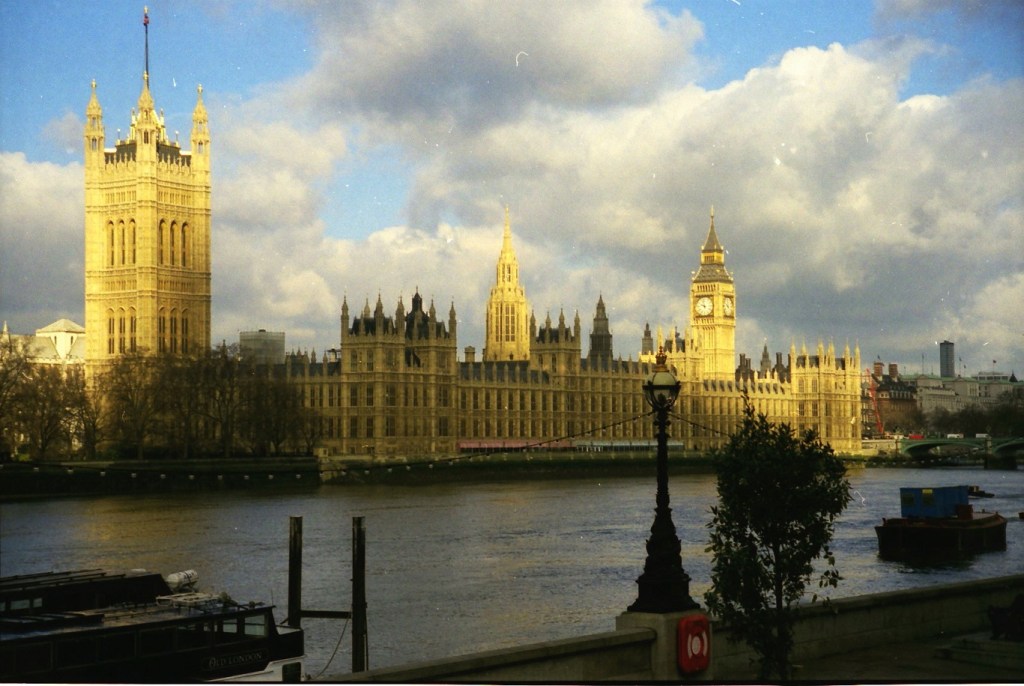
[The Palace of Westminster serves as the meeting place for both the House of Commons and the House of Lords, the two houses of the Parliament of the United Kingdom. Informally known as the Houses of Parliament after its occupants, the Palace lies on the north bank of the River Thames in the City of Westminster, in central London. Its name, which derives from the neighbouring Westminster Abbey, may refer to several historic structures but most often: the Old Palace, a medieval building-complex largely destroyed by fire in 1834, or its replacement, the New Palace that stands today. The palace is owned by the monarch in right of the Crown and, for ceremonial purposes, retains its original status as a royal residence. Committees appointed by both houses manage the building and report to the Speaker of the House of Commons and to the Lord Speaker (Wikipedia).]

[With the Eye as backdrop, Boadicea and Her Daughters is a bronze sculptural group in London representing Boudica, queen of the Celtic Iceni tribe, who led an uprising in Roman Britain. It is located to the north side of the western end of Westminster Bridge. It was not erected in its current position until 1902 (Wikipedia).]

[10 Downing Street . . . ]

(Nelson’s Column . . . ]

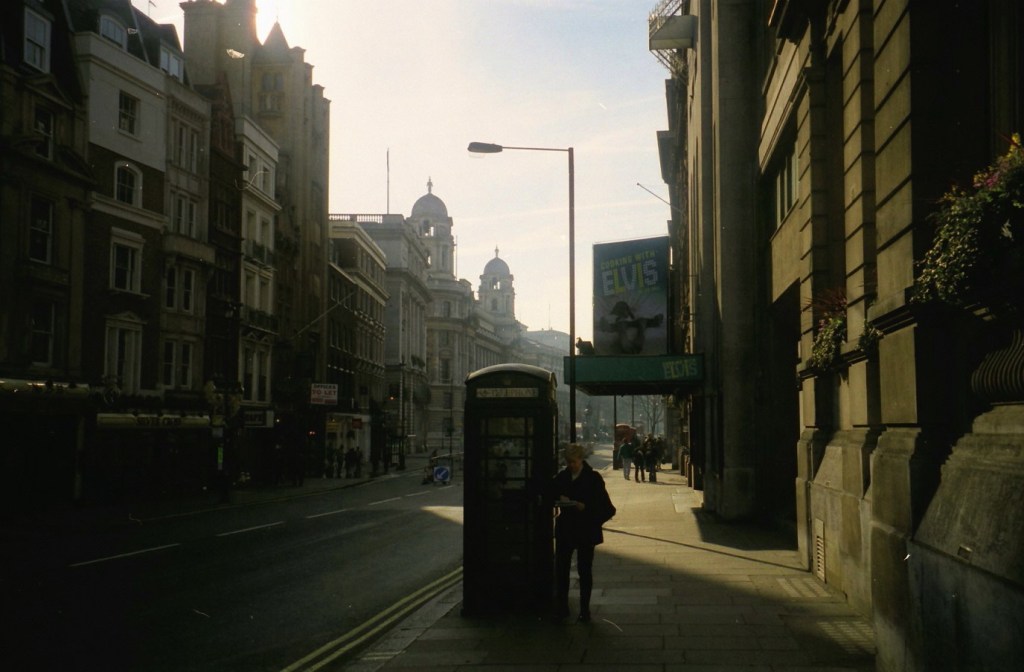
[The Super called to see if any tickets were still available for Elvis . . . ]

[Trafalgar Square . . . ]

[Refurbishment of Admiralty Arch . . . ]

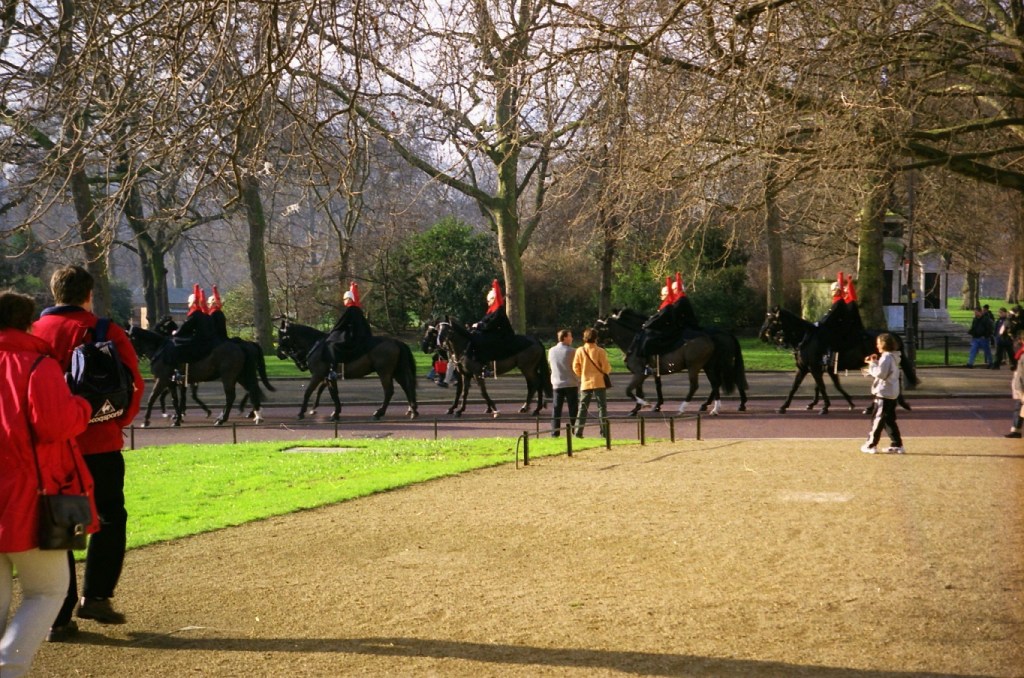
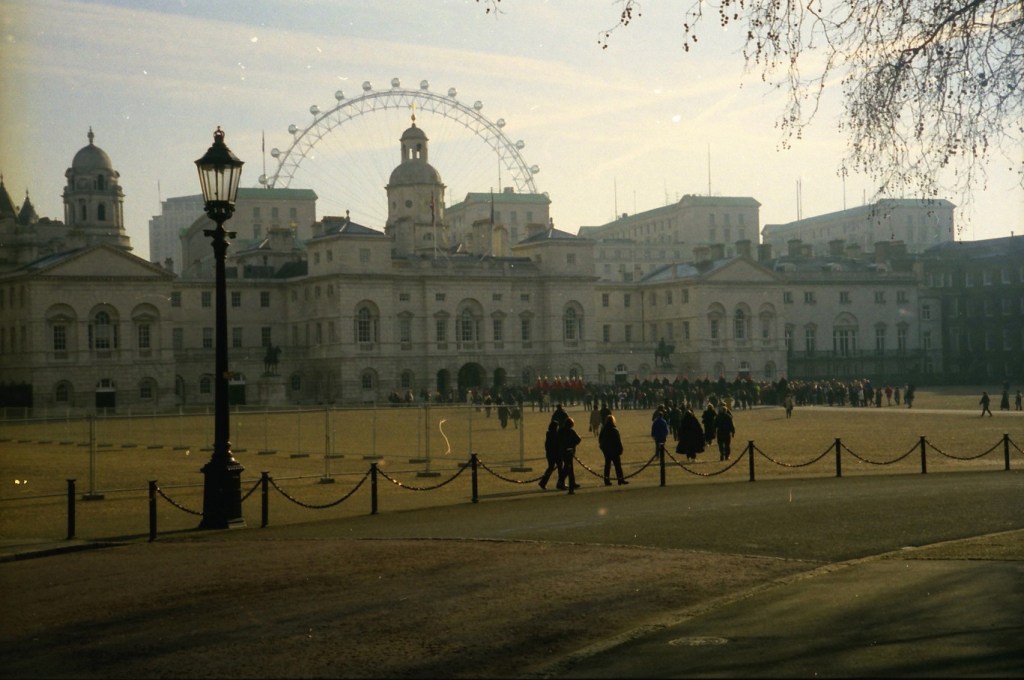
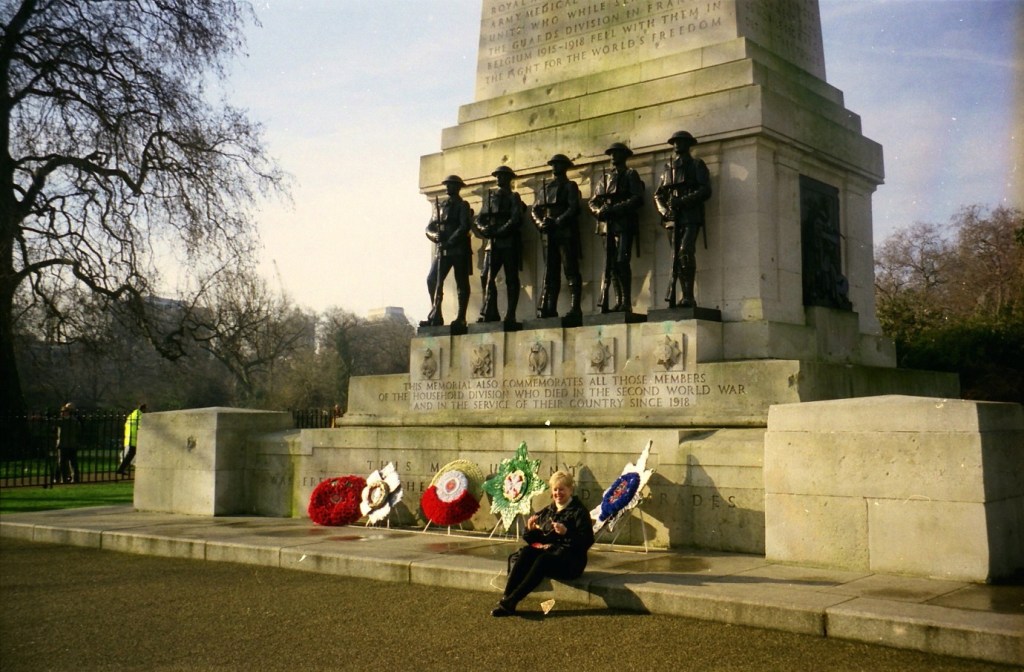
[The Queen’s Guard and Queen’s Life Guard (called King’s Guard and King’s Life Guard when the reigning monarch is male) are the names given to contingents of infantry and cavalry soldiers charged with guarding the official royal residences in the United Kingdom. The British Army has regiments of both Horse Guards and Foot Guards predating the English Restoration (1660), and since the reign of King Charles II these regiments have been responsible for guarding the Sovereign’s palaces. The Guards are fully operational soldiers (Wikipedia).]

[On the way to . . . ]

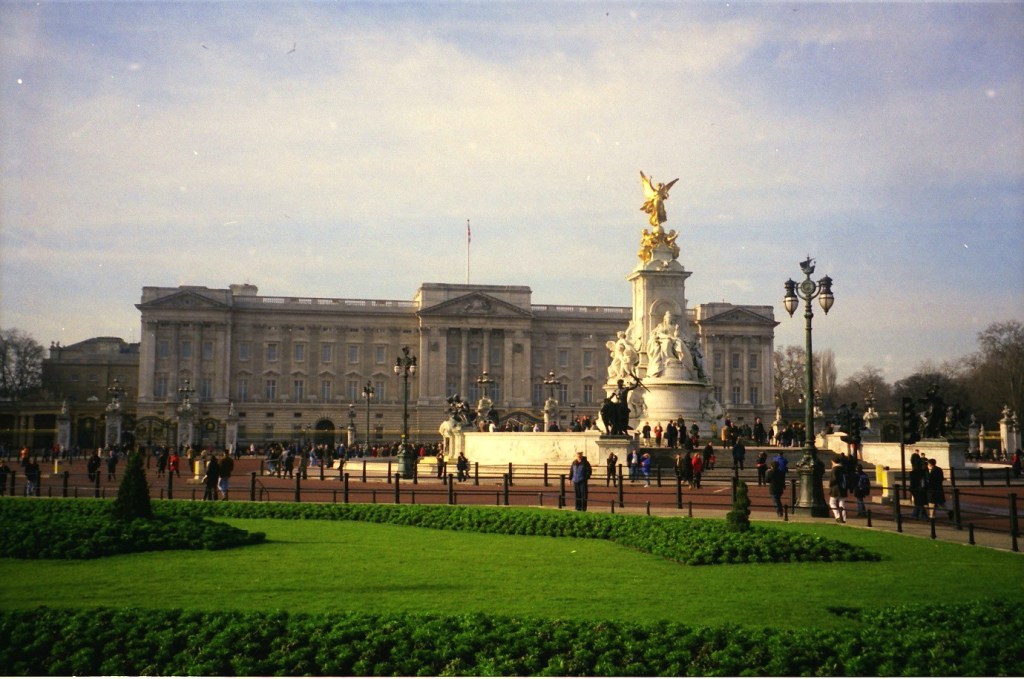
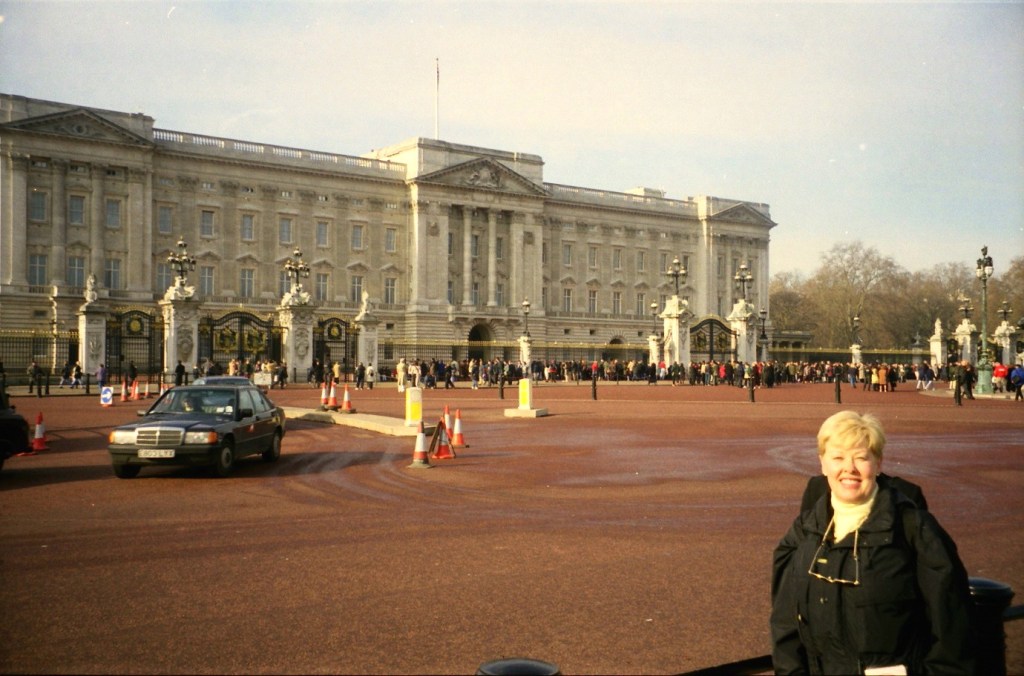
[Buckingham Palace is the London residence and administrative headquarters of the monarch of the United Kingdom.  Located in the City of Westminster, the palace is often at the centre of state occasions and royal hospitality. Originally known as Buckingham House, the building at the core of today’s palace was a large townhouse built for the Duke of Buckingham in 1703 on a site that had been in private ownership for at least 150 years. It was acquired by King George III in 1761 as a private residence for Queen Charlotte and became known as The Queen’s House. During the 19th century it was enlarged with three wings around a central courtyard. Buckingham Palace became the London residence of the British monarch on the accession of Queen Victoria in 1837. The palace has 775 rooms, and the garden is the largest private garden in London. The state rooms, used for official and state entertaining, are open to the public each year for most of August and September and on some days in winter and spring (Wikipedia).]

I don’t know what London’s coming to. The higher the buildings the lower the morals. ~ Noel Coward.

In London, love and scandal are considered the best sweeteners of tea. ~ John Osborne

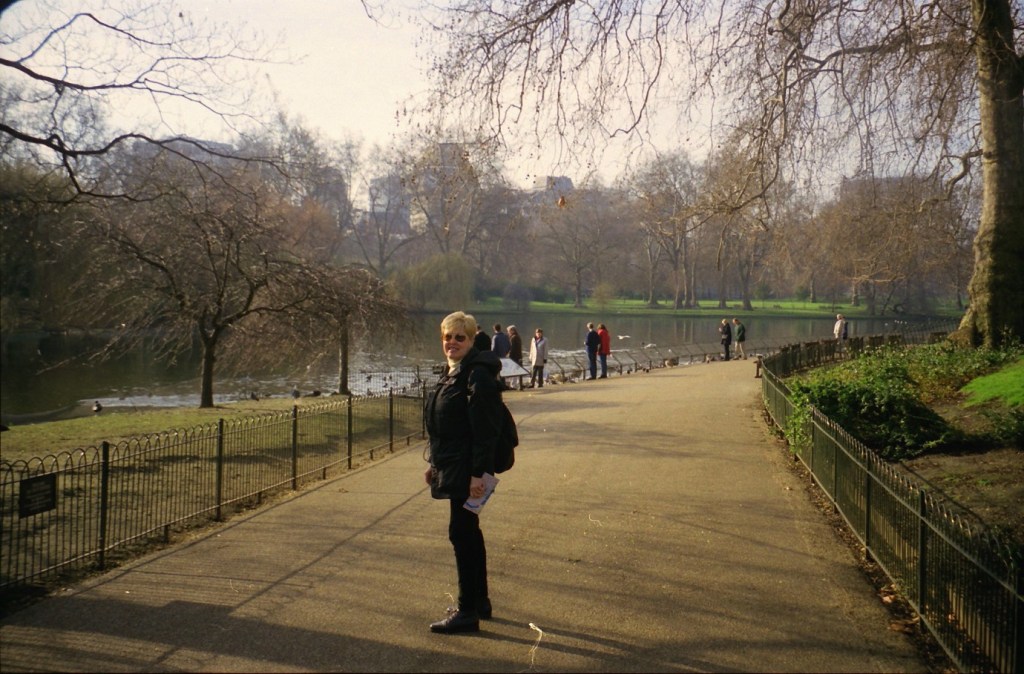
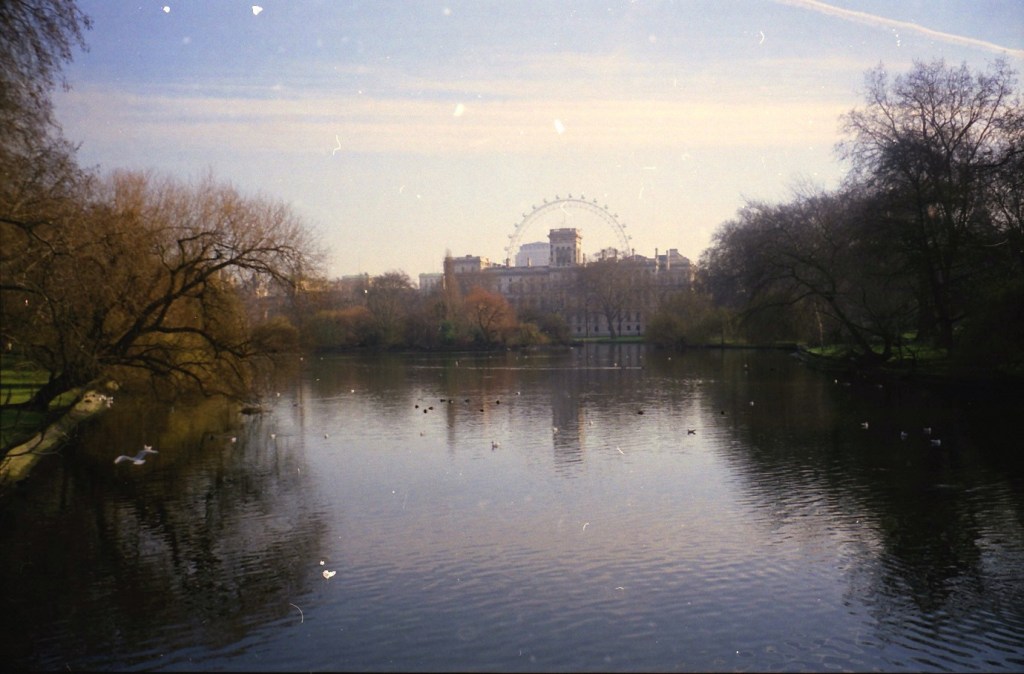
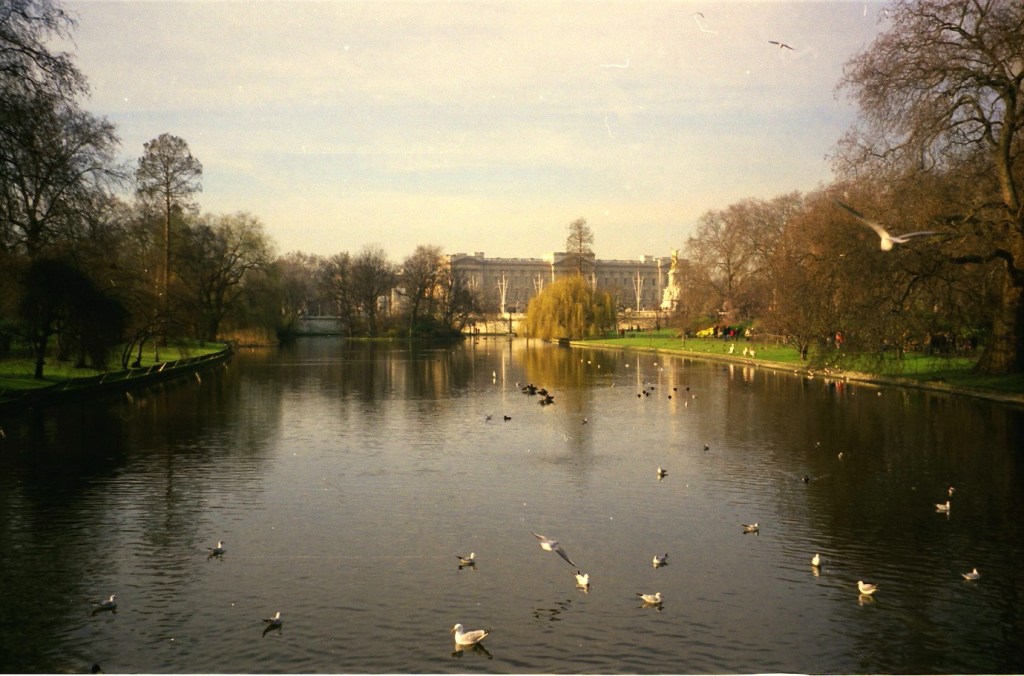
[St James’s Park is a 23-hectare (57-acre) park in the City of Westminster, central London. It is at the southernmost tip of the St James’s area, which was named after a leper hospital dedicated to St James the Less. It is the most easterly of a near-continuous chain of parks that includes (moving westward) Green Park, Hyde Park, and Kensington Gardens. The park is bounded by Buckingham Palace to the west, the Mall to the north, Horse Guards to the east, and Birdcage Walk to the south. It meets Green Park at Queen’s Gardens with the Victoria Memorial at its centre, opposite the entrance to Buckingham Palace.  St Jame’s Palace is on the opposite side of The Mall. The park is Grade I listed on the Register of Historic Parks and Gardens (Wikipedia).]

[I remember the pelican. It tried to eat a pigeon. The pigeon wasn’t happy about it . . . ]

The climate suits me, and London has the greatest serious music that you can hear any day of the week in the world – you think it’s going to be Vienna or Paris or somewhere, but if you go to Vienna or Paris and say, ‘Let’s hear some good music’, there isn’t any. ~ David Attenborough

When it’s three o’clock in New York, it’s still 1938 in London. ~  Bette Midler

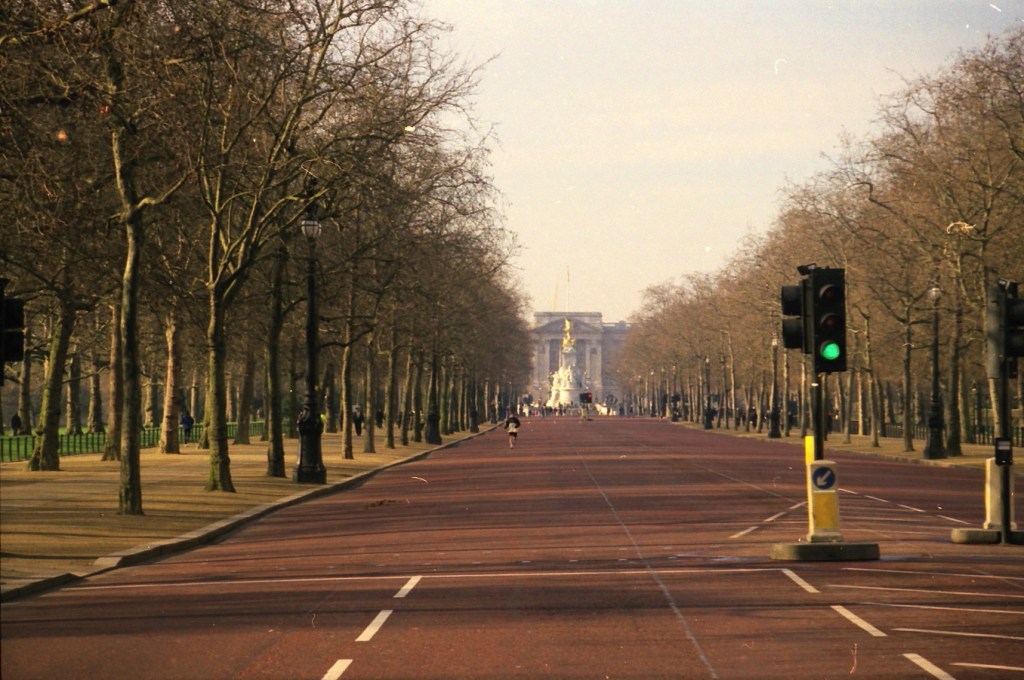
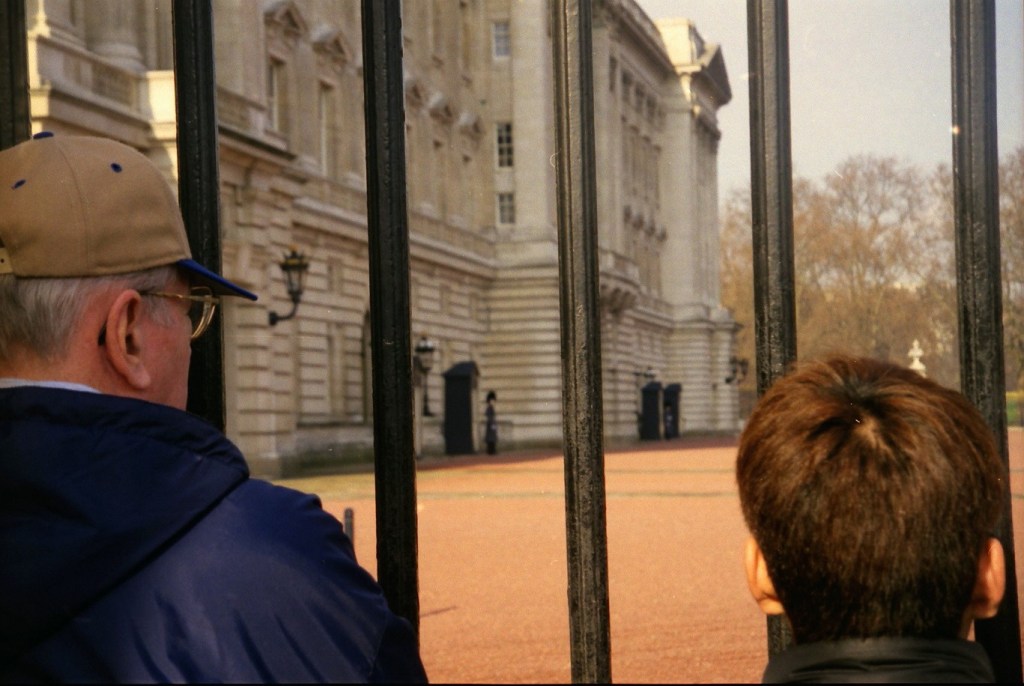
[We came to see the queen . . . ]

[Well, not me, but maybe the Super . . . ]

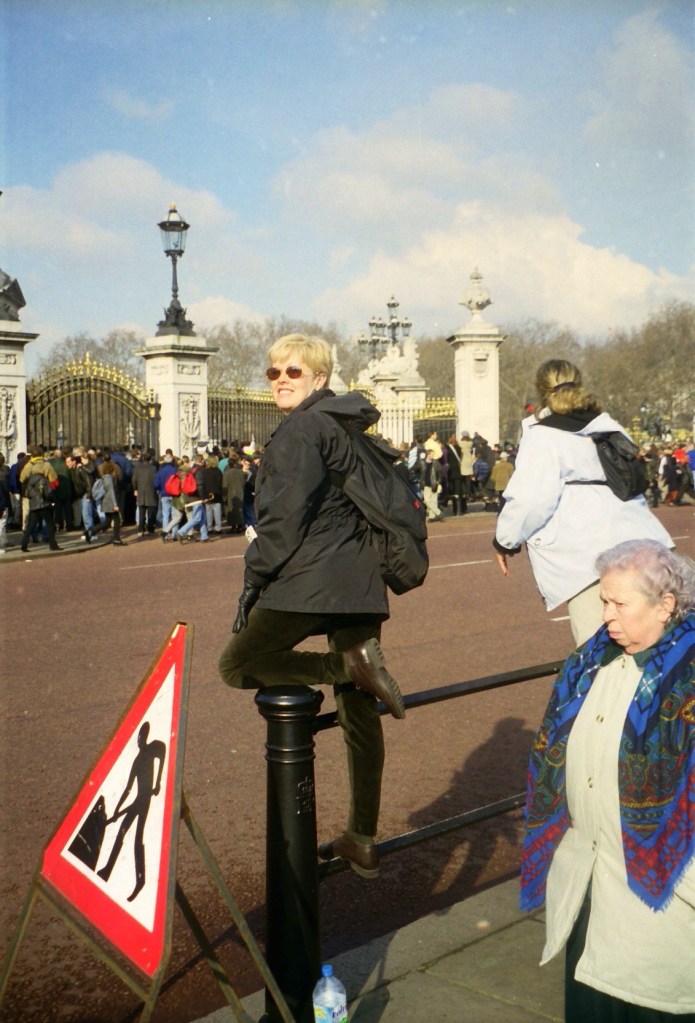
[You can do this at the White House now, but behind about four layers of fences . . . ]

[Following the Battle of Waterloo and the action in which they gained their name, the Grenadier Guards were permitted to wear the bearskin. In 1831, this practice was extended to the other two Foot Guards units at the time. The standard bearskin of the British Foot Guards is 18 inches tall, weighs 1.5 pounnds and is made from the fur of the Canadian black bear. However, an officer’s bearskin is made from the fur of the Canadian brown bear as the female brown bear has thicker, fuller fur, and is dyed black. An entire skin is used for each hat. The British Army purchase the hats, which are known as caps, from a British hatmaker which sources its pelts from an international auction. The hatmakers purchase between 50 and 100 black bear skins each year at a cost of about £650 each. If properly maintained, the caps last for decades (Wikipedia).]

The Sun in London ran a front page declaring my bum a national treasure. I really did laugh at that. Its not like it can actually do anything, except wiggle. ~  Kylie Minogue

Ladies and gentlemen, the Beatles have left the building!

I think I saw a Kardashian?

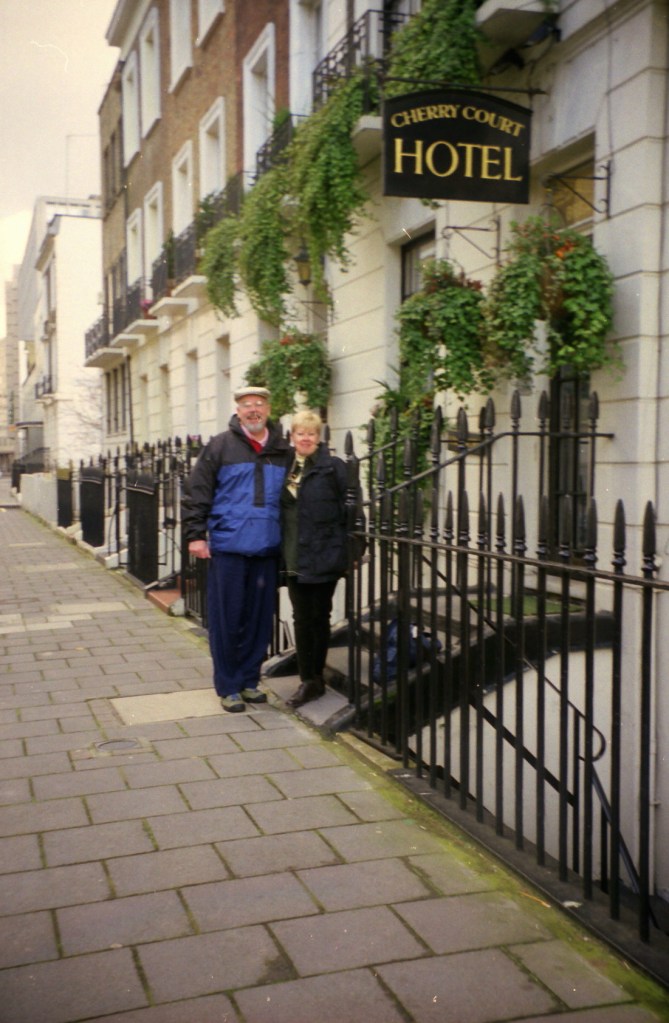
[We left our bags in a closet. When we returned, we discovered it was our room!]

Antwerp

The we took the Eurostar under the English Channel to Brussels. But it must have been a quick drop off at our hosts and on to the diamond capital of the world . . .

[The Cathedral of Our Lady is a Roman Catholic cathedral in Antwerp, Belgium. Today’s see of the Diocese of Antwerp started in 1352 and, although the first stage of construction was ended in 1521, has never been ‘completed’. In Gothic style, its architects were Jan and Pieter Appelmans and contains a number of significant works by the Baroque painter Peter Paul Rubens. The belfry of the cathedral is included in the Belfries of Belgium and France entry in the list of UNESCO World Heritage Sites (Wikipedia).]

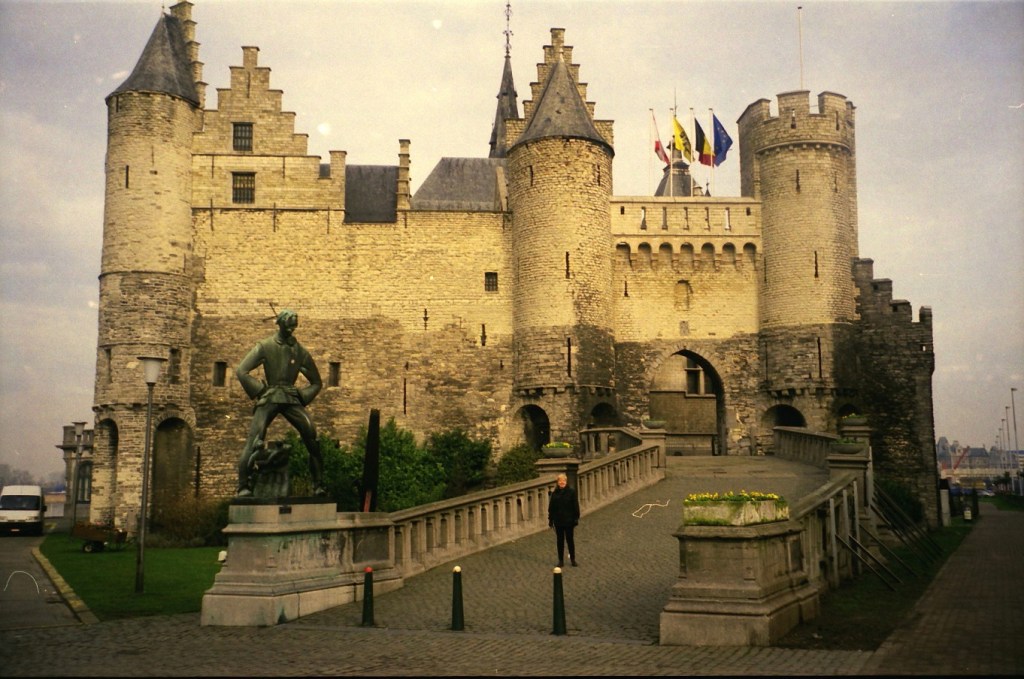
[Het Steen is a medieval fortress in the old city centre of Antwerp, one of Europe’s biggest ports. Built after the Viking incursions in the early Middle Ages as the first stone fortress of Antwerp, Het Steen is Antwerp’s oldest building and used to be its oldest urban centre. Previously known as Antwerpen Burcht (fortress), Het Steen gained its current name in around 1520, after significant rebuilding under Charles V. The Dutch word “steen” means “stone”, and used to be used for “fortress” or “palace”, as in the “Gravensteen” in Ghent, Belgium. At the entrance bridge to the castle is a statue of a giant and two humans. It depicts the giant Lange Wapper who used to terrorise the inhabitants of the city in medieval times (Wikipedia).]

[Antwerp is the undisputed diamond capital of the world. With 84% of the world’s rough diamonds and 50% of cut diamonds passing through, the city attracts international traders seeking the highest quality diamonds (www.sandersjewelers.net).] It was eerie walking through the diamond district – quiet, few people on the street, a feeling “eyes” were following you wherever you went . . . ]

The No. 1 place I’ve visited so far was Antwerp, Belgium. That was one of the coolest cities I’ve ever seen. Every day I woke up, I felt like I was in a movie. ~ Sam Mikulak

MERRY 2020* CHRISTMAS

December 5

* The year that will live in infamy . . .

So, how will you remember this year? The year of the pandemic? The year of the national election that may have saved democracy? The year of George Floyd and the international consequences? The year of Ruth Bader Ginsburg? The year of the ZOOM meeting? The year of outdoor dining? The year of only having to fill your gas tank once a month? The year the Earth fought back with record numbers of hurricanes and wild fires? The year of the jigsaw puzzle? The year where we never once escaped the boundaries of Minnesota? The year in which summer camp and Mini-University were cancelled? The year the Fat Boys Walking Club achieved international fame and went full-time exterior? And as I recall we were within sniffing distance of family members only twice the entire year . . .

The entire year encapsulated in a single photograph – the Super wearing a RBG COVID mask . .

If only in my dreams . . .

And so, with limited adieu, and the usual acknowledgments to Dave Barry, here is the year in review:

[The end of 2019 . . . ]

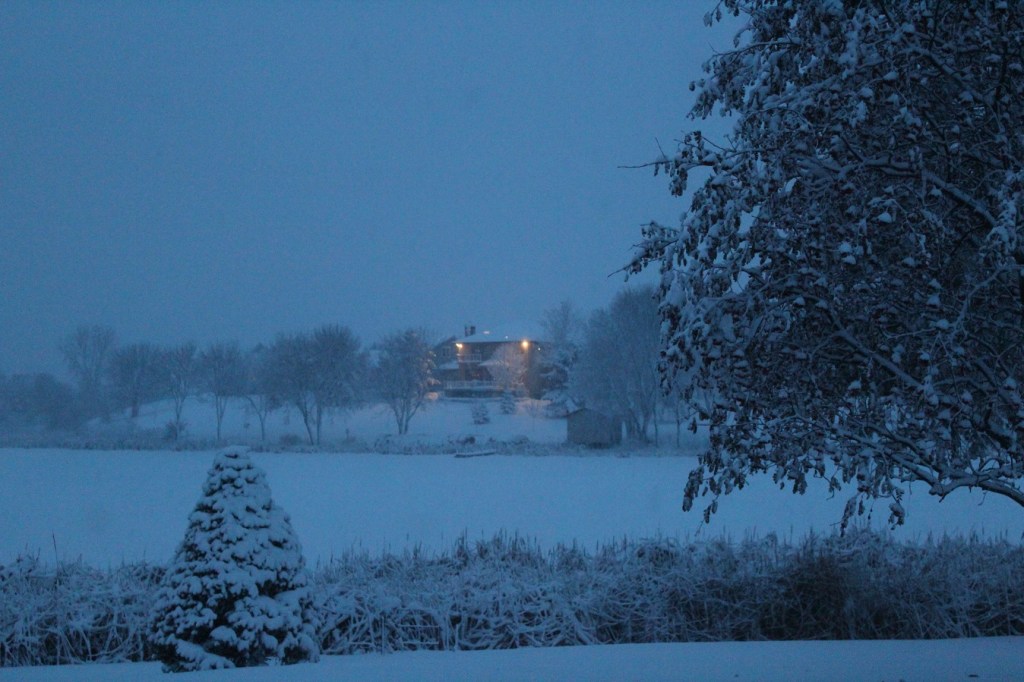
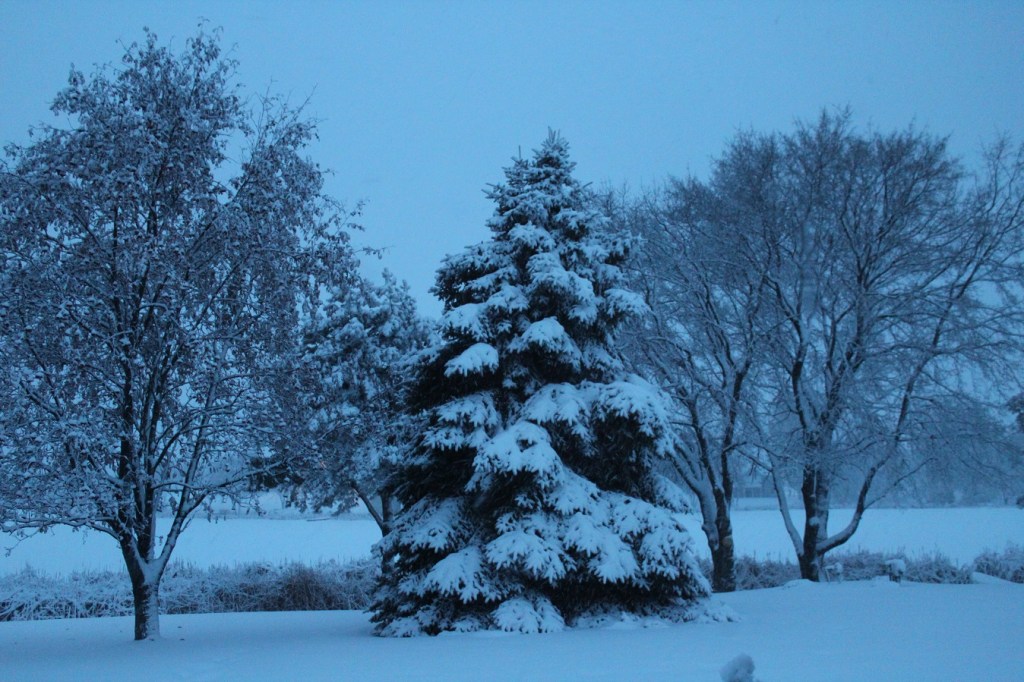
[Was beautifully wintery.]

[New Years Eve at the Garden Bar on 6th with Tuesday Night Club, a group notably distinguished for every member being older than me (l-r: Terry Kennedy, Jim Faber, Bill Riggs, Mel Lamar) . . . ]

The Super always starts the New Year . . .

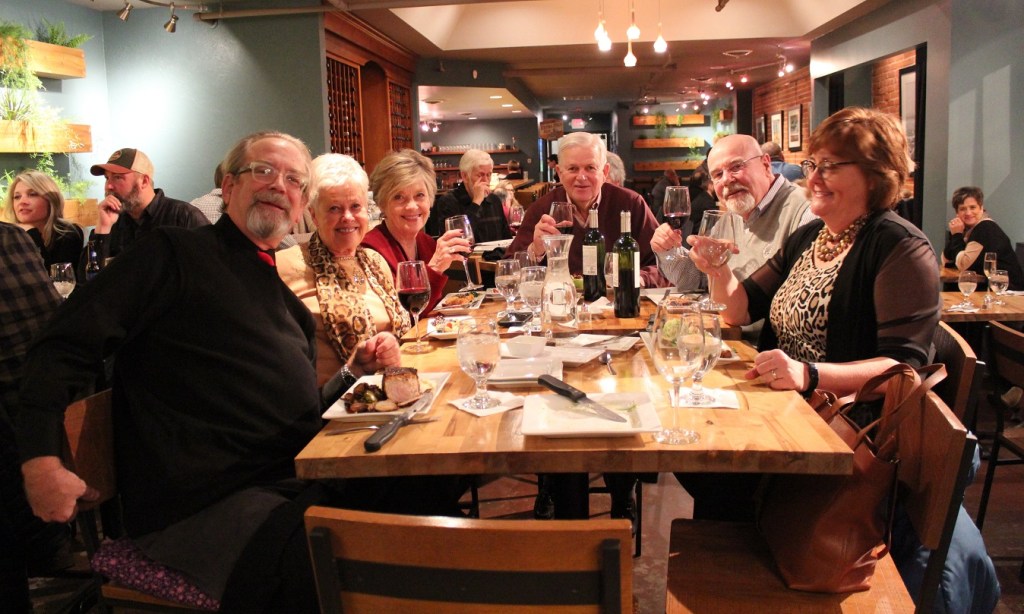
[New Year’s Eve is of course also the Super’s birthday eve. I have no idea who any of these people are, but they invited us to join their table for her birthday dinner . . . ]

[The author foster-cared our kitties (story when we get to October), and as I write this Jess just introduced a new novel, Bloodline . . . ]

[The photos above and below reflect the Super’s New Year’s Day birthday and the presents she received as a result of said day . . . ]

February

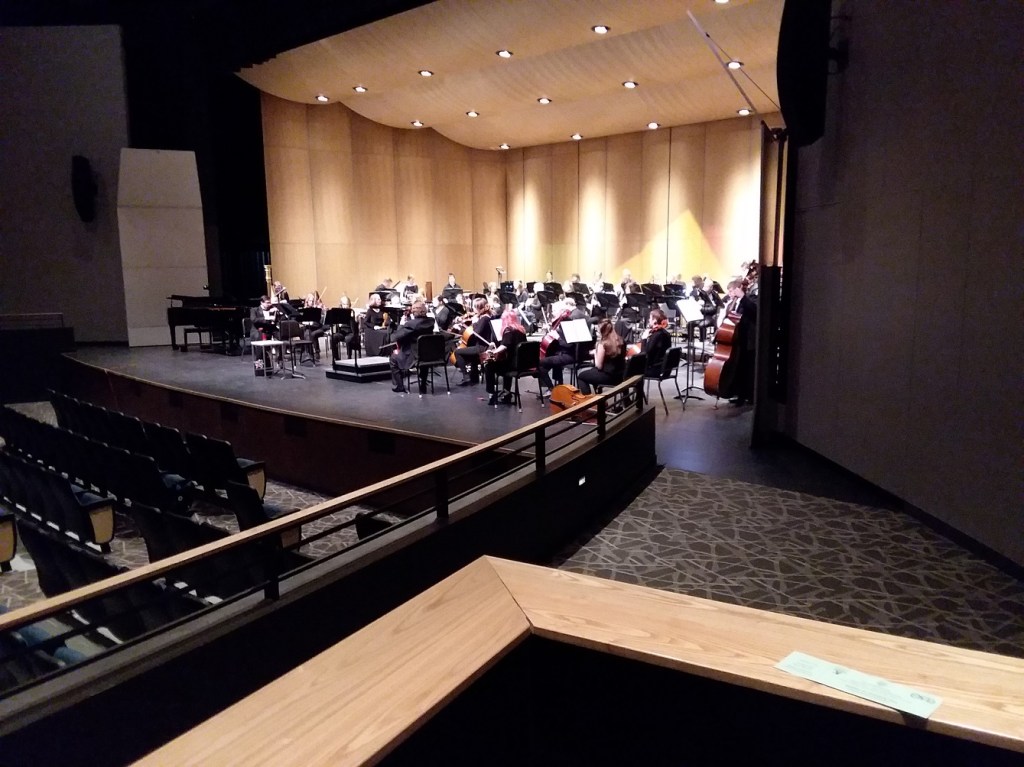
[The Central Lakes Symphony Orchestra, a winter jewel for the area’s non-snowbirds, in the Alexandra Area High School Performing Arts Center . . . ]

March

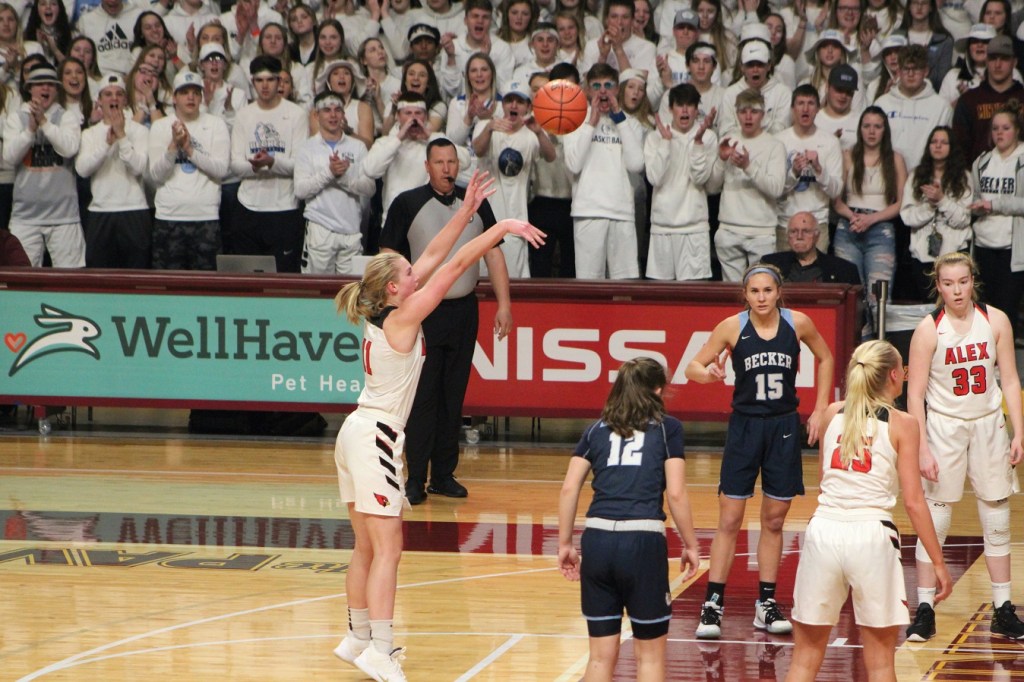
[The Super prefers I not put sports in the Christmas card. But it’s what I do all winter. I am the Cub Reporter and after 40 years I am concerned that I still have not lost the “Cub” portion of the sobriquet. So I keep trying. This is senior Ella Grove (11) and it’s a photo I particularly like . . . ]

[The Ella theme then led us into the COVID theme. This was the state tournament on the campus of the University of Minnesota. Alex played No. 2-ranked Becker in the first round. I liked this photo because Alex was in white, and Ella was shooting a free throw against a backdrop of white clad Becker fans. Alex lost a close game, then won the 1st round of the consolation bracket the next morning, and then everything stopped. This is when the pandemic shut everything down. Ella was nevertheless named to the all tournament team . . . ]

[And the Super and I were at the tournament with high school classmate Kathy Skadsberg. Kathy’s granddaughter played for the No. 1 ranked team in the state, Hopkins. The pandemic cut short Hopkins’ attempt for back-to-back state titles and an undefeated season . . . ]

April

We worked a lot of jigsaw puzzles . . .

May

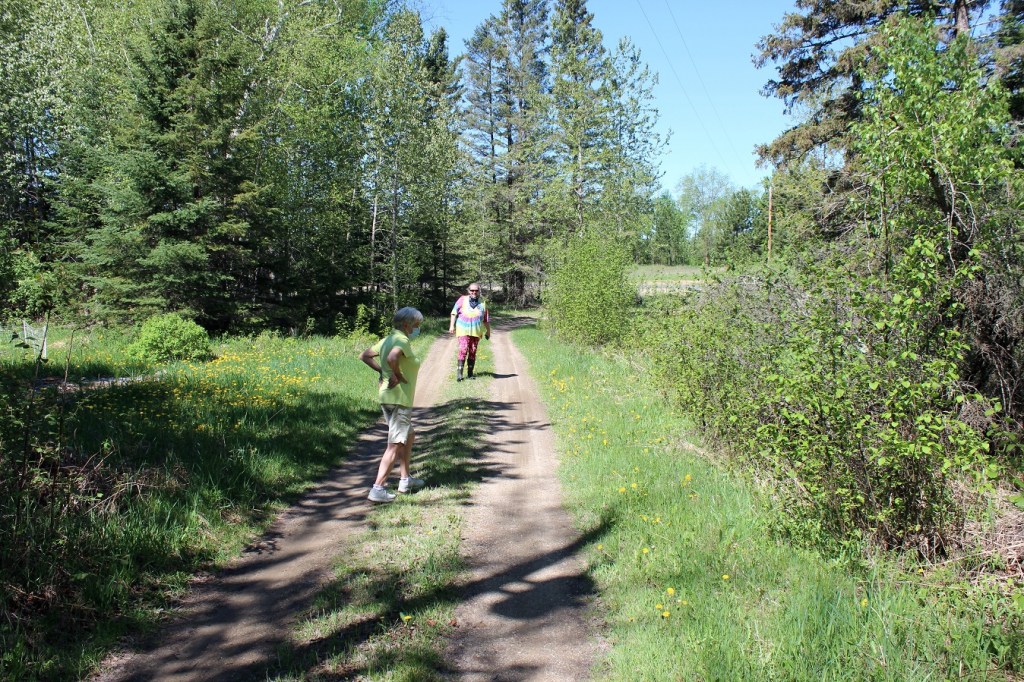
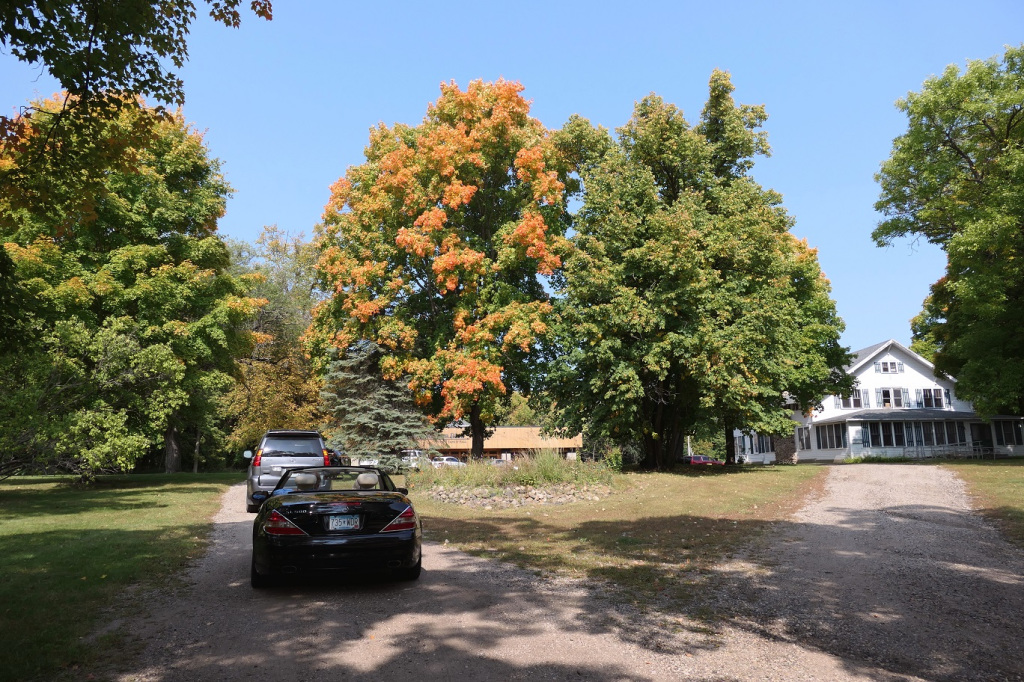
[After two months in lock down, we were getting antsy. We decided on a road trip to see Jami and Danny at The Harn, a 2 1/2-hour drive north. Here’s Ruthie and Jami on The Harn’s quarter mile long driveway. No creatures were harmed in documenting this event . . . ]

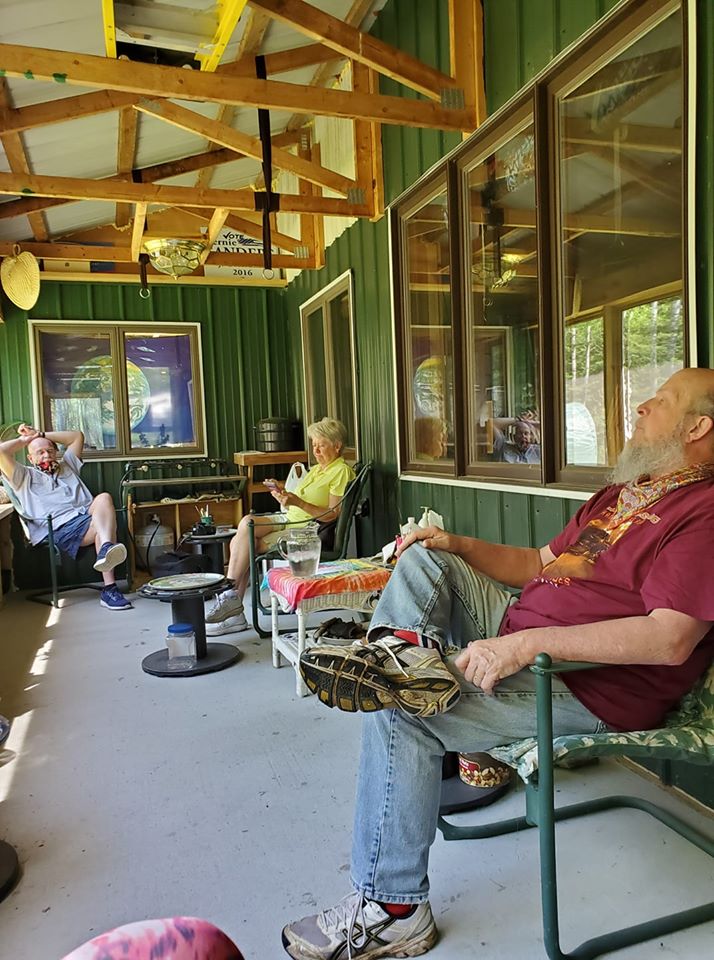
[We visited on their porch, keeping social distancing throughout . . . ]

[The Super “at the center of” Are You an Ally to Black & Brown People?]

June

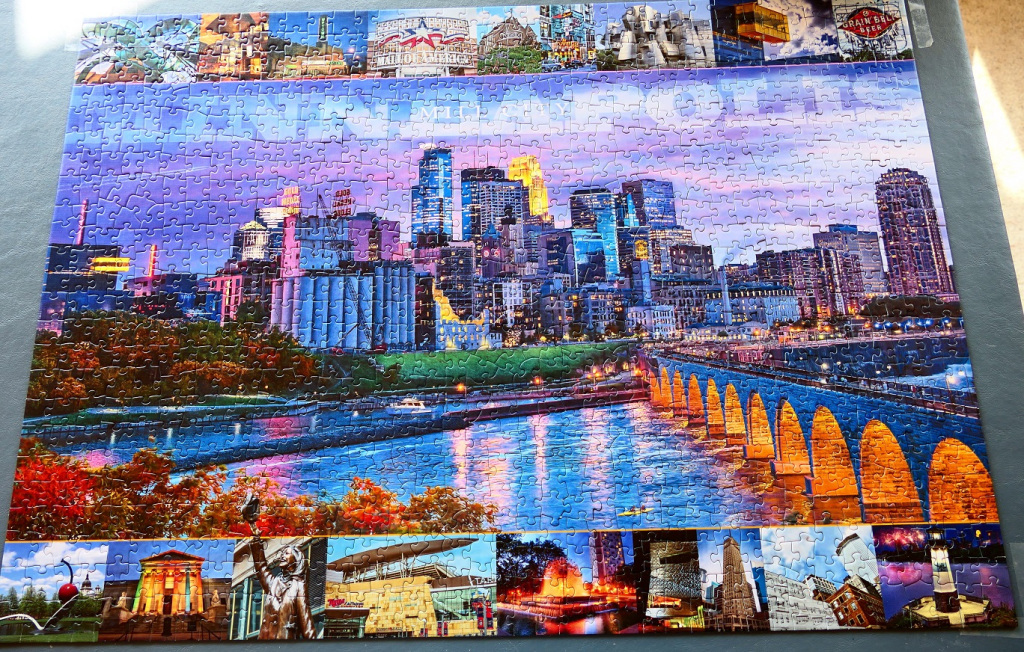
[In the year of the jigsaw puzzle, the Super completed 14 with my occasional assistance. Any further attempts at such projects have been curtailed due to excessive felines on the premises . . . ]

[The Super arrives at the Time for Change rally on the grounds of the old high school. This was all part of the George Floyd aftermath taking place all over the world . . . ]

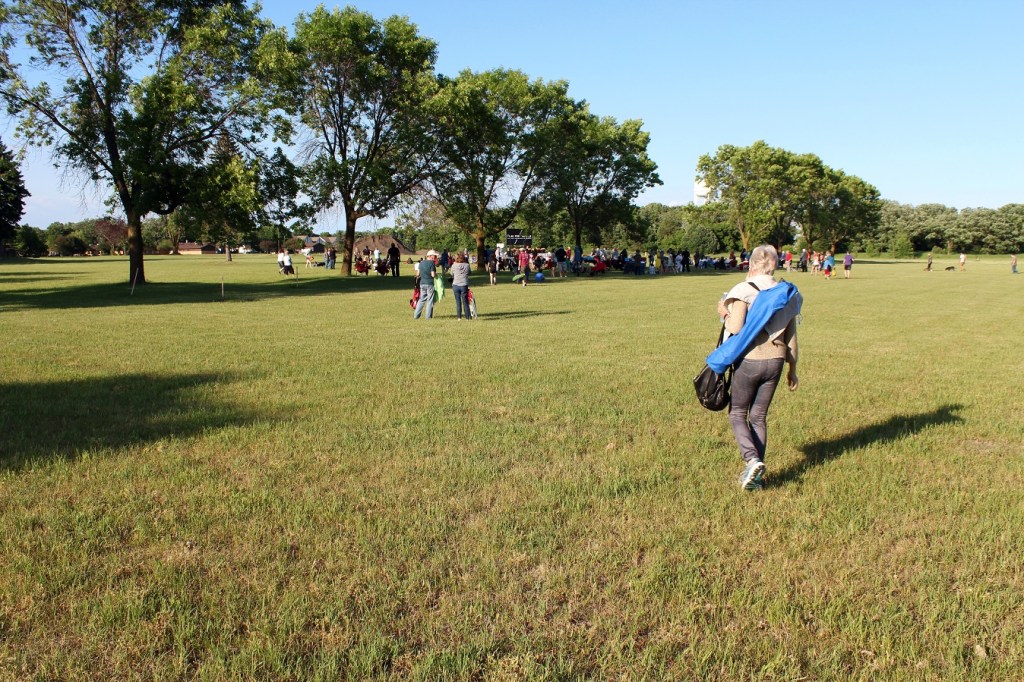
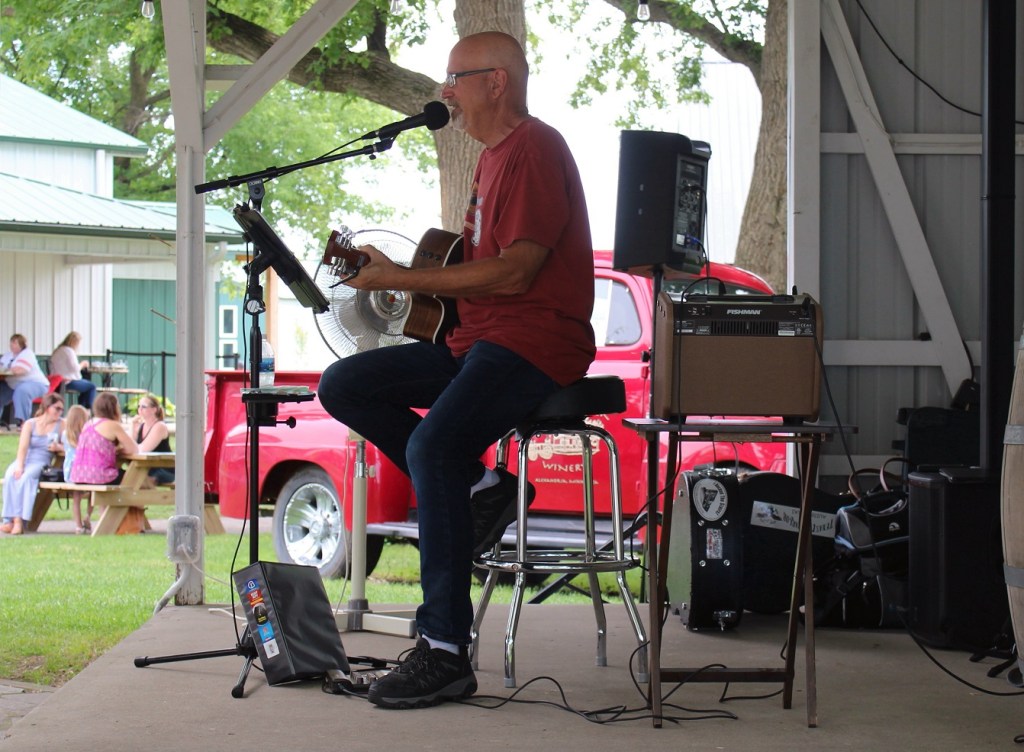
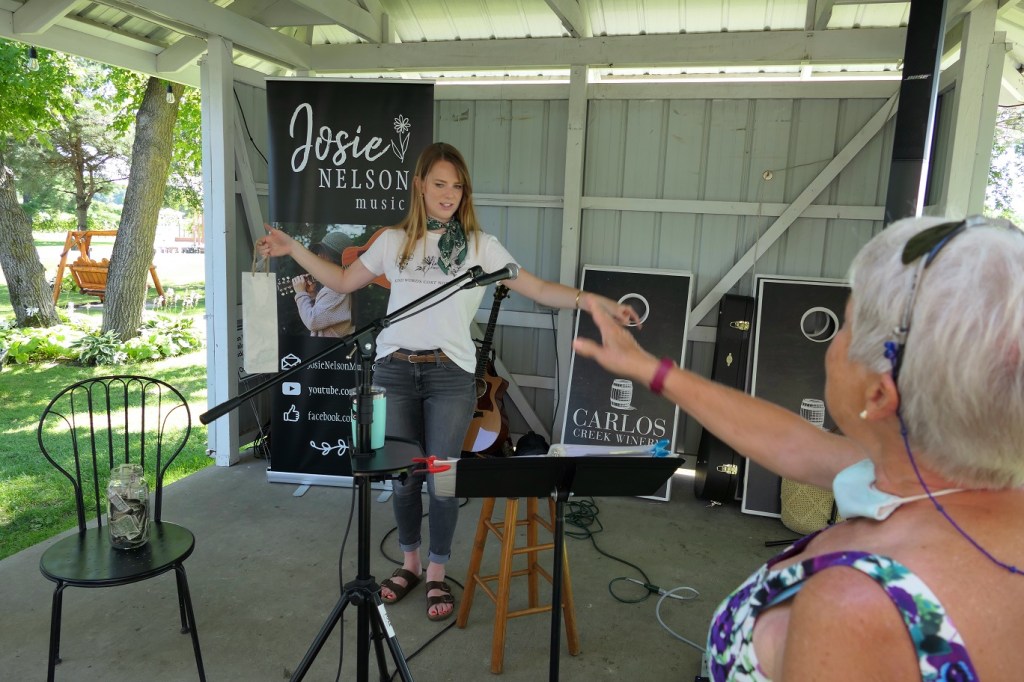
[The regulars at Carlos Creek Winery. We did outdoor music events when we could. In keeping with the traditions of this bizarre year, this was late June and everyone was bundled up . . . ]

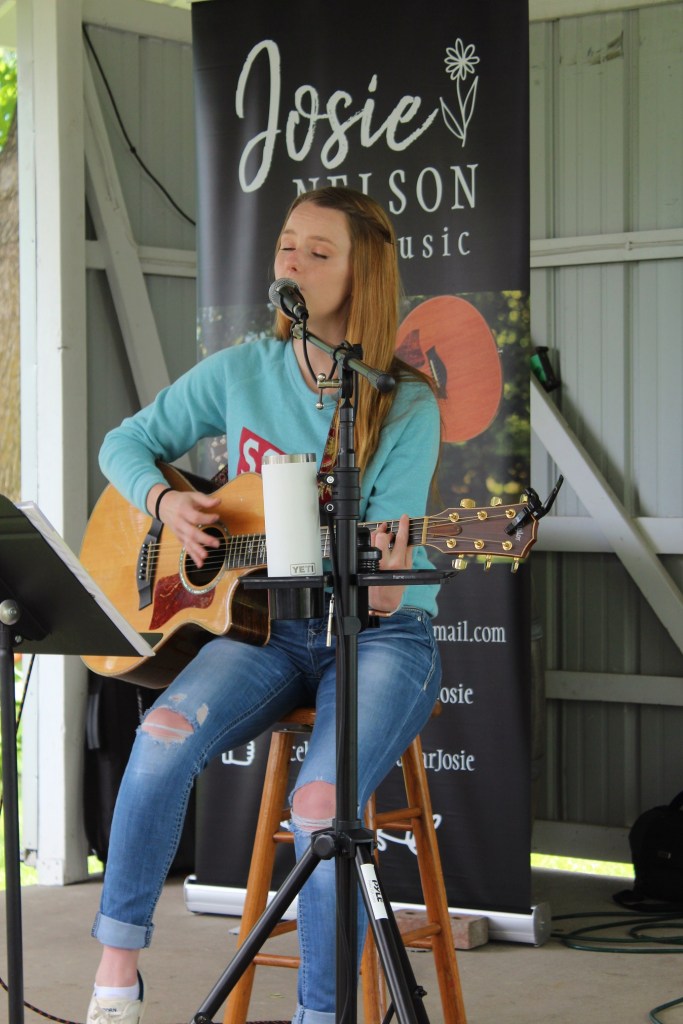
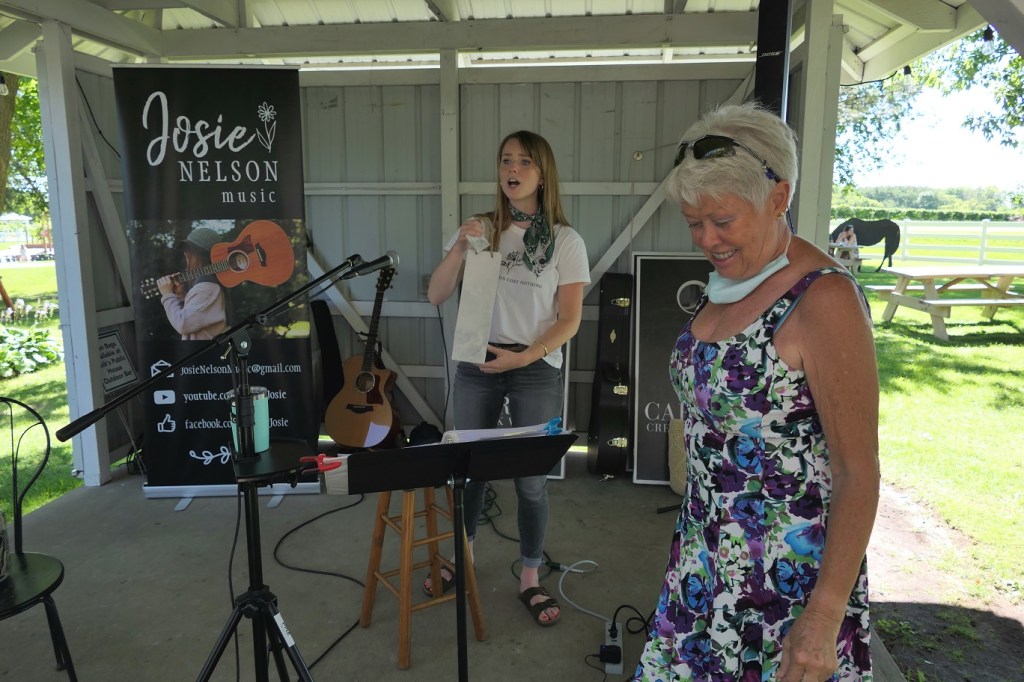
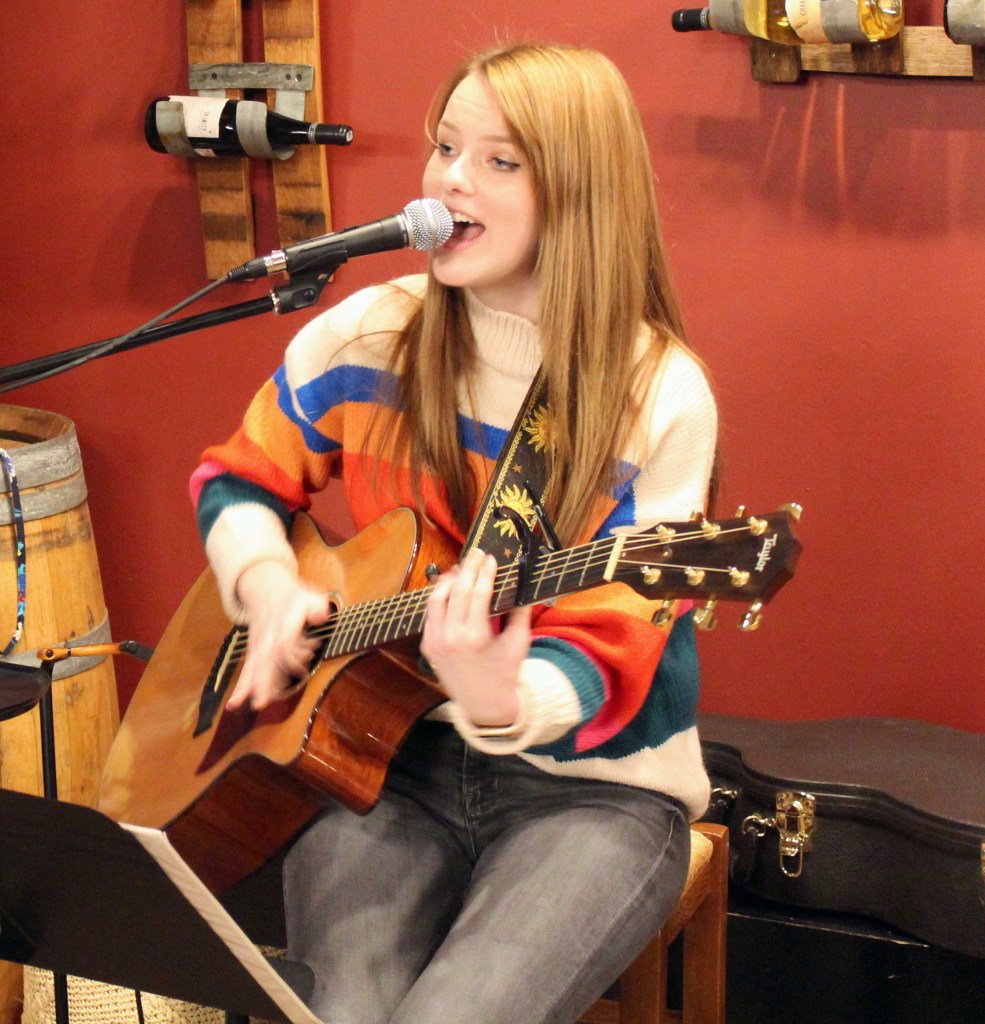
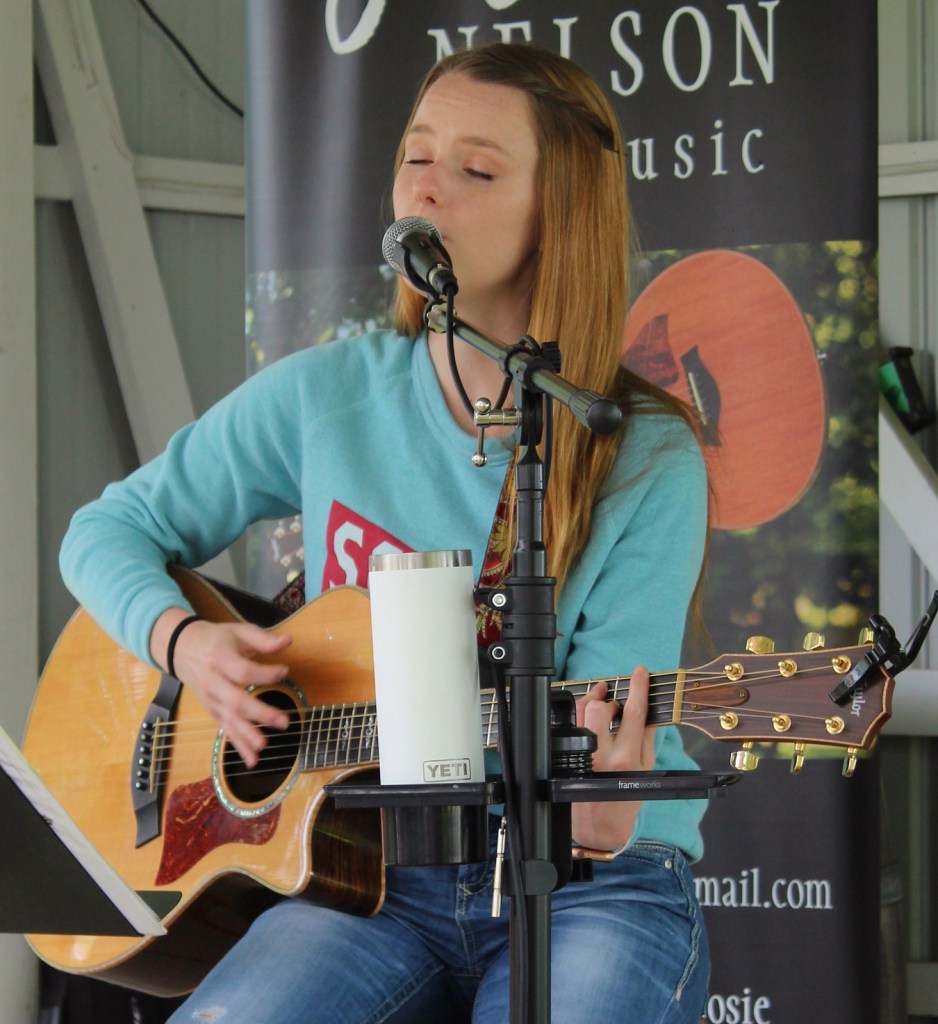
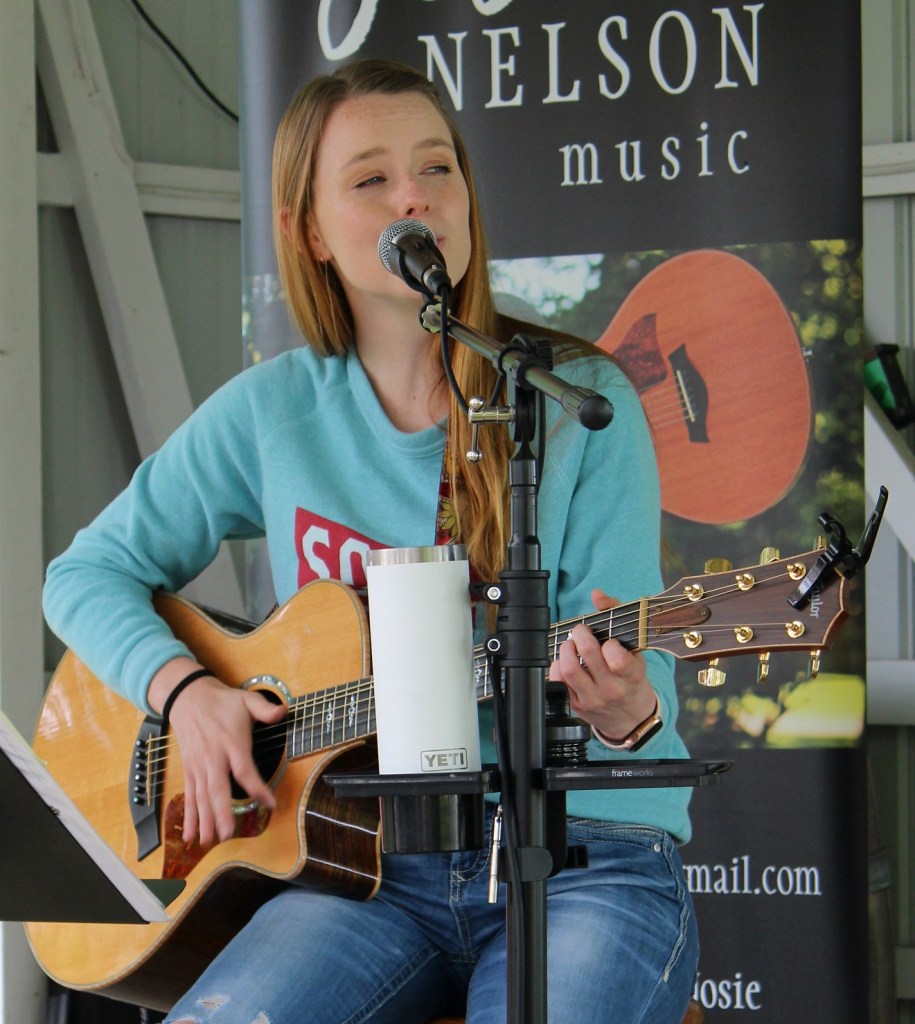
[We were there to see Josie. Editor’s note: Absent the usual Christmas report on the year’s travels, this year’s blogging involved taking trips back to days of yore. I was able to blog a 1997 European trip and a 1983 Japan trip; and a 20-episode posting of the Complete Abridged History of Music in the greater Alexandria metropolitan statistical area. Josie played a major role in the latter . . . ]

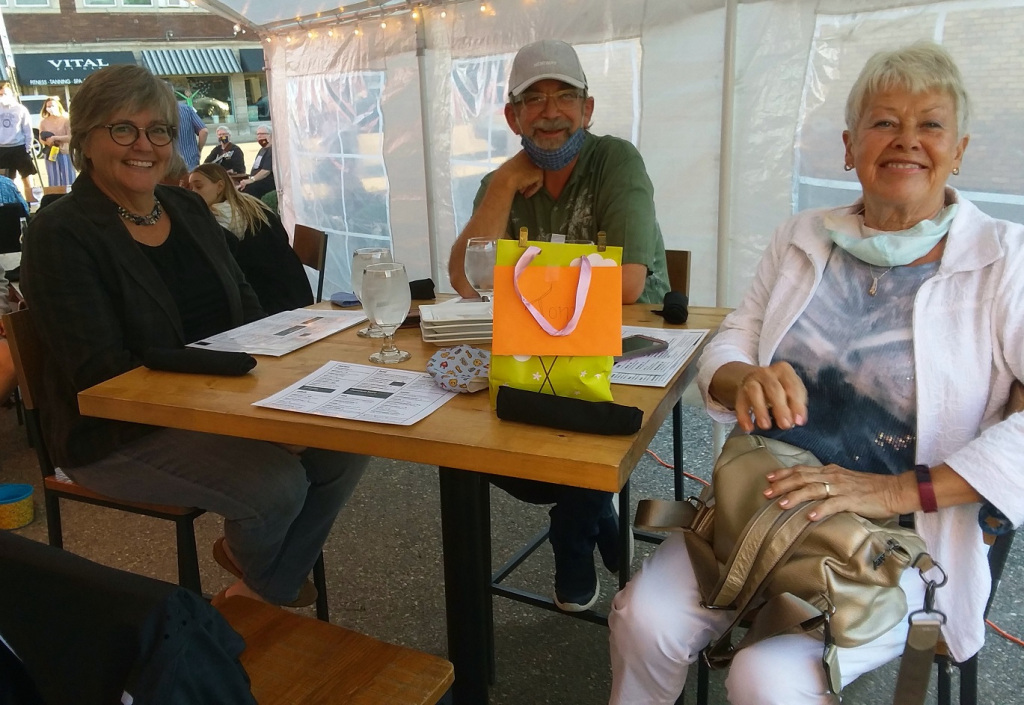
[Outdoor dining every Wednesday at the Alexandria Golf Club with past and current members of the senior men’s league . . . ]

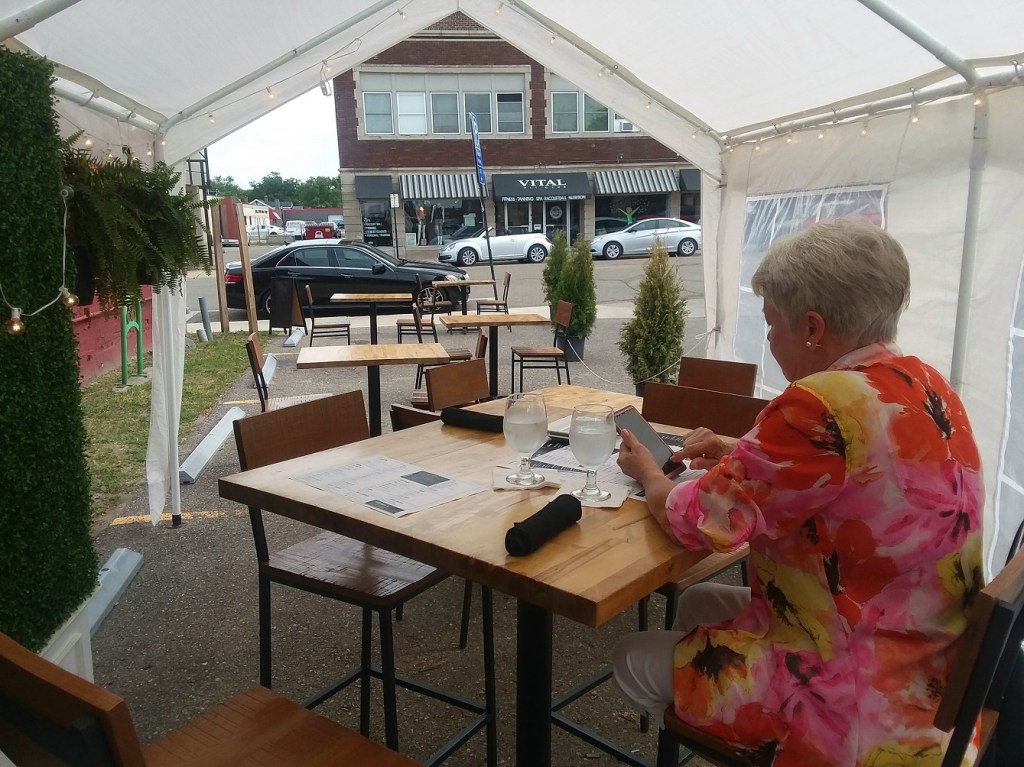
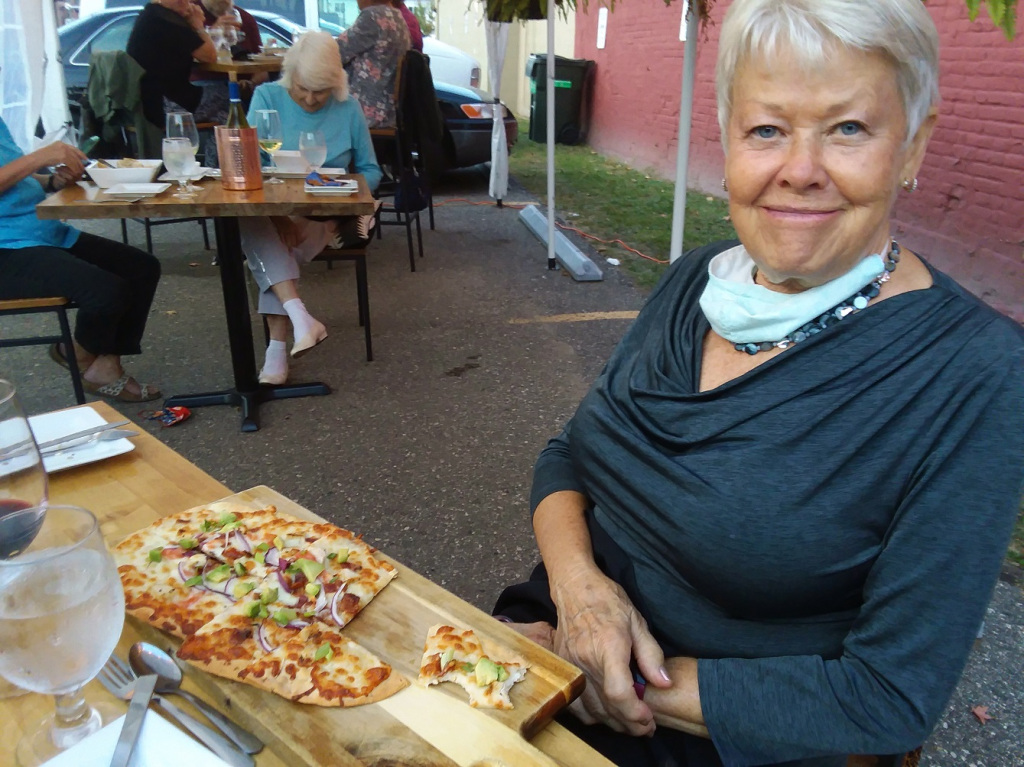
[And downtown outdoor dining whenever we could at the Garden Bar on 6th . . . ]

[That’s the Super’s VW convertible on the far side of 6th as we await fellow diners . . . ]

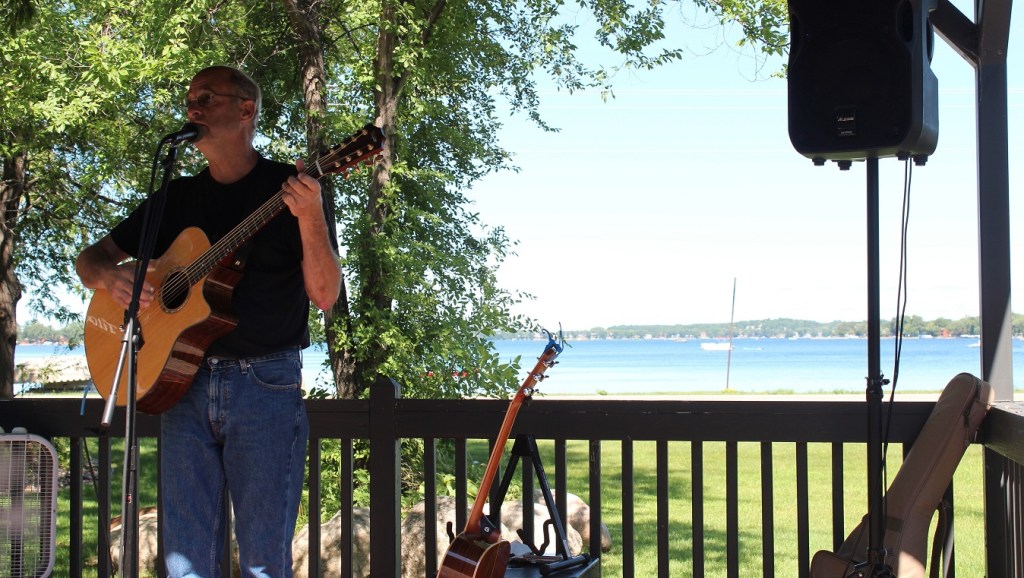
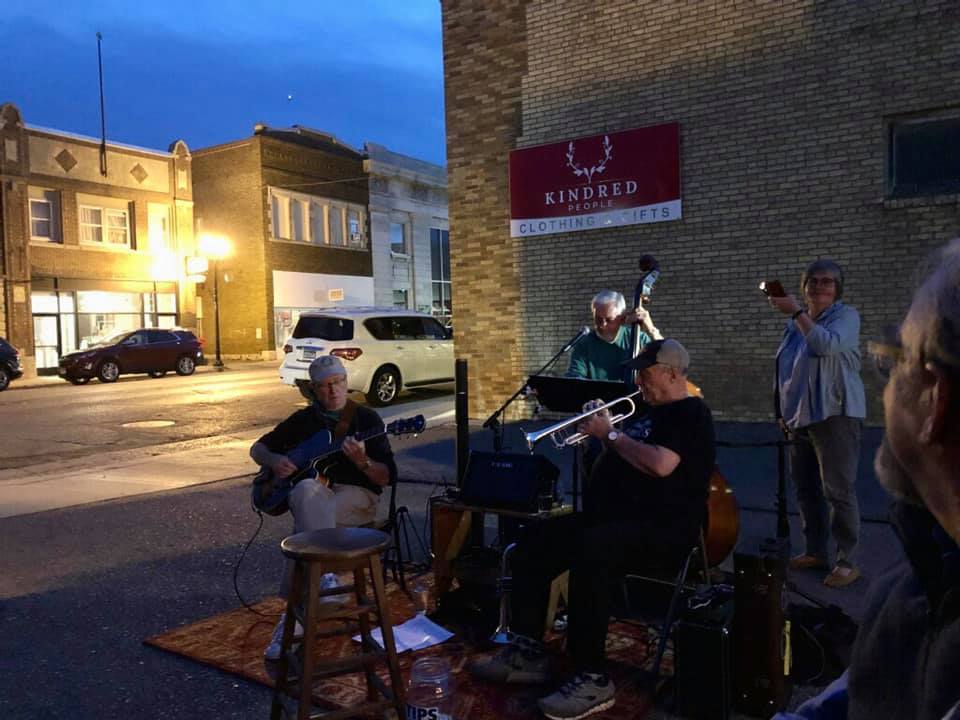
[And music, always music, at the Garden Bar where Terry Kennedy and Bill Riggs entertained us in the alley all summer . . . ]

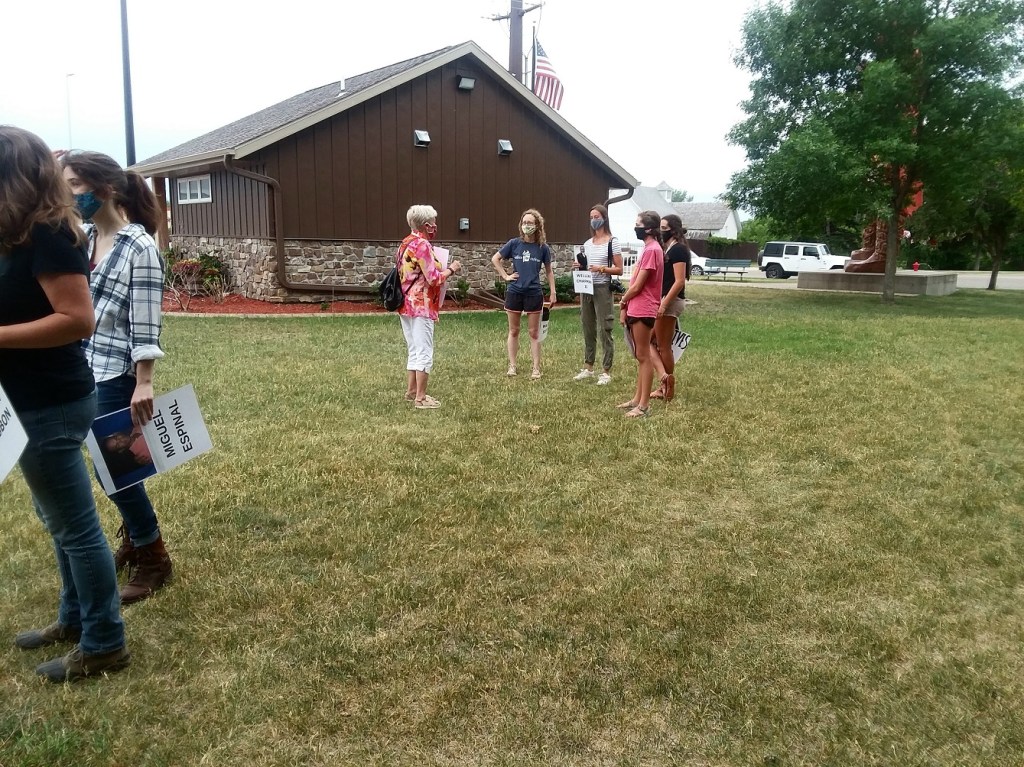
[And then we joined a Change in Motion rally at Big Ole park. Change in Motion, started by two Alexandria college freshmen, is an organization for racial justice. Here the Super is talking with four college students . . . ]

[Say Their Names . . . ]

[And here’s the Super as we lined up along 3rd Avenue . . . ]

[We found ourselves in need of a road trip. The Redhead Creamery in Brooten (pop. 743) was featured on the cover of the University of Minnesota Alumni magazine. It’s a mere 33 miles south of Alex, on roads not heavily traveled . . . ]

[Lookin’ for a ride, big boy?]

[The last miles into the creamery were on dirt roads, again not heavily traveled . . . ]

[We’re here . . . ]

[And enjoying another outdoor dining experience . . . ]

[The Boy Tenor with the Salty Dogs at Carlos Creek Winery . . . ]

July

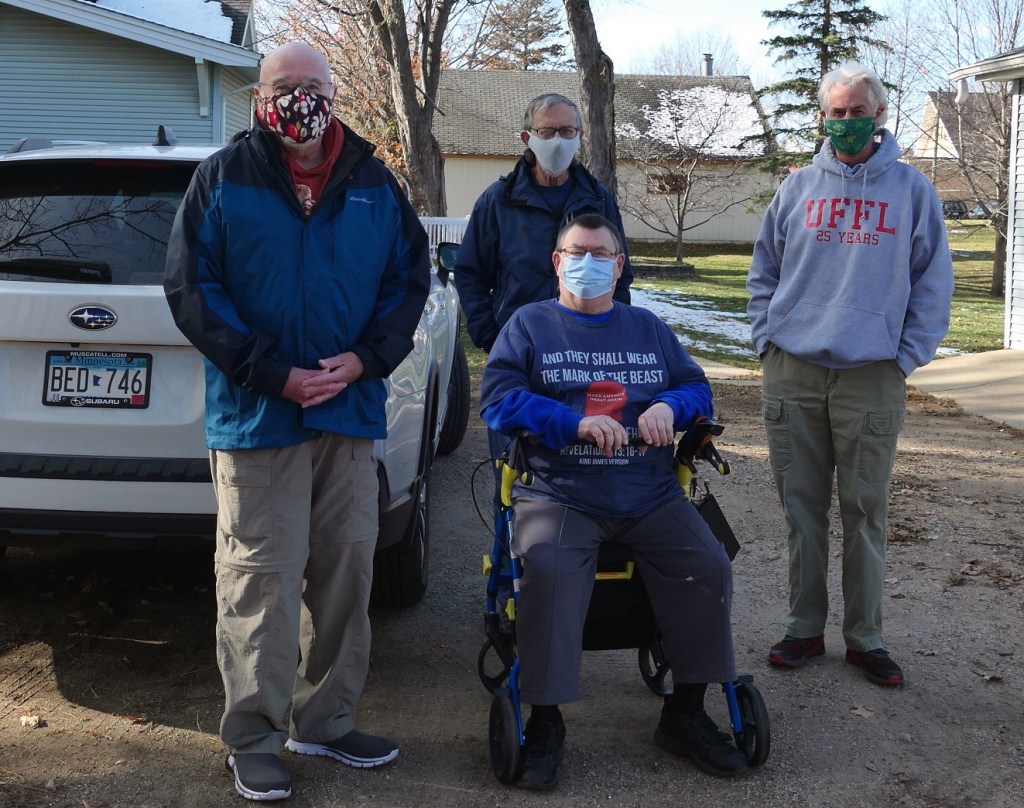
[The Fat Boys Walking Club returning to their parked cars in Big Ole Park. The pandemic required a change of venue to the great outdoors for our daily amblings . . . ]

[Erik Schultz at Carlos Creek Winery. As the pandemic kept becoming a more worrisome issue here in the heartland, the Salty Dogs were reduced to solos by Erik . . . ]

[Winery owner Tami Bredesen checking to make sure all is well for the 4th . . . ]

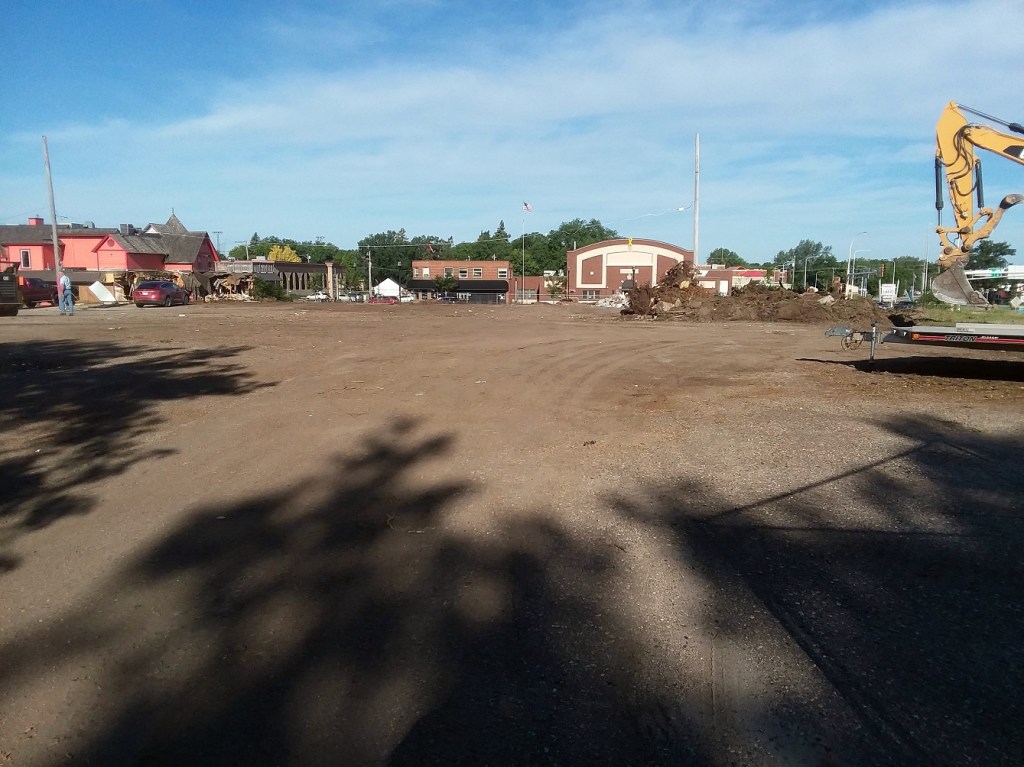
[The entire city block between 3rd & 4th on Broadway was razed in preparation for the Rune, a 4-story multi-purpose building scheduled for a 2022 completion . . . ]

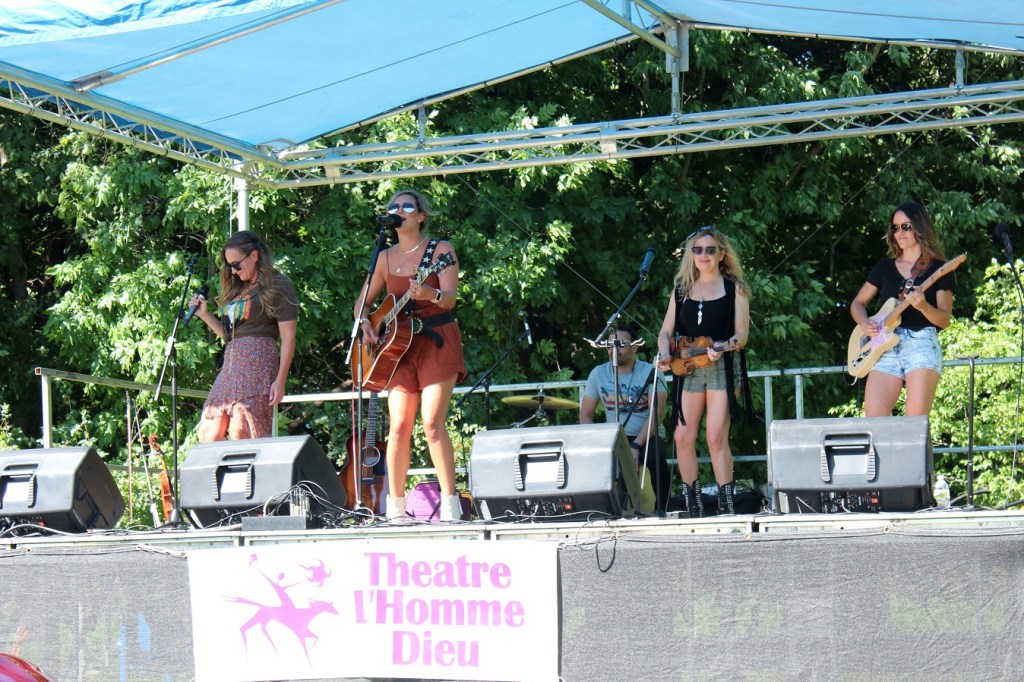
[Theatre L’Homme Dieu was on the cutting edge of keeping live entertainment alive during the pandemic. On July 15, Farewell Angelina performed our first outdoor concert of the year. This national group was delighted to perform before an audience for the first time in months . . . ]

[They were great!!]

I know Samantha Bee, and I know she’s not a racist or anything. ~ Carl Reiner

[Anthony Miltich at Lure Lakebar overlooking Lake Le Homme Dieu. Anthony was also prominently featured in A Complete Abridged History of Music . . . ]

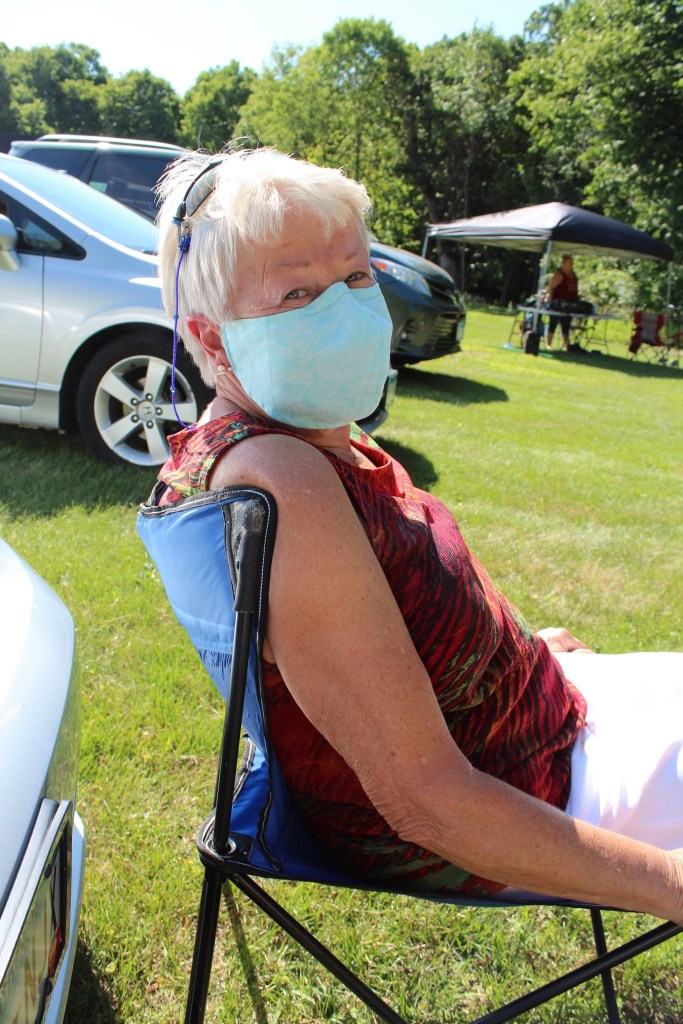
[These two featured masks made by the Super as we dined outdoors at Interlachen prior to the next outdoor event at Theatre L’Homme Dieu . . . ]

[A panoramic photo from the concert stage at Theatre L’Homme Dieu . . . ]

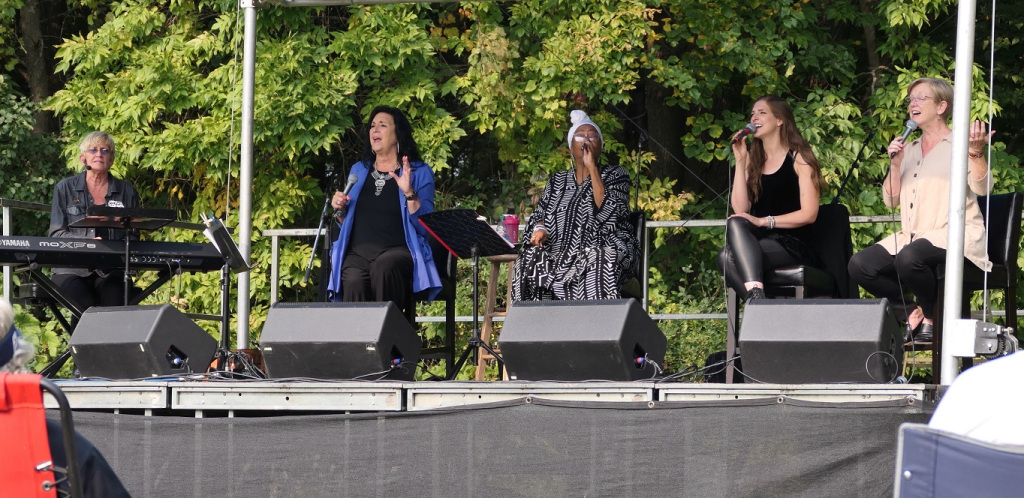
[The cast of Love at a Distance, featuring opera and show tunes . . . ]

August

[The Super sitting behind the 9th green at the Resorters Golf Tournament at the Alexandria Golf Club. This was the first time in years we were able to attend. In “normal” years we spend the 1st week in August at the Indiana University Alumni Camp in Elkhart Lake, Wisconsin . . . ]

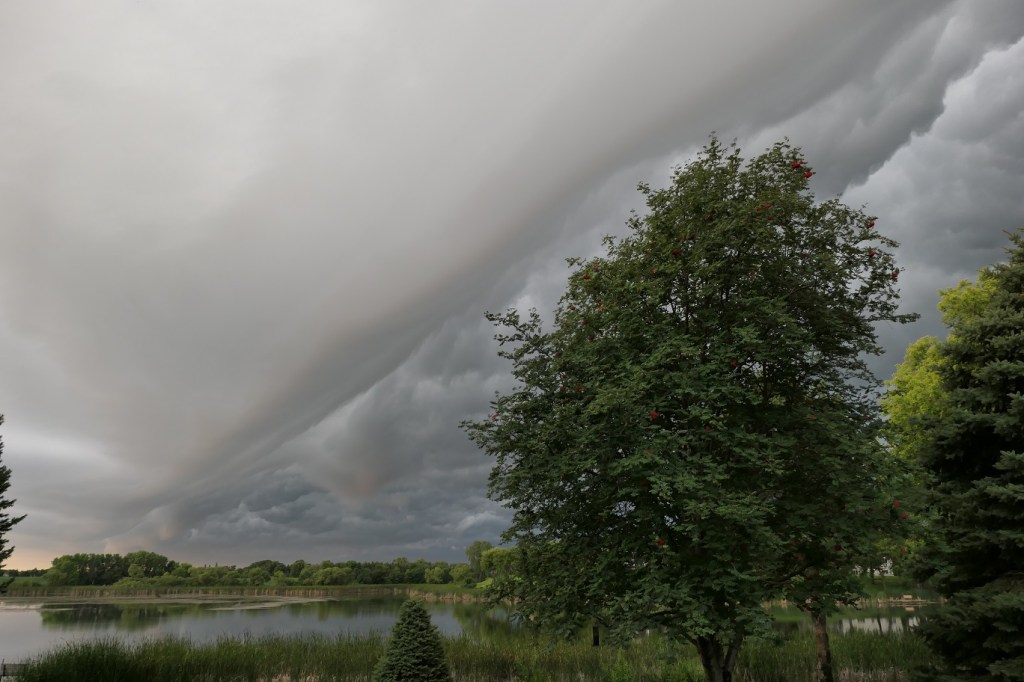
[The sky over Lake H2Obert on August 12; two days later the Super and I went to our 10×10 basement shelter for the first time in 19 years . . . ]

The one thing women don’t want to find in their stockings on Christmas morning is their husband. ~ Joan Rivers

You want to do what you can while you are on this earth. Otherwise, the alternative is to go shopping. ~ Saul Landau

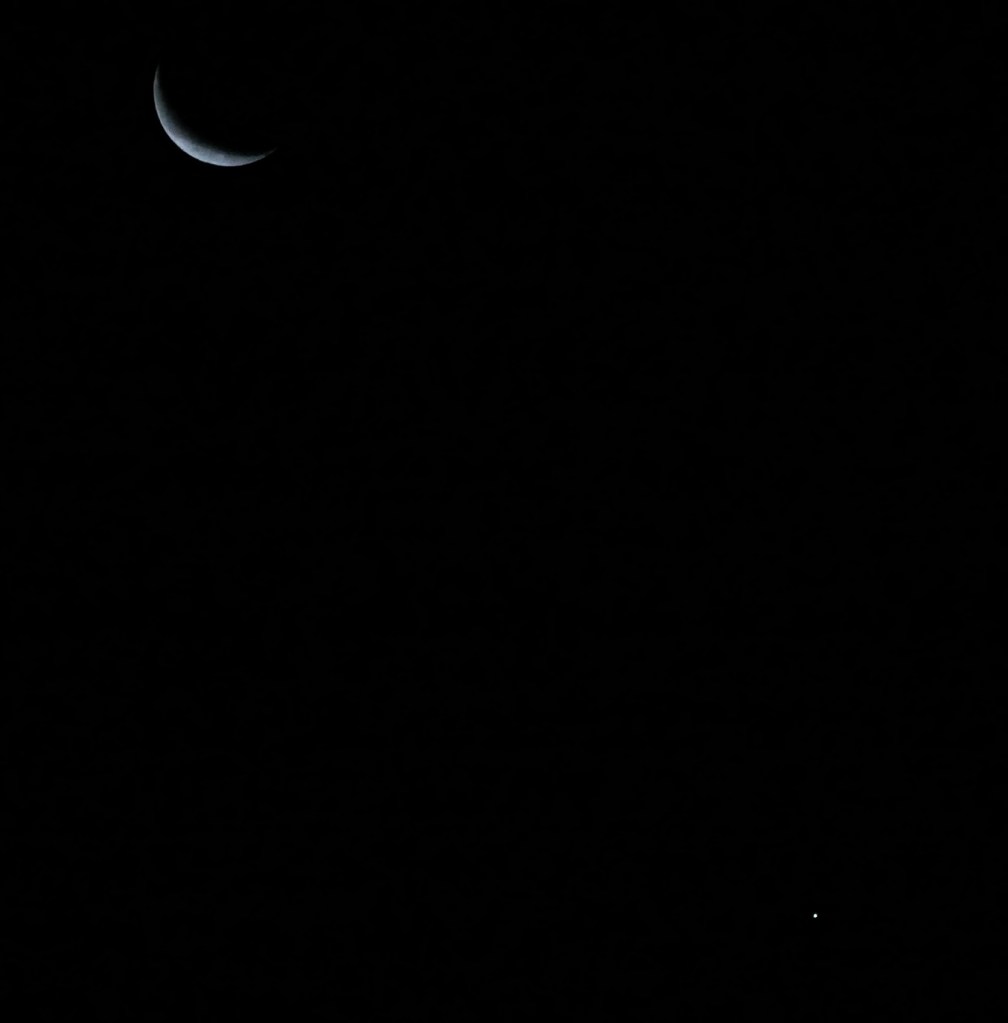
[That is indeed the moon and Venus on August 15 . . . ]

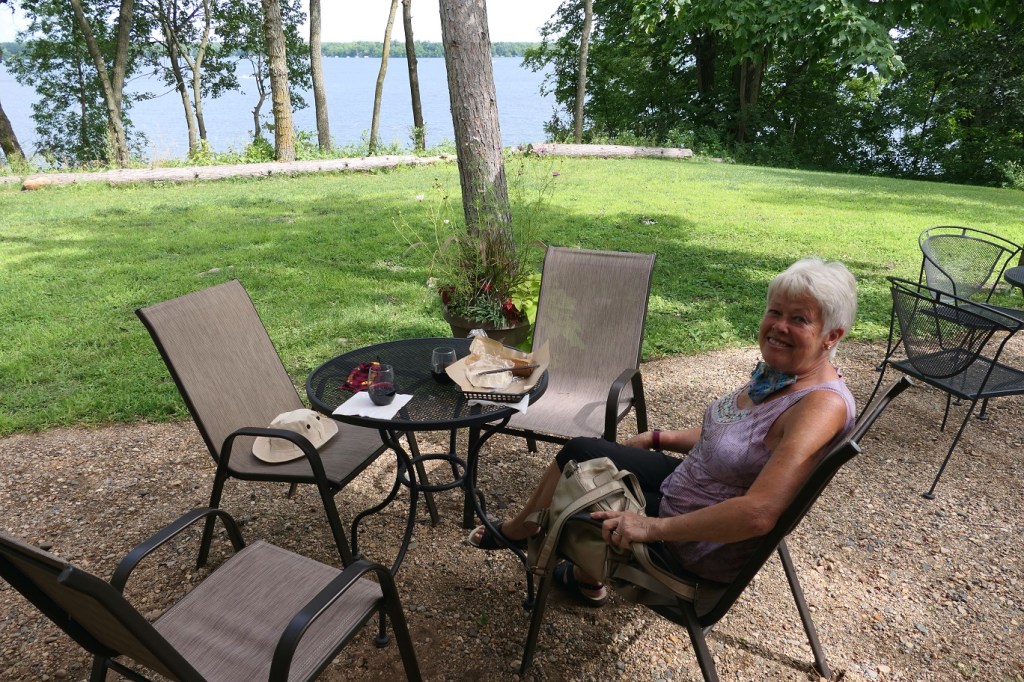
[On the grounds of L’Etoile du Nord winery (16 miles north of Alex) overlooking Lake Irene . . . ]

OMG!!

[Josie turned 21 this year . . . ]

[We thought a bottle of Carlos Creek wine an appropriate present since she has been performing here for 10 years . . . ]

[We call it our Wednesday night “fine dining” at the golf club. This is a commercial (the name of the entree, with fire-roasted corn) . . . ]

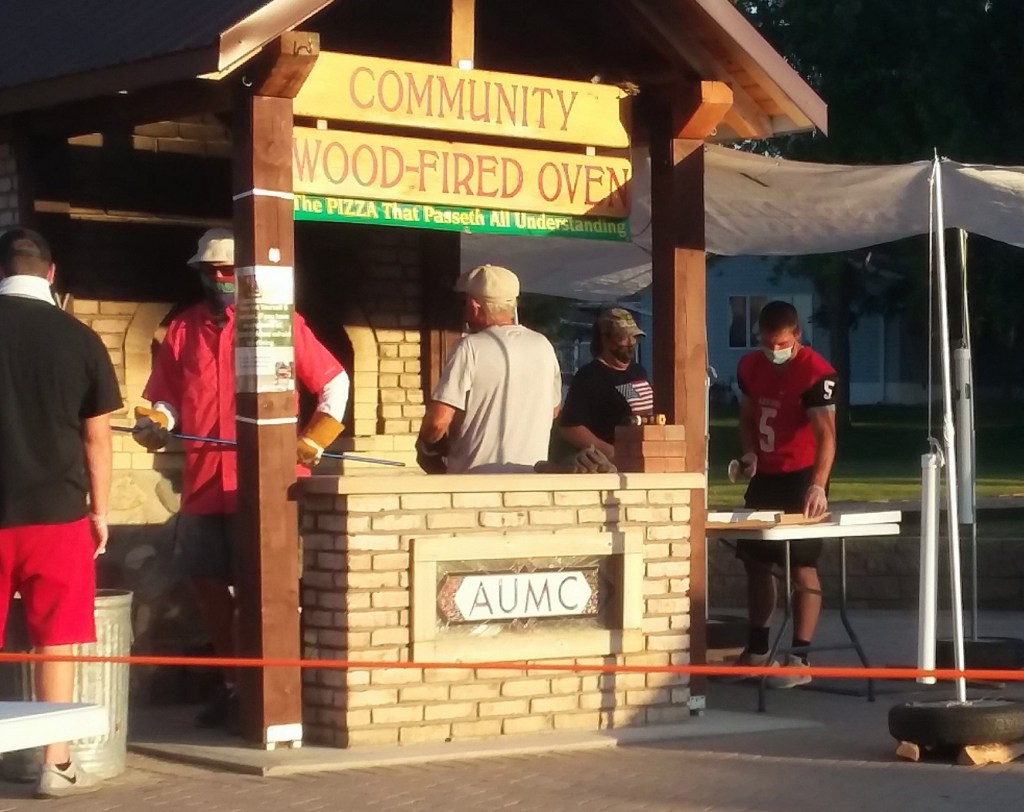
[Wednesday fine golf club dining conflicted with pizza night at the Methodist church wood-fired pizza oven. We often ate first at the golf club, then went to church and got a take home pizza for the next night. The Cardinal No. 5 helping in the background is Alexandria football’s all-time leading rusher . . . ]

[The Super heads to the next outdoor event at Theatre L’Homme Dieu . . . ]

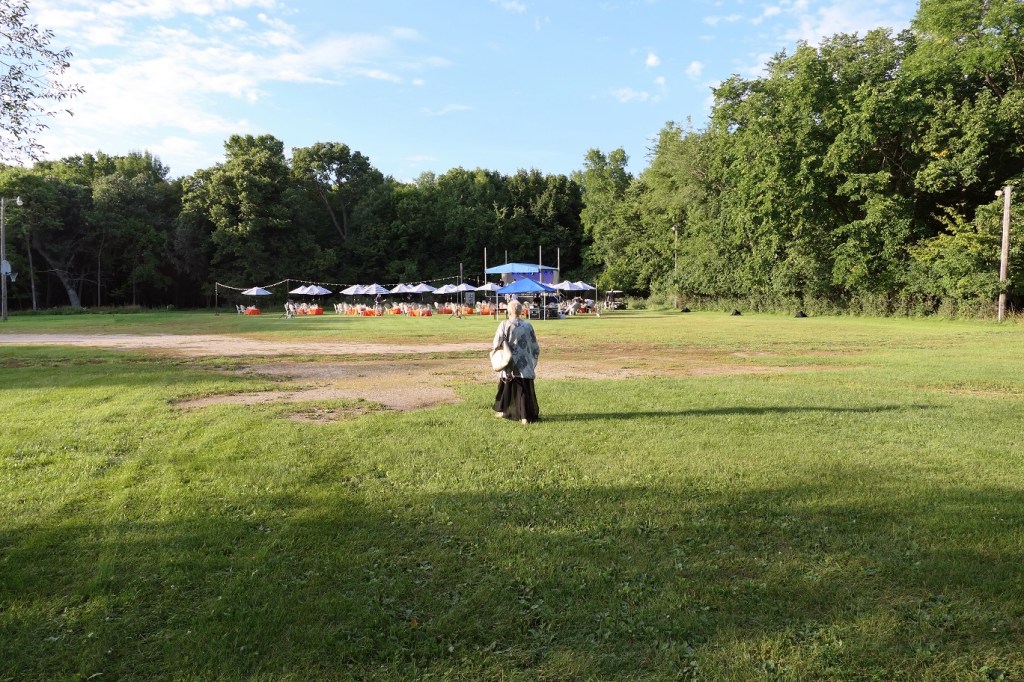
[A panorama shot of the attendees . . . ]

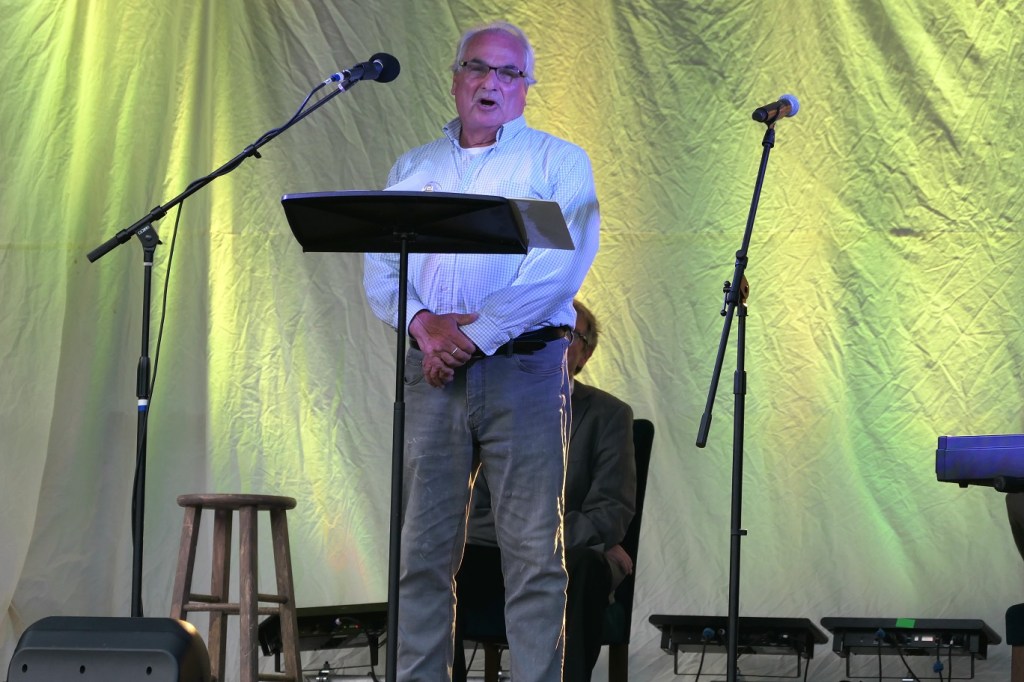
[An evening with Kevin Kling, Minnesota’s storyteller . . . ]

[And it doubled as the theatre’s annual fundraiser . . . ]

[And a bit of TLHD history from Jack Reuler. In his spare time, Jack is also founder and artistic director of Mixed Blood Theatre in Minneapolis . . . ]

Heavenly shades of night are falling, It’s twilight time . . . ~ The Platters

Freedom means the freedom not to get infected by the idiot who refuses to mask up. Even John Stuart Mill would have agreed. ~ Michael Tomasky

September

[The Fat Boys Walking Club, a/k/a, Carol Wenner’s outdoor campaign staff for the Minnesota House of Representatives . . . ]

[And, of course, the Fat Boys gained international recognition when the local newspaper ran a full page story on us on September 8 . . . ]

[Happy Birthday to me! The Super brought birthday cupcakes to Wednesday night fine dining . . . ]

[And then birthday dinner with Deb and Paul at the Garden Bar . . . ]

[In the year of the jigsaw puzzle, the Super built Minneapolis . . . ]

[The year’s final event at Theatre L’Homme Dieu . . . ]

[The panorama shot from the stage . . . ]

[Our fearless leader, executive director, Nicole Mulder, was a bit overcome as she was able to give us a partial season under extraordinary circumstances . . . ]

[I Am Woman, Hear Me Roar . . . ]

Then and now, my model is audiences coming together to fight racism. ~ Jack Reuler

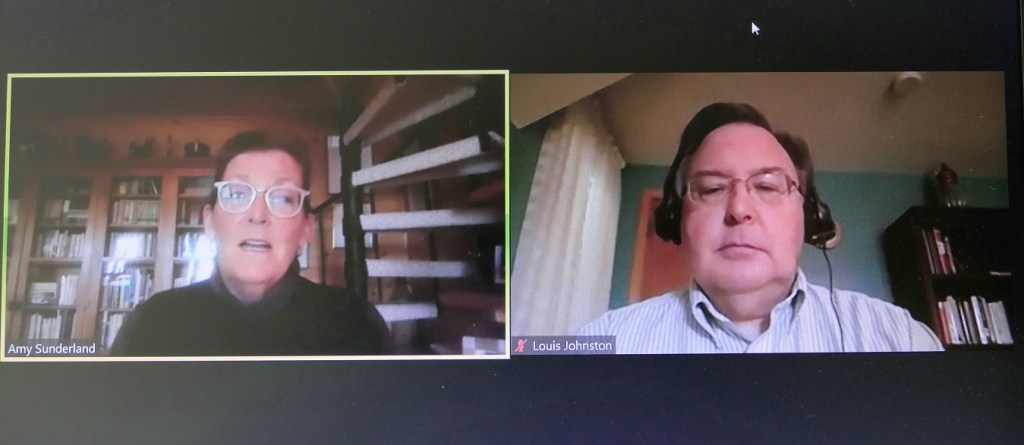
[Senior College had to go virtual this year. Rather than 225 mature students in an Alexandria Technical & Community College auditorium, we ZOOMED. Here Amy Sunderland, senior college director, and Louis Johnston, a favorite and regular lecturer as a St. John’s/St. Ben’s economics professor . . . ]

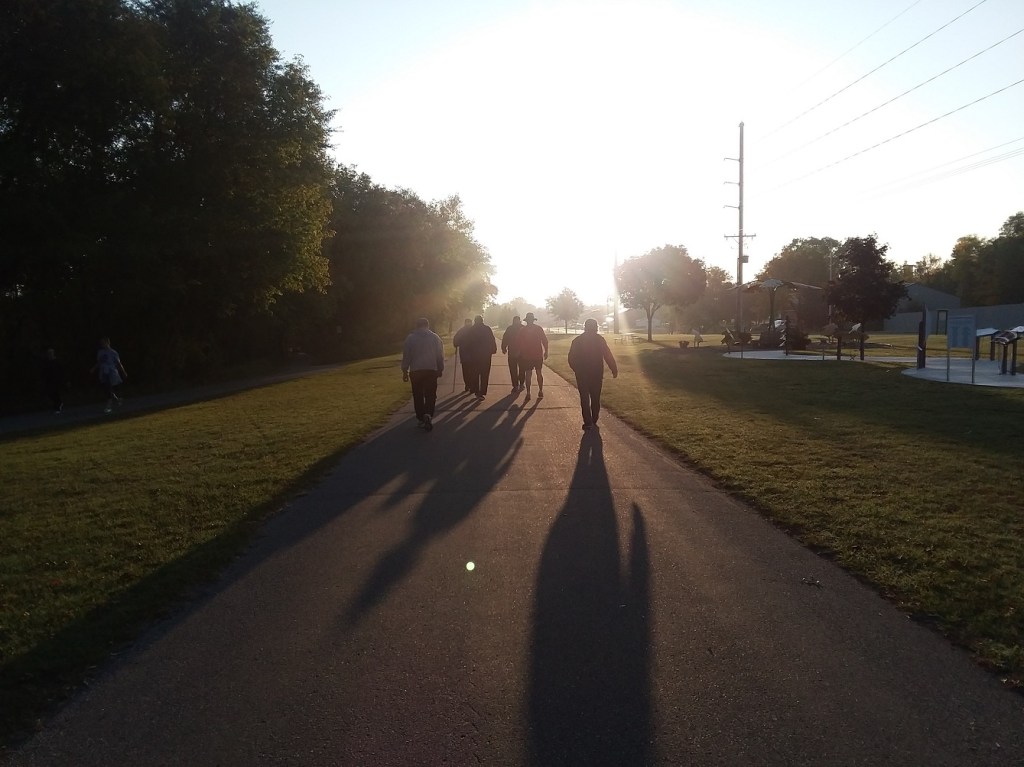
[The Fat Boys ambling off into sunrise on the Central Lakes Trail . . . ]

[A tall, thin stranger oft visited our dock on Lake H2Obert . . . ]

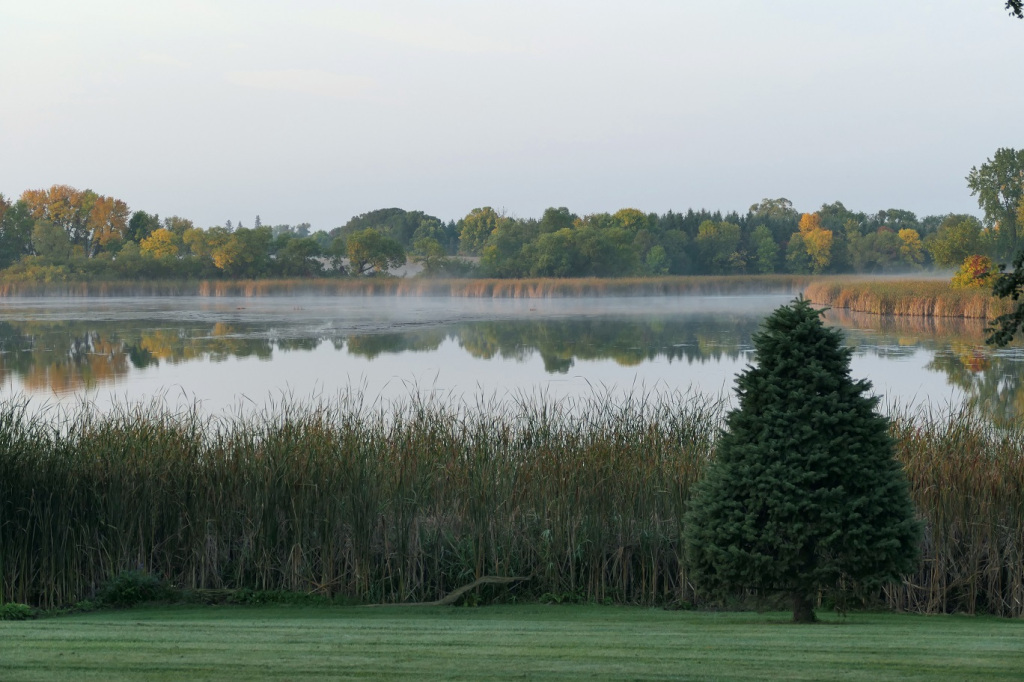
[A hint of a change of seasons is in the air . . . ]

[As an unofficial good-bye to summer, we visited Crazy Dave and Mary on Lake Darling before they snowbird off to Sarasota . . . ]

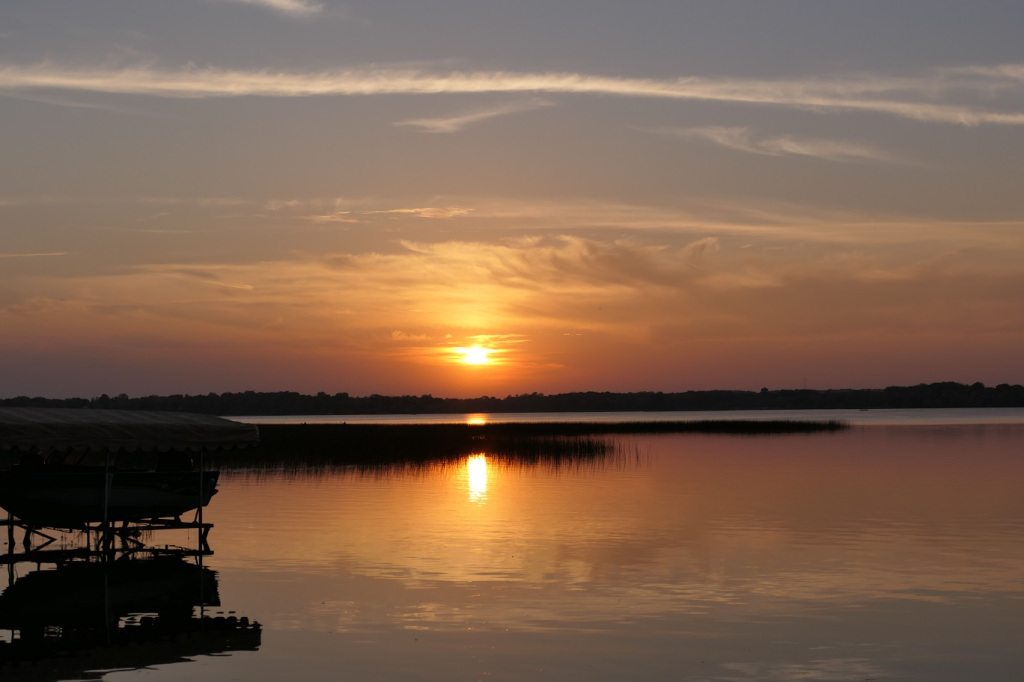
[Nothing like a fall sunset over a Minnesota lake . . . ]

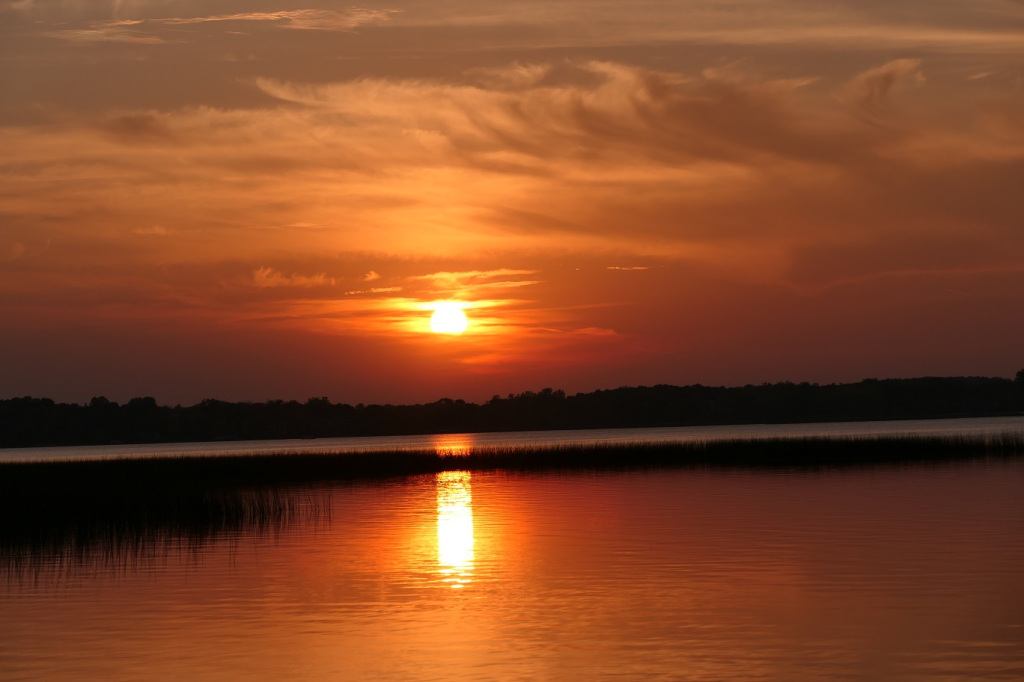
[From the sunset vantage point . . . ]

[And a feeling we’re getting close to the end of the outdoor dining season at the Garden Bar . . . ]

[And the Tuesday Night Club boys are still playing us through dinner . . . ]

[The Fat Boys Walking Club trail reflects the changing seasons . . . ]

The margin is narrow, but the responsibility is clear. ~ John F. Kennedy

[Wrapping up the outdoor music season with Anthony at Carlos Creek Winery . . . ]

October

[And then on October 3, our lives changed forever – for the rest of our lives. We adopted two-month old brother and sister from the Humane Society in Golden Valley . . . ]

[And here they are: Gallahad, on top, and Guinevere. The “babies” were an absolute necessity for our emotional distractions and unrequited feelings of wanderlust . . . ]

[Trying, with little effort, to be cute . . . ]

[Trying, with a great deal of effort, to be cute . . . ]

[Not only was the annual turkey day at Basketball Dan’s cancelled this year . . . ]

[But Sid died at age 100 . . . ]

[The Fat Boys not quite as lovely as their surroundings . . . ]

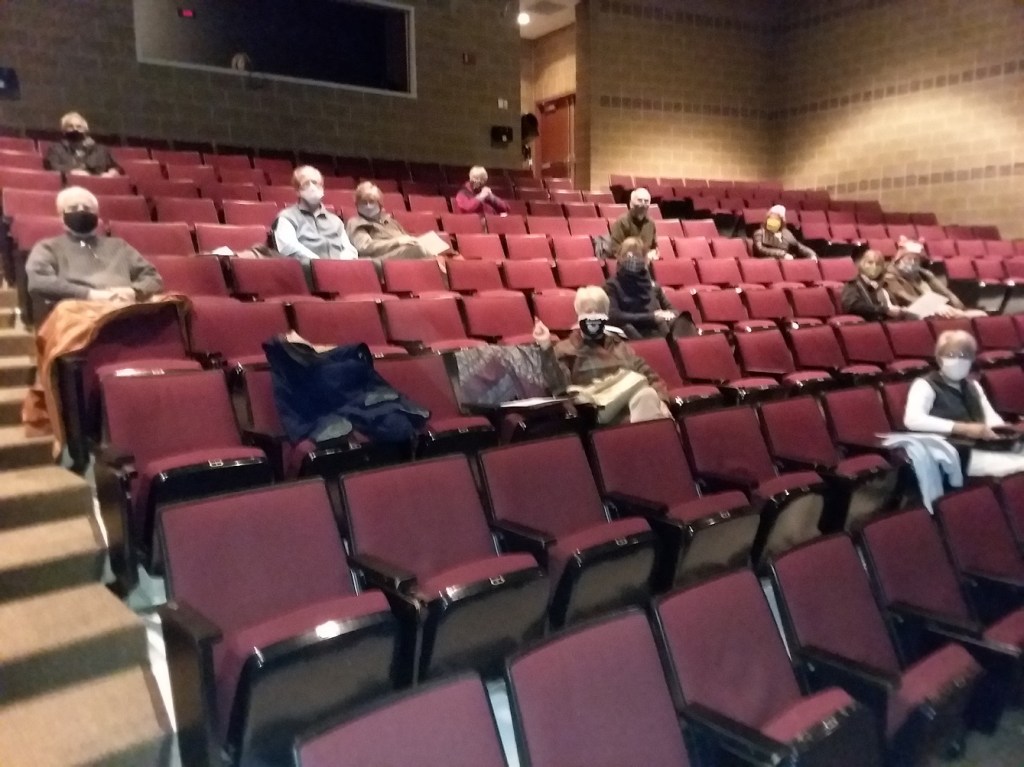
[We tried to maintain Community Education movie nights, but we eventually had to throw in the towel. We had to change the venue from Grand Arbor (senior housing) for COVID reasons to the auditorium at the middle school. We were nicely spaced but we all got too nervous after a couple of movies . . . ]

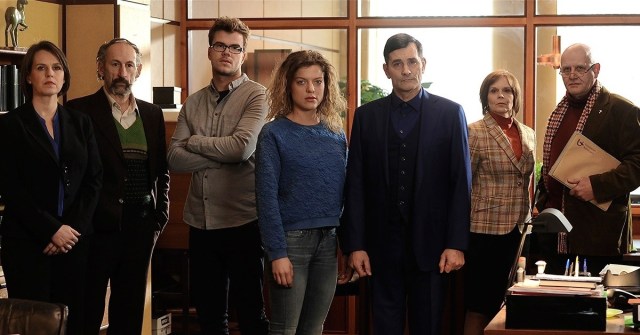
[Absent our movies, we have to rely on Professor T. to carry us through the quarantine . . . ]

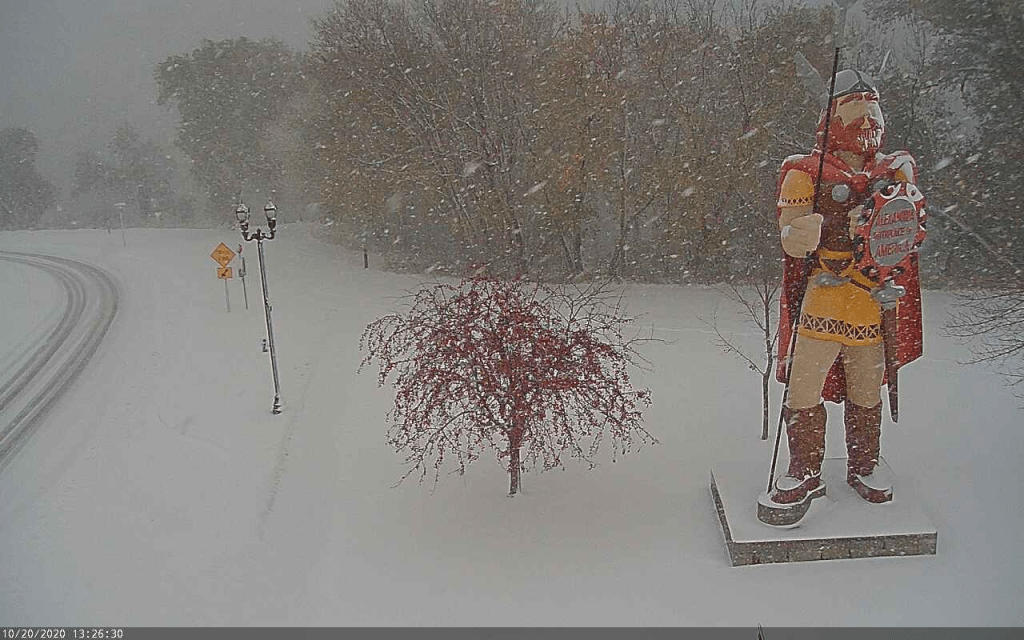
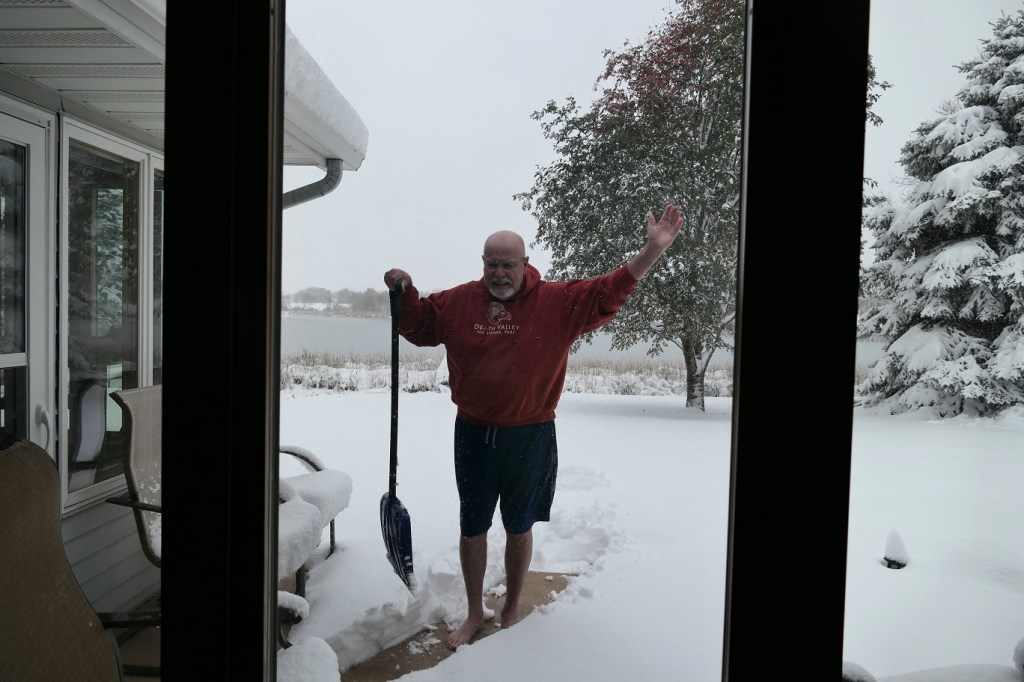
[This was October 20, and it actually happened again a couple more times. It’s hard to believe now in the first week of December we have no snow on the ground . . . ]

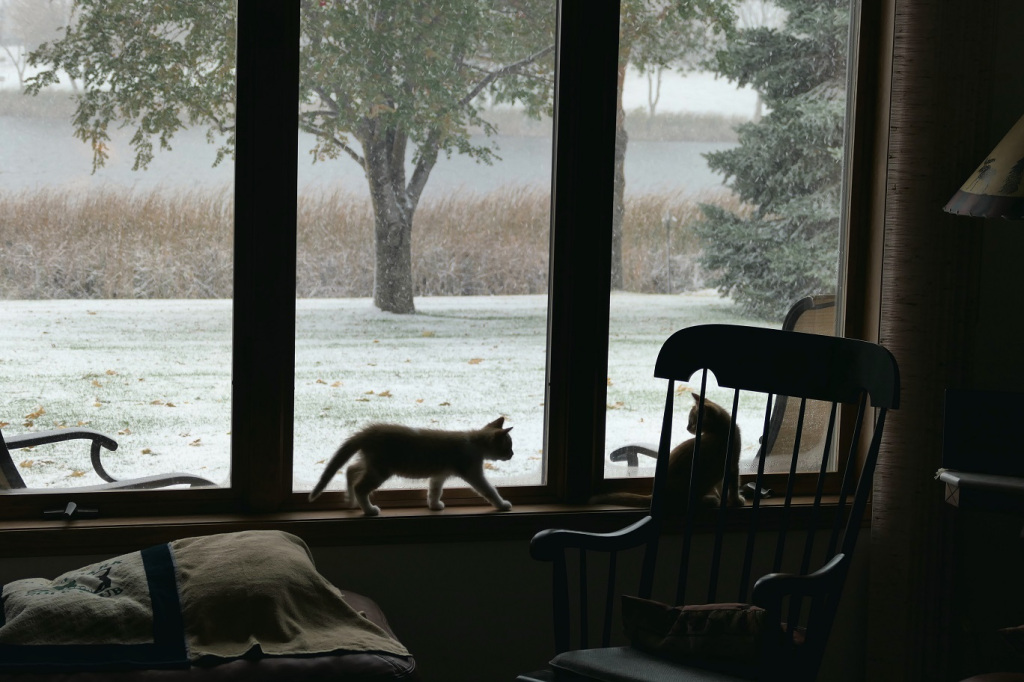
[The kitties first snow . . . ]

It doesn’t matter what is true, it only matters what people believe is true. ~ Paul Watson

[Shoes? I don’t need no stinking shoes!]

November

[The Boys of ’65 continued monthly lunches when possible. All four of us made the lunch on November 2 when Tom Kiehne came up from Austin, Texas (to join Brad Anderson, Greg Johnson, and me), for his dad’s, Merill, 99th birthday. We’re looking forward to his 100th next year . . . ]

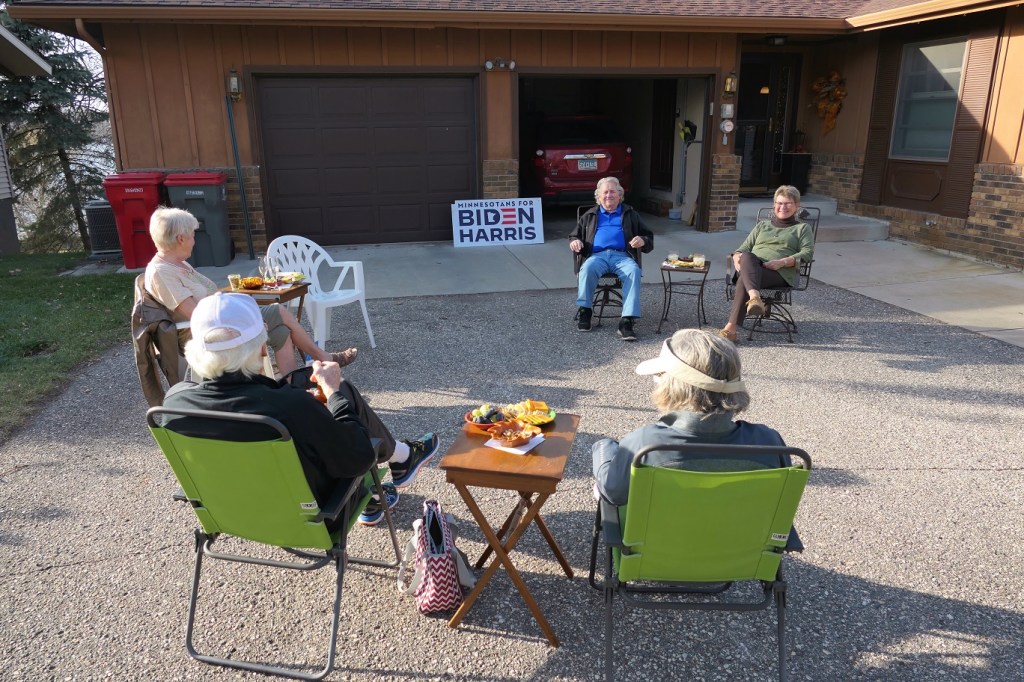
[In the era of COVID, how Happy Hour was celebrated with friends on November 6 . . . ]

[The kitties’ playpen . . . ]

[Lake H2Obert has gone through multiple freeze-thaw cycles this fall . . . ]

[The kitties first Christmas tree. As their alter egos, the Tasmanian Devils, they have made many demolition attempts against the tree . . . ]

[Sister Gretchen has acted as a stringer all year providing reports from the nation’s capital . . . ]

[Gretch also provides regular updates from the Big Ole camera. Where’s the snow? . . . ]

Happy Thanksgiving!!

[We had guests but kept them in a separate room . . . ]

A lovely thing about Christmas is that it’s compulsory, like a thunderstorm, and we all go through it together. ~ Garrison Keillor

December

That’s the true spirit of Christmas; people being helped by people other than me. ~ Jerry Seinfeld

Sending Christmas cards is a good way to let your friends and family know that you think they’re worth the price of a stamp. ~ Melanie White

This holiday season, no matter what your religion is, please take a moment to reflect on why it’s better than all the other ones. ~ Guy Endore Kaiser

[Until we get COVID under control, hunker down, and enjoy a glass of wine . . . ]

[Read some good books and have a Merry Christmas . . . ]

At Christmas mom would make krumkakes, fattigmanns, sandbakkels, rosettes, cookies shaped like Christmas trees and Santa and iced in green and red, divinity, and Russian tea cakes. Looking back, all I can say is, “Wow, way to go, Mom!” ~ Me

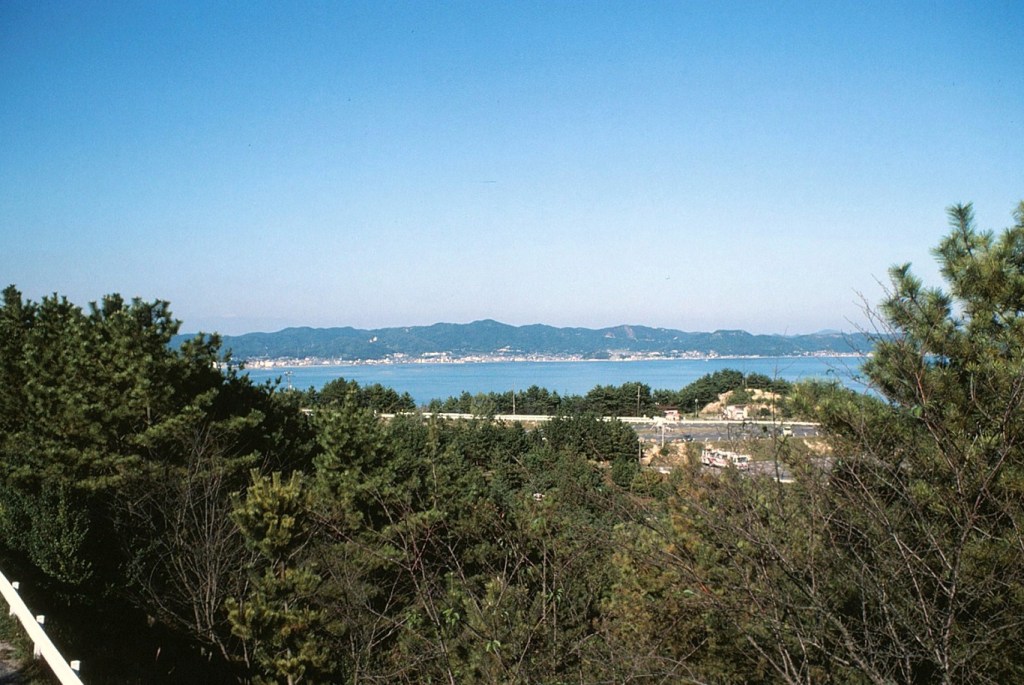
Japan 1983 (Part 12)

November 24

The art of life lies in a constant readjustment to our surroundings. ~  Kakuzo Okakura

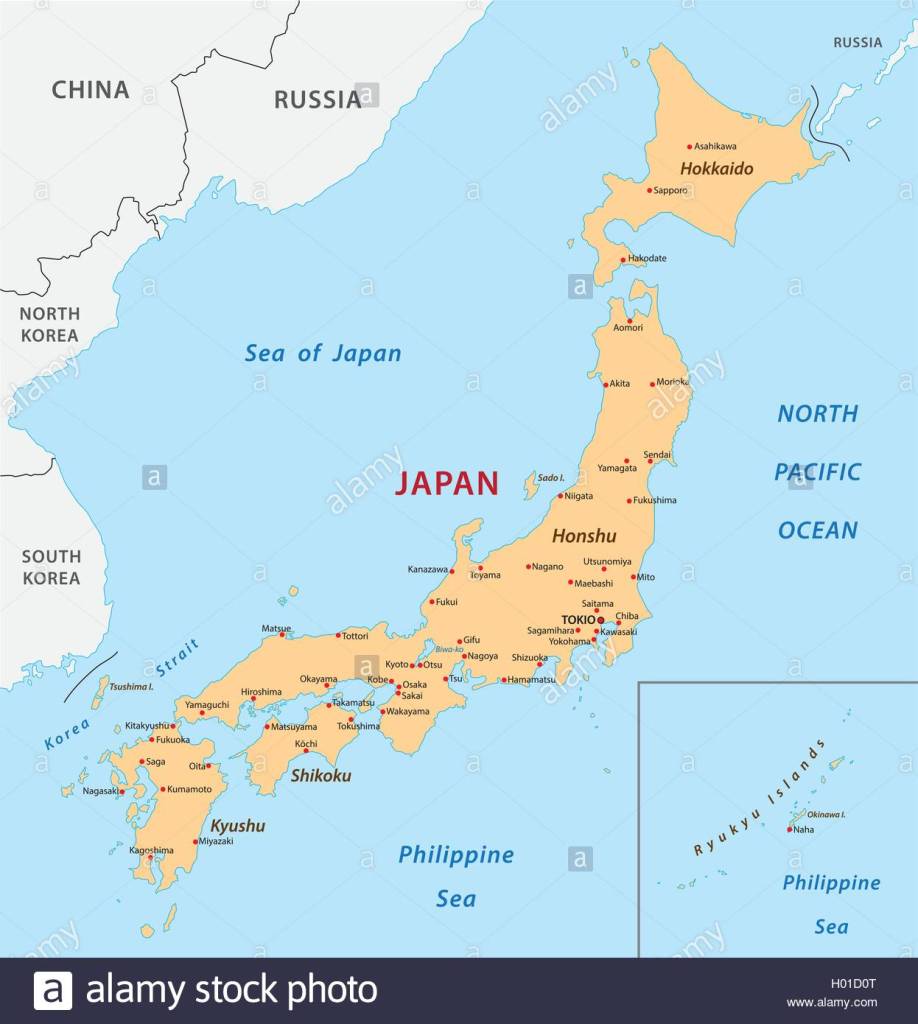
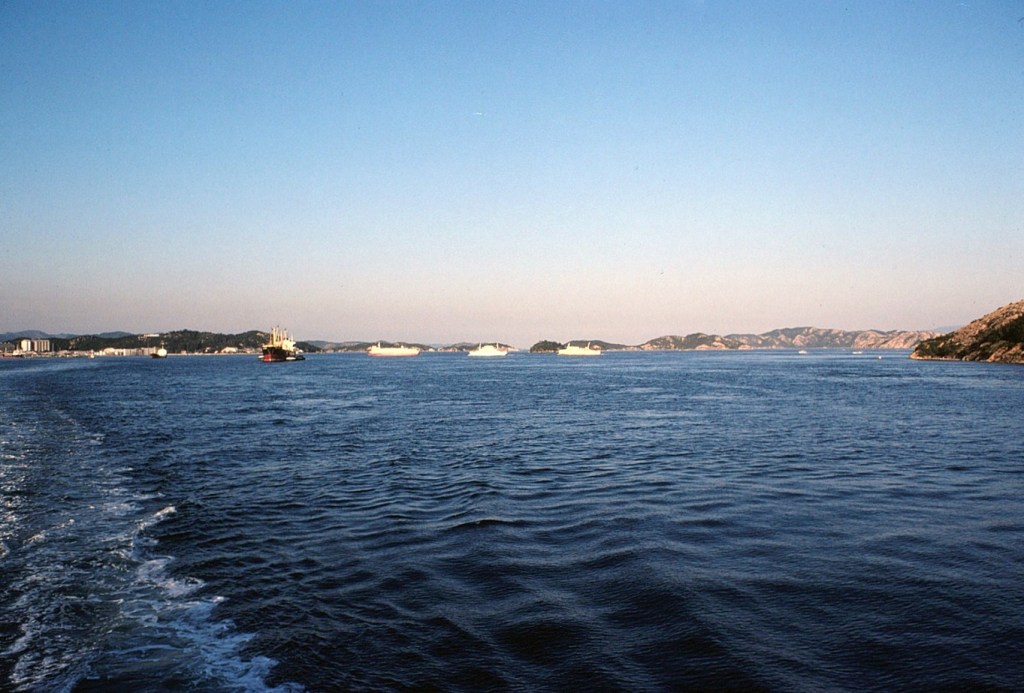
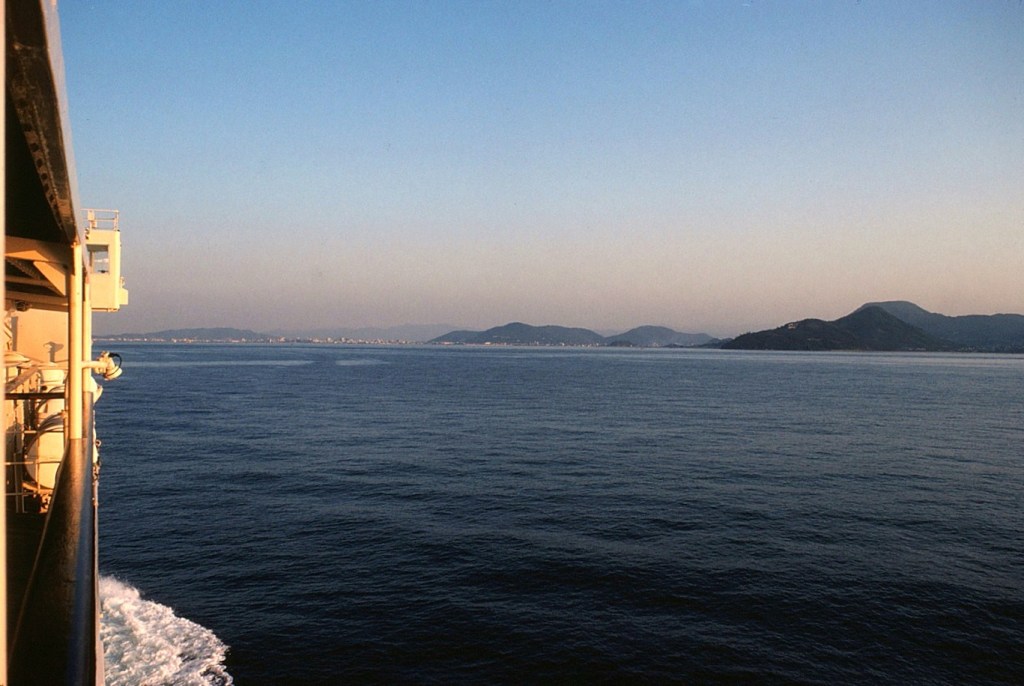
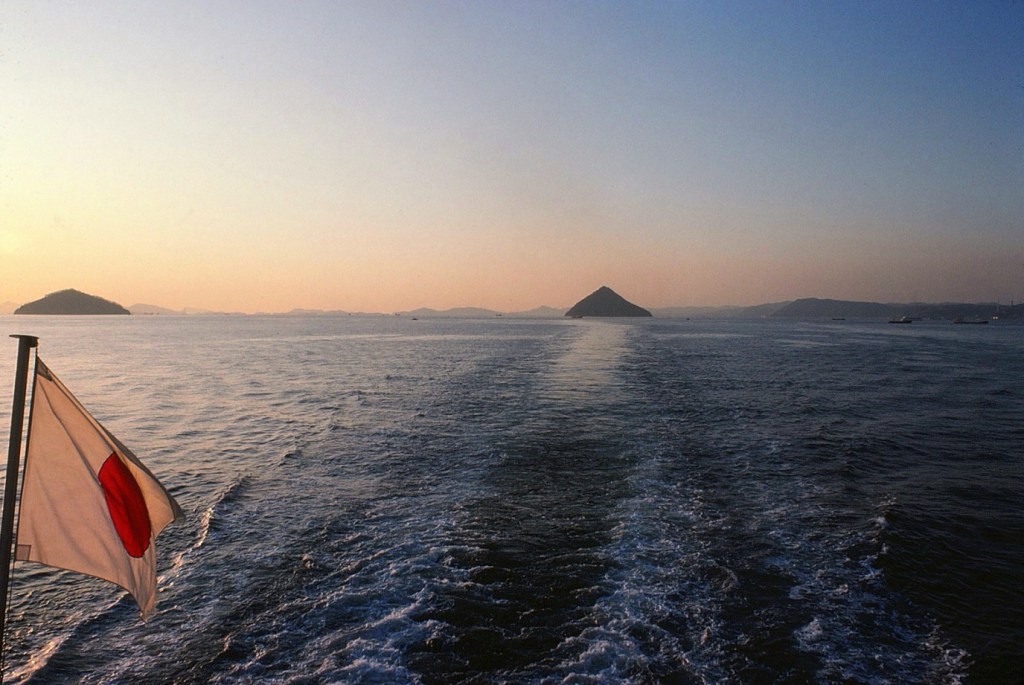
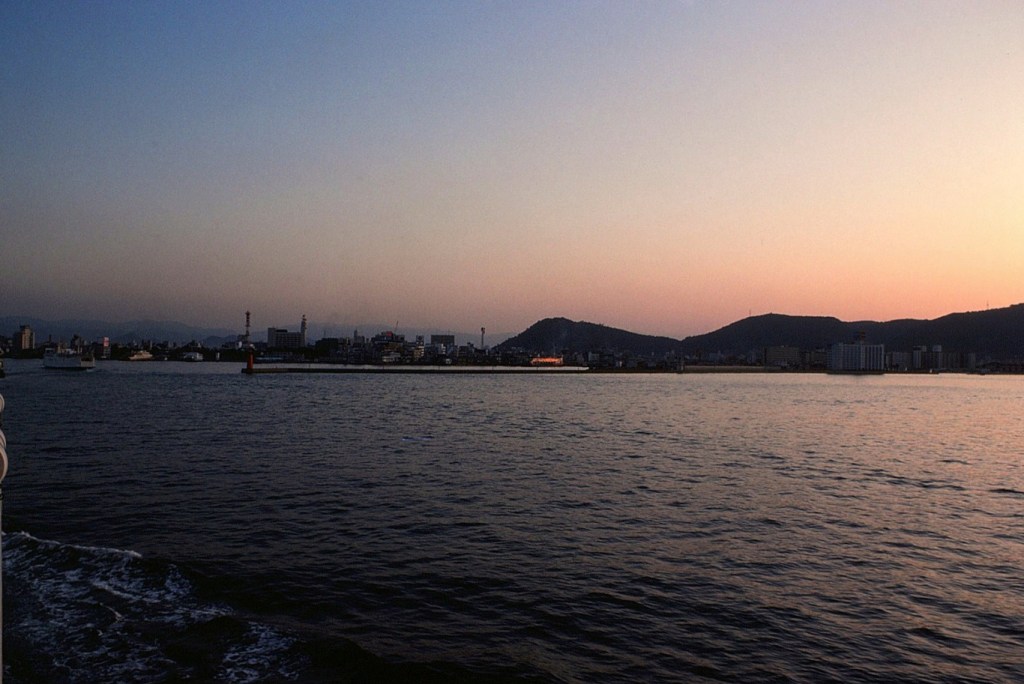
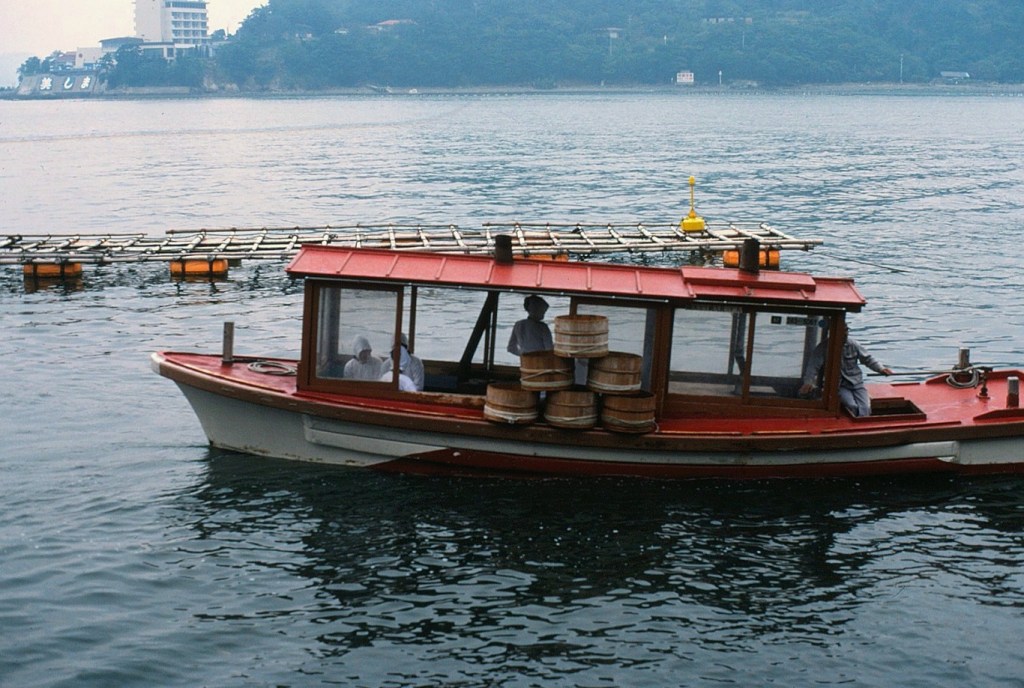
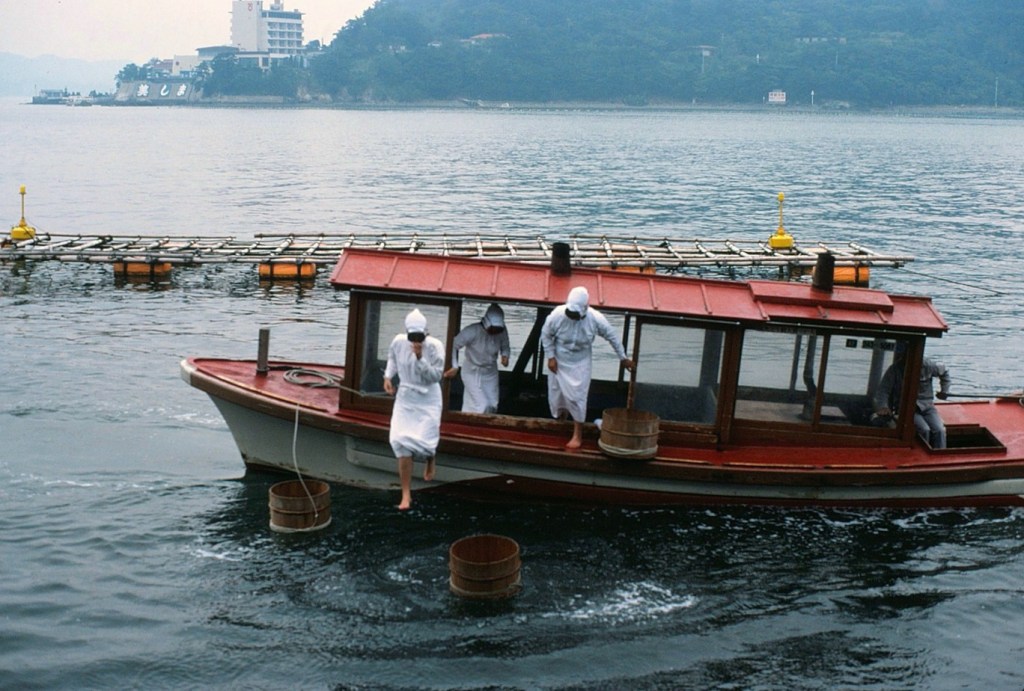
This wraps up Japan 1983. It was a fun trip down memory lane, which now requires mask wearing and social distancing. I was able to “find” most of the places we visited despite large memory gaps. But unfortunately for this final post I hit a brick wall. I cannot identify any of the places photographed herein. I remember taking the ferry (boat) across the water to one of the country’s southern islands and back (until now, everything has been on the main island of Honshu) – it was either to Kyushu or Shikoku, but I can’t remember which. There were some lovely Japanese gardens here, but I can’t find them in the Google-machine. Looking back, as I’ve said previously, I loved everything about this trip. I love that cab drivers in Japan wear white gloves; I love that the subways have professional passenger pushers (who also wear white gloves) who make sure each subway car is packed to capacity, like college kids shoehorning into a VW beetle. We took the subway in Tokyo, but for some reason didn’t take any photos – probably out of fear of my camera being jostled to floor. A highlight was taking the subway at night to see the Ginza. When we came out, we didn’t know which direction to walk. I asked a local, in my very limited Japanese, which way to go. He understood and pointed the way. Now all I can say is here are our final hours in Japan . . .

One very good way to invite stares of disapproval in Japan is to walk and eat at the same time. ~ Andrew Horvat

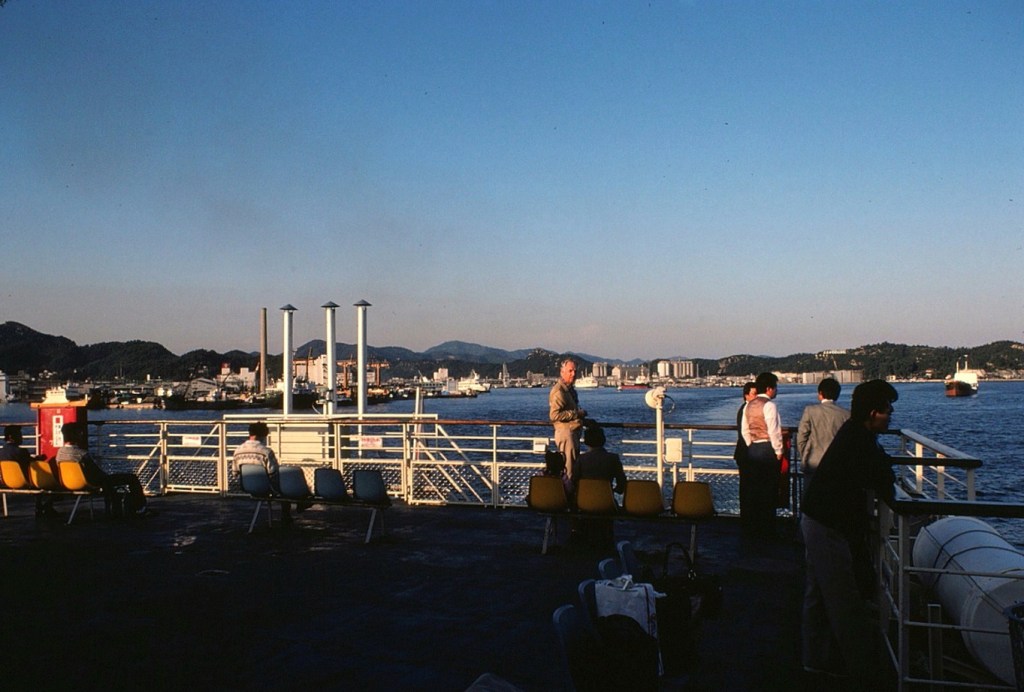
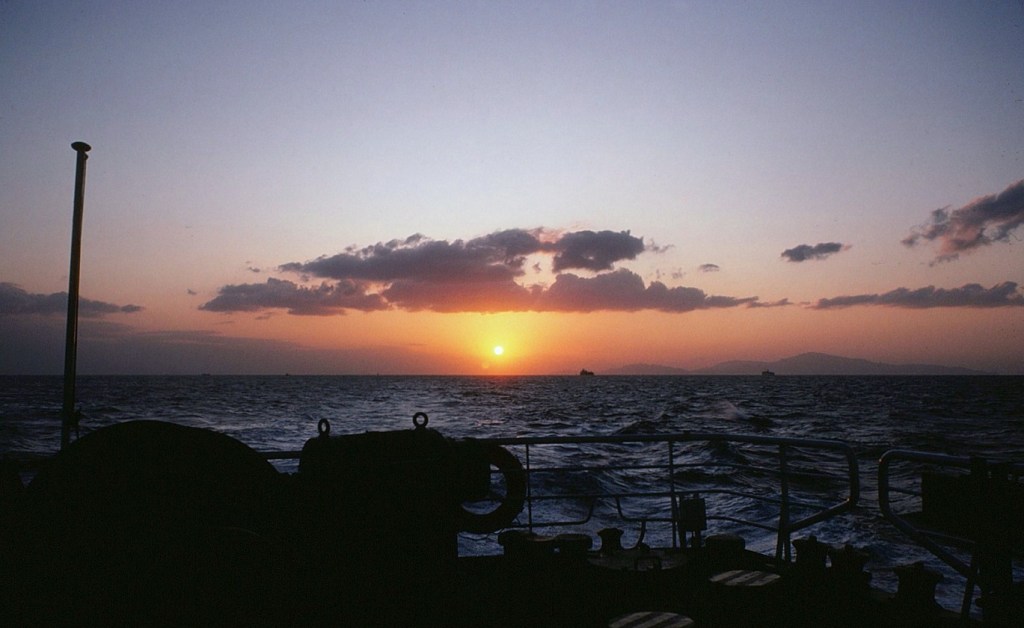
[We begin our water voyage to Kyushu . . . or Shikoku . . . ]

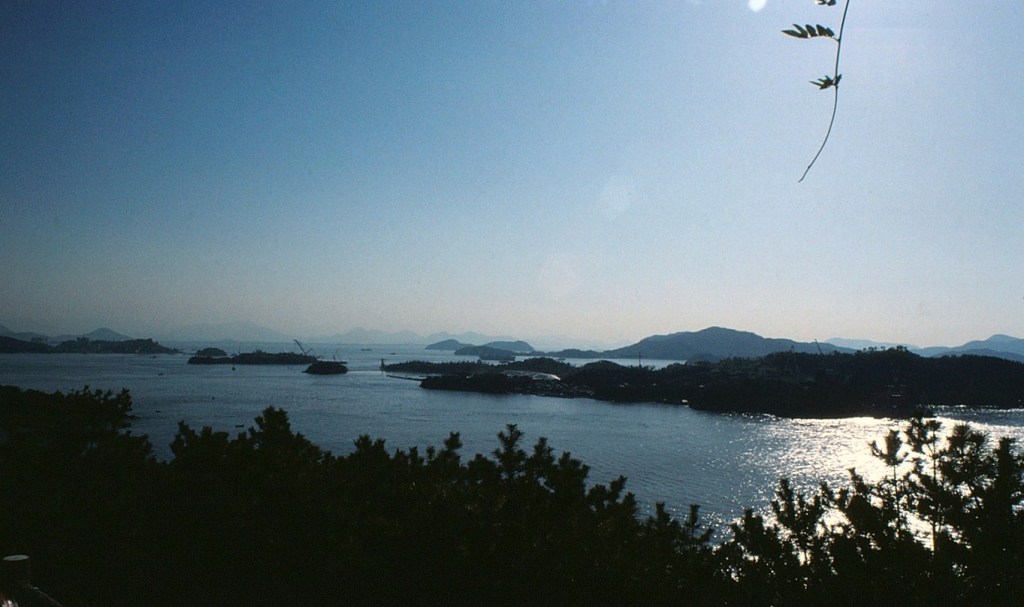
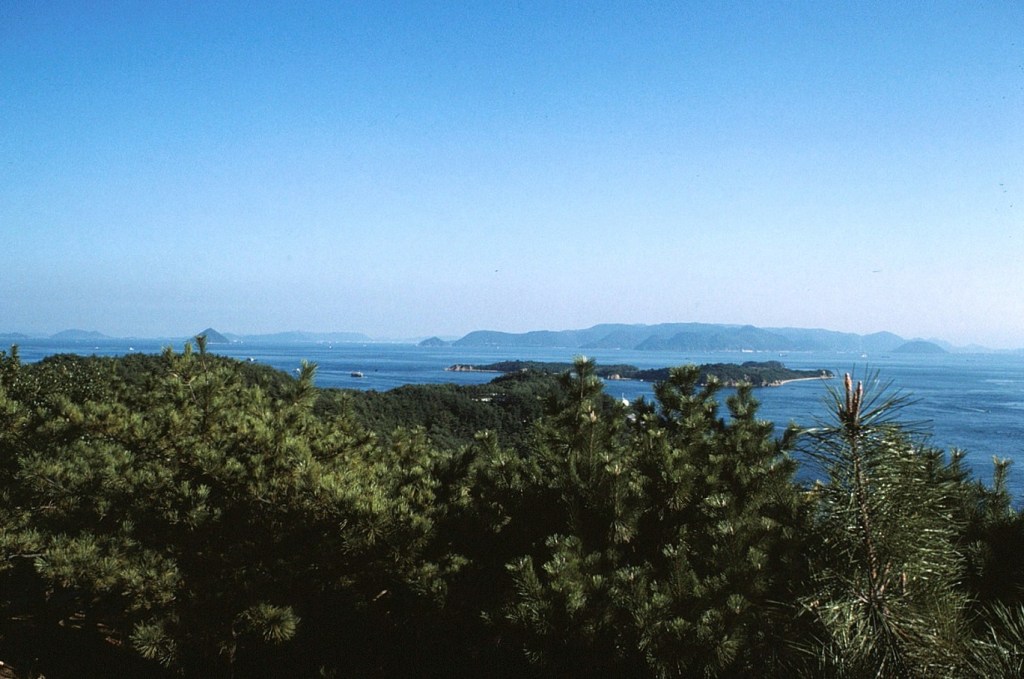
[Inland Sea, Japanese Seto-naikai, the body of water lying between the Japanese islands of Honshu, Shikoku, and Kyushu. It is composed of five distinct basins linked together by channels. Its east-west length is about 270 miles (440 km), and its waters are easily navigable (brittanica.com).]

When you look at Japanese traditional architecture, you have to look at Japanese culture and its relationship with nature. You can actually live in harmonious, close contact with nature – this very unique to Japan. ~ Tadao Ando

In Japanese culture, there is belief that God is everywhere – in mountains, trees, rocks, even in our sympathy for robots or hello kitty toys. ~ Ryuichi Sakamoto

[One of my favorite photos, if I do say so myself . . . ]

The whole of Japan is a pure invention. There is no such country, there are no such people…. the Japanese people are…. simply a mode of style, an exquisite fancy of art. ~ Oscar Wilde

What do Japanese artisans, engineers, Zen philosophy, and cuisine have in common? Simplicity and attention to detail. ~ Hector Garcia

The wise never marry. And when they marry they become otherwise. ~ Japanese saying  

We were in Japan once where they had 30 kinds of green tea. I thought there was one. ~ Billy Corgan

Some beautiful paths can’t be discovered without getting lost. ~ Erol Ozan

The Japanese see self-assertion s immoral and self-sacrifice as the sensible course to take in life. ~ Akira Kurosawa

I do think that Japan will be one of the nations that have equality, and that, too, will serve as an example for other Asian nations. ~ George Takei

[Now this is a unique tree. If it is still alive, one would think it could be found on the internet?]

[What could be cooler than a raked sand garden?]

[Koi is a colored varieties of the Amur carp (Cyprinus rubrofuscus) that are kept for decorative purposes in outdoor koi ponds, water gardens or aquariums. The word of koi comes from the Japanese pronunciation of the common character between Japan and China meaning carp (Wikipedia).]

[This has to be something?]

I miss riding those fast trains in Japan… ’cause I’d never seen a train that fast in my life. ~ Ike Turner

What they have done in Japan, which I find so inspirational, is they’ve brought the toilet out from behind the locked door. They’ve made it conversational. People go out and upgrade their toilet. They talk about it. They’ve sanitized it. ~  Rose George  

[In the photo above, one is indeed exposed to the public when functioning. Below: Kṣitigarbha is a bodhisattva primarily revered in East Asian Buddhism and usually depicted as a Buddhist monk. His name may be translated as “Earth Treasury”, “Earth Store”, “Earth Matrix”, or “Earth Womb”. He is therefore often regarded as the bodhisattva of hell-beings, as well as the guardian of children and patron deity of deceased children and aborted fetuses in Japanese culture, where he is known as Jizō or Ojizō-sama (Wikipedia).]

I’m not a new age person, but I do believe in meditation, and for that reason I’ve always liked the Buddhist religion. When I’ve been to Japan, I’ve been to Buddhist temples and meditated, and I found that rewarding. ~ Clint Eastwood

Charlotte: That was the worst lunch. Bob: So bad. What kind of restaurant makes you cook your own food? ~ “Lost in Translation”

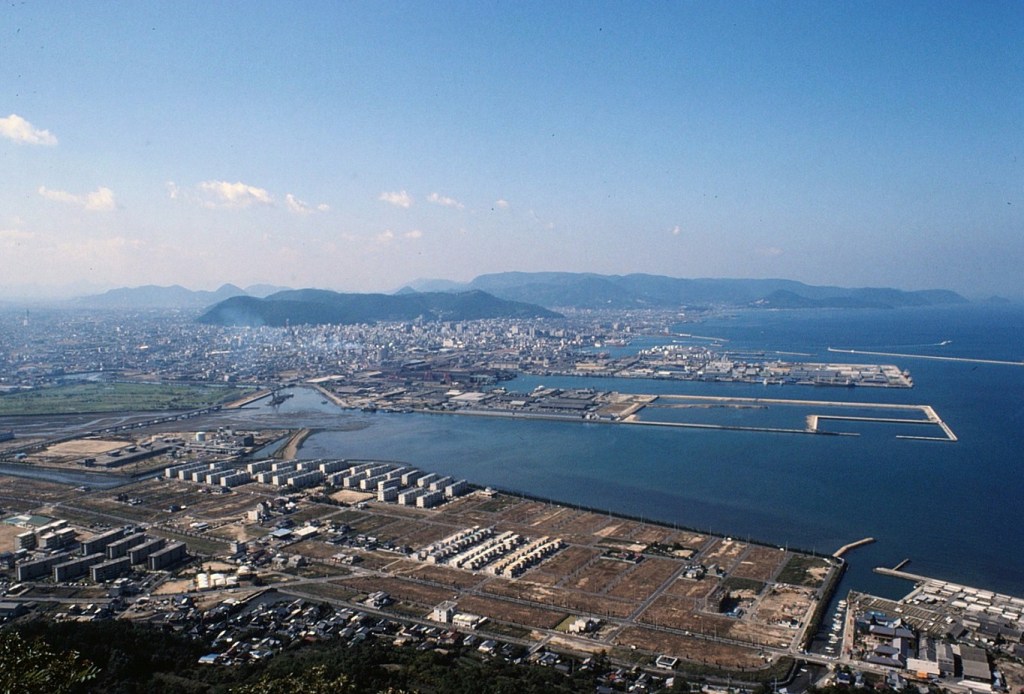
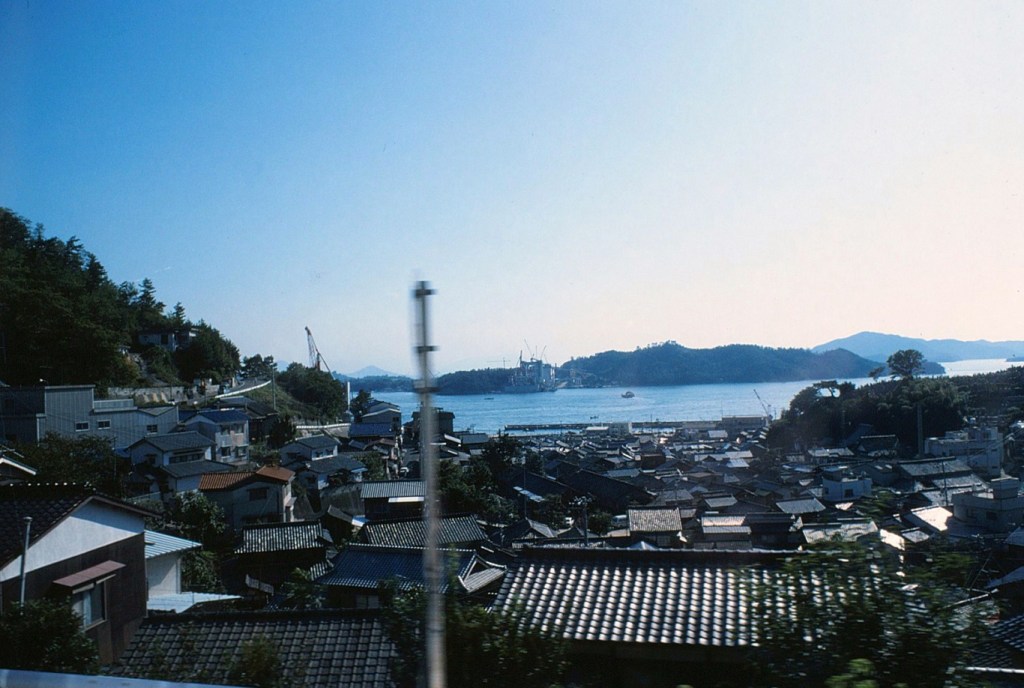
[Appears to be a major port city . . . ]

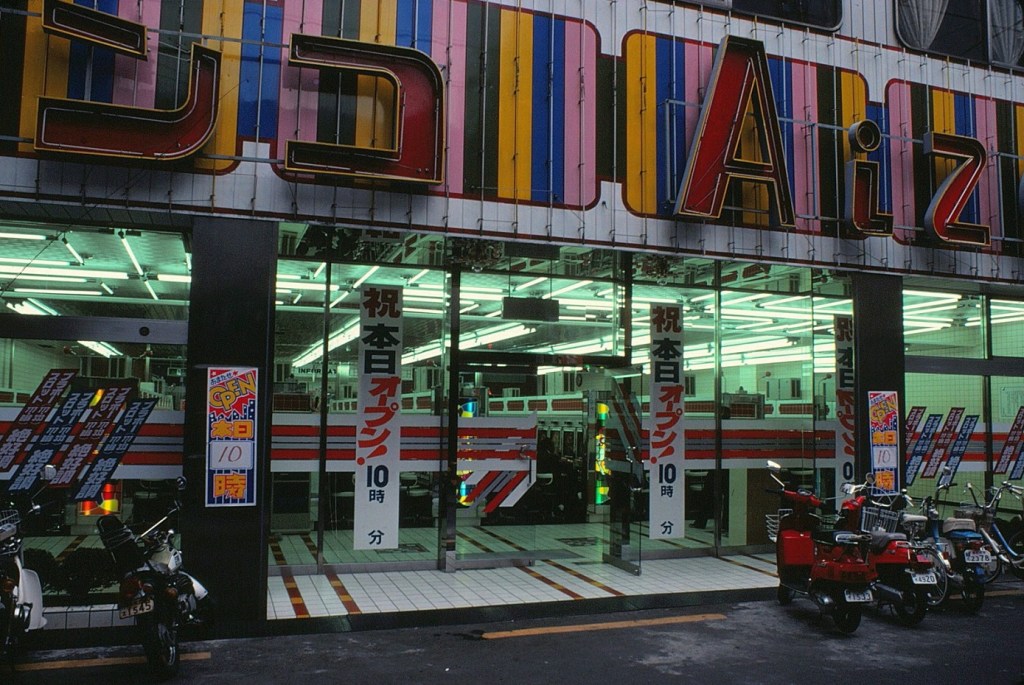
[Either a motorcycle dealership or a pachinko parlor . . . ]

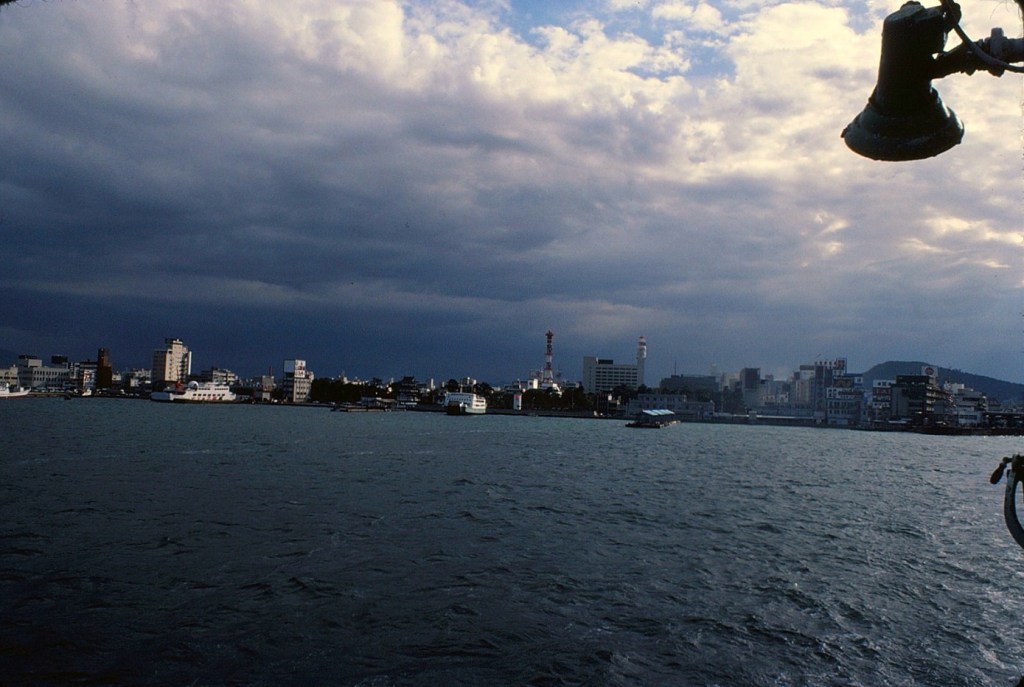
[Boating back to Honshu . . . ]

[Sayonara to wherever we were . . . ]

[That may be Roy standing in the window . . . ]

[As the sun sets into the Inland Sea . . . ]

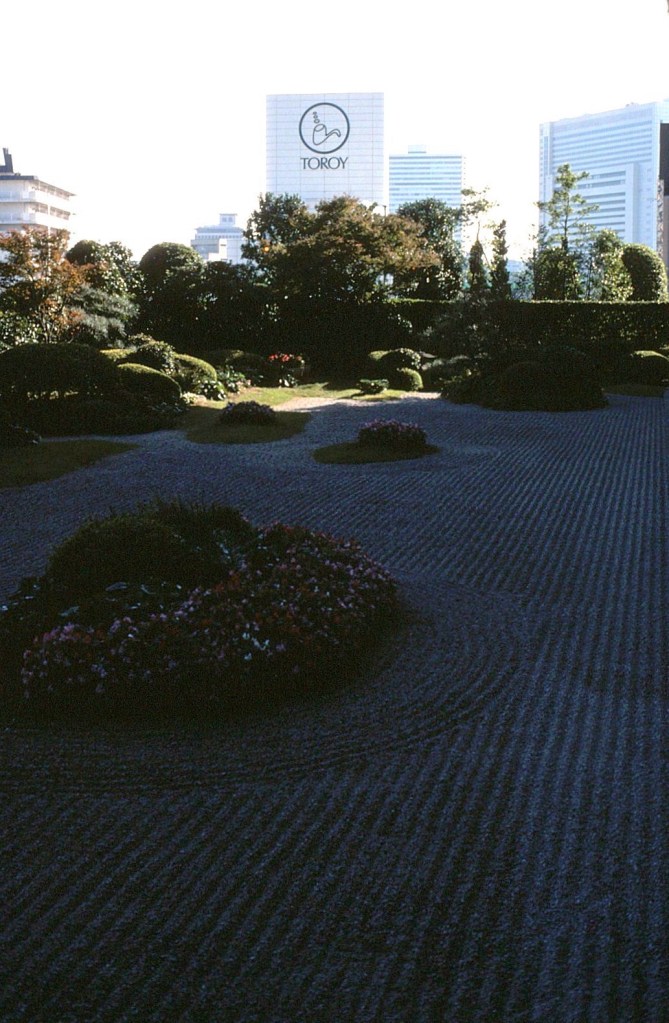
[Somewhere in Honshu. Couldn’t find the Toroy tobacco pipe building?]

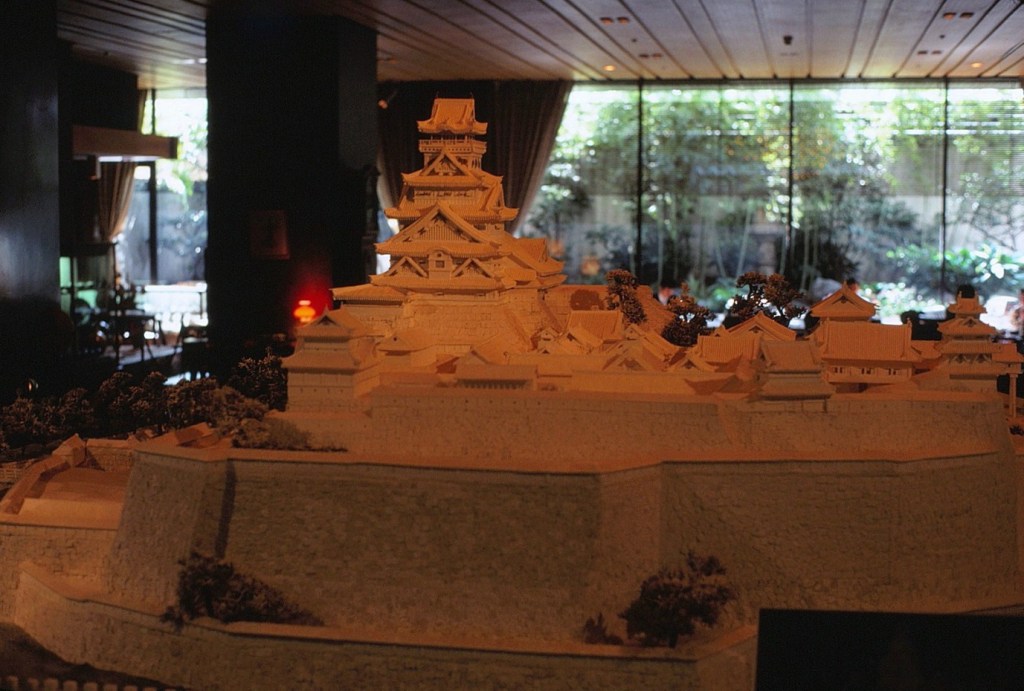
[Funny last photo in Japan. I think it was a sugar castle in a hotel lobby . . . ]

And now, this reminds me that back in the days of film I would return from such an adventure with photo shots still available in the camera. So, in a rush to get all my film developed, I would have to shoot up the remaining last roll as soon as possible. In this instance, that meant shots at home . . .

[So here’s a shot out the window of my 1983 swinging bachelor pad in Arlington, Virginia. It was a one-bedroom apartment in a 3-story garden style complex of WWII vintage. It was a place popular with newcomers to the D.C. area for its affordability and accessibility. If I drove the 5 miles to work at the Department of Labor, I only had one stoplight. The apartments were called Lee Gardens (now likely Grant Gardens?) and were on Route 50, a four lane highway to Virginia environs. I could stand outside my bedroom window and throw a ball over the highway into Fort Myer.

[Fort Myer is the previous name used for a U.S. Army post to Arlington National Cemetery in Arington County, Virginia, and across the Potomac River from Washington, D.C. Founded during the American Civil War as Fort Cass and Fort Whipple, the post merged in 2005 with the neighboring Marina Corps installation, Henderson Hall, and is today named Joint Base Myer-Henderson Hall. The post has been a Signal Corps post, a showcase for the US Army’s cavalry, and, since the 1940s, home to the Army’s elite ceremonial units—The United States Army Band (“Pershing’s Own”) and the 3rd U.S. Infantry Regiment (“The Old Guard”). The National Weather Service was originated there by General Albert J. Myer in 1870 (Wikipedia).]

[Lee Gardens on Wayne Street (above) and my apartment (below, top floor, photo middle) – Ft. Myer was across the highway on the other side of the building. My further connection to Ft. Myer is that I was in the Army Signal Corps, and it’s where I went to the retirement ceremony of my Alexandria friend, Colonel Tom Kiehne . . . ]

[I lived here for 13 years, and likely would have stayed longer except it was converting to condominiums. So I moved to a new condominium a mile away on Lee Highway (now likely Grant Highway?) where I met the Super . . . ]

[Above obviously was the nice sized bedroom, below my living room with bay windows. Its concession to its age was that it had old-fashioned radiator heat on which I placed empty pot pie tins full of water for humidity . . . ]

[What goes around, comes around. My dining room table then is the dining room table the Super and I are using in our house right now . . . ]

[Looking out the living room window, I was on the cul-de-sac circle . . . ]

[The living room – the feature liked by all that you can’t see here were the parquet wooden floors . . . ]

The Big Finish from Japan . . .

[The school girls wanted a picture with me. Though I felt like a Beatle, they thought I was Peewee Herman. It’s nice to know I’ve been memorialized in Japanese family scrapbooks . . . ]

[Formed after we met there, our travel clique: Randy, Marsha, Roy, and me, with photo likely by Toku . . . ]

[Same group, now with Toku in the middle . . . ]

[Until we meet again (Roy did with all of us) . . . ]

Gift giving is part of the culture no matter where you are and no matter how long you stay. ~ Christalyn Brannen

He did not care about titles and was proud to be a farmer beyond all else. ~ Tsuneichi Miyamoto

Up Next: Either Thanksgiving stuff or Europe 2000

Japan 1983 (Part 11)

November 23

Fall (my personal favourite) is the time to view the changing colors of the leaves. Momijigari is the Japanese word for leaf peeping. Many Kyoto temples and parks hold night illuminations with the colorful trees lit up beautifully. ~ Abby Denson

As I begin the penultimate post on this blog subject, Rosemary Clooney is crooning on the Sinatra Channel. The Super and I have been participating in a Nielsen survey this past week. So, on the way to Big Ole walks every morning, it’s generally brief interludes with the Comedy and Progressive channels; for extended listening at home Sinatra gets a lot of play, along with The Bridge (classic rock ‘n roll) and The Beatles channels . . .

Ruth was a novelist, and novelists, Oliver asserted, should have cats and books. ~ Ruth Ozeki

[I believe we’re still in Kyoto on the grounds of Kiyomizu-dera . . . ]

[This may be at the Kodaiji Temple . . . ]

[Looks like a shogun’s palace?]

Philip K. Dick could have been Japanese. He seemed to know a lot about how the world is never what it looks like. That’s pretty much Japan through and through. ~  Christopher Barzak

[I very much remember this photo. The part of Japanese culture I admire as much an any. Take your damn shoes off when . . . well, here, as Roy demonstrates, you must before entering any temple or shrine, wear the slippers provided, and put your shoes back on when you leave . . . ]

[From Kyoto, we then ventured 30 miles south to Nara . . . ]

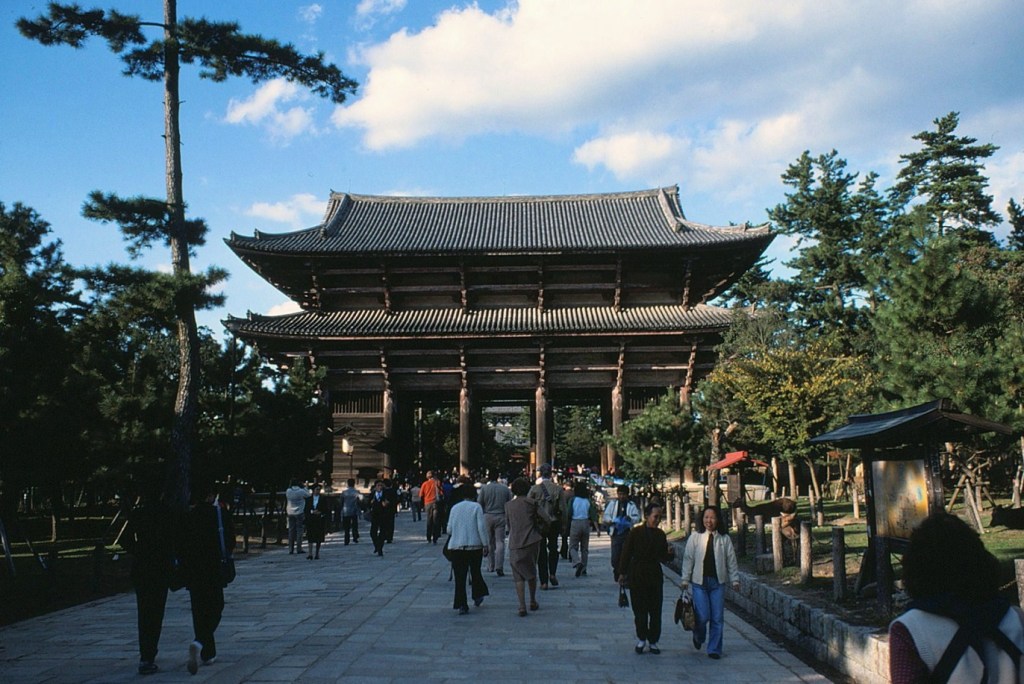
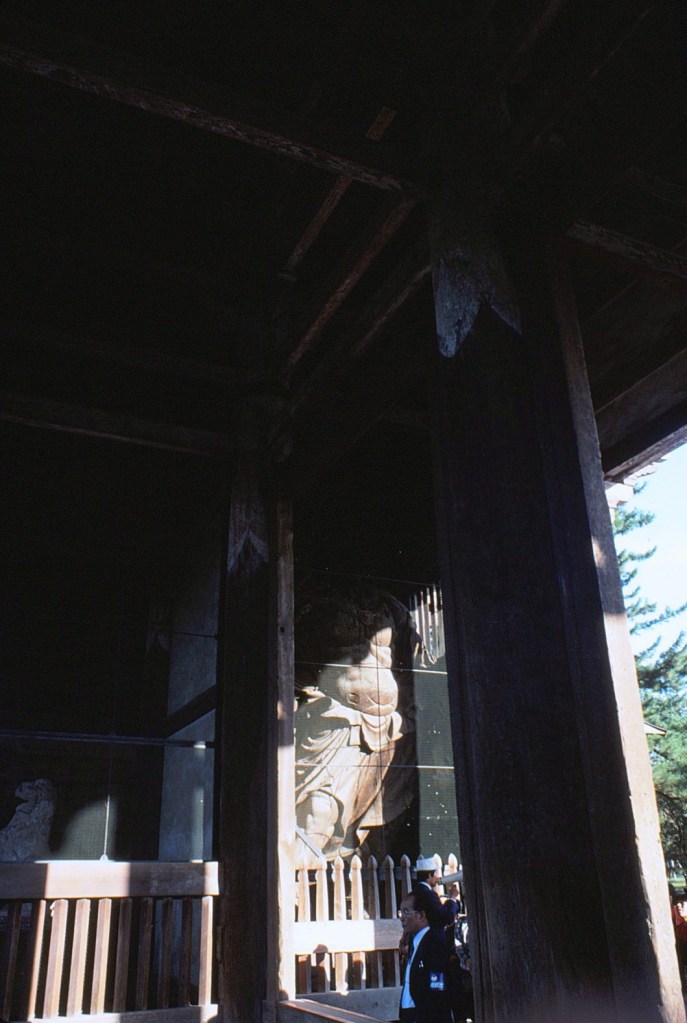
[The Great South Gate (‘Nandai-mon’) is the main gate of Tōdai-ji. The original, erected during the Nara period, was destroyed by a typhoon during the Heian period. The present structure, which dates to the Kamakura period, was built using what is known as the “Daibutsu style.” A type of construction based upon Sung Chinese models, it was newly introduced to Japan by Chōgen, the monk responsible for restoring Tōdai-ji, at the end of the twelfth century. The ridgepole was raised in 1199 and the structure was completed in 1203 along with the statues of the guardian dieties, the Two Ni-ō housed in the gate. The gate with its double hip-and-gable roof is five bays wide and two bays deep. Originally there were three pairs of doors. The eighteen giant pillars that support the roof measure twenty-one meters and the entire structure rises 25.46 meters above the stone plinth on which it rests. The Great South Gate is the largest temple entrance gate in Japan, suitable in scale to the Great Buddha Hall (www.todaiji.or.jp/).]

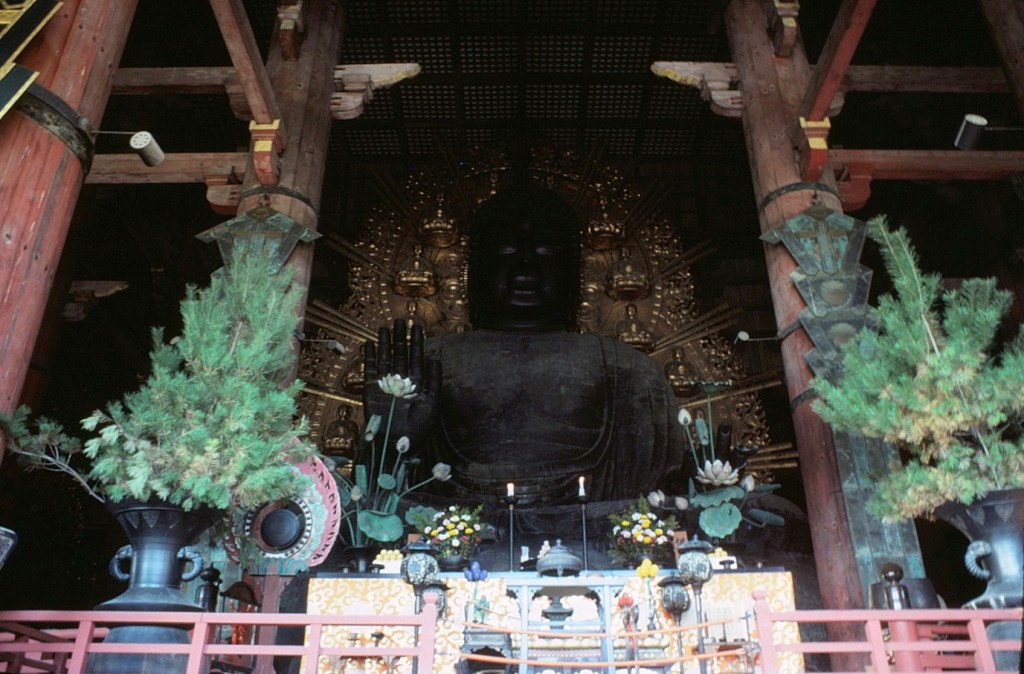
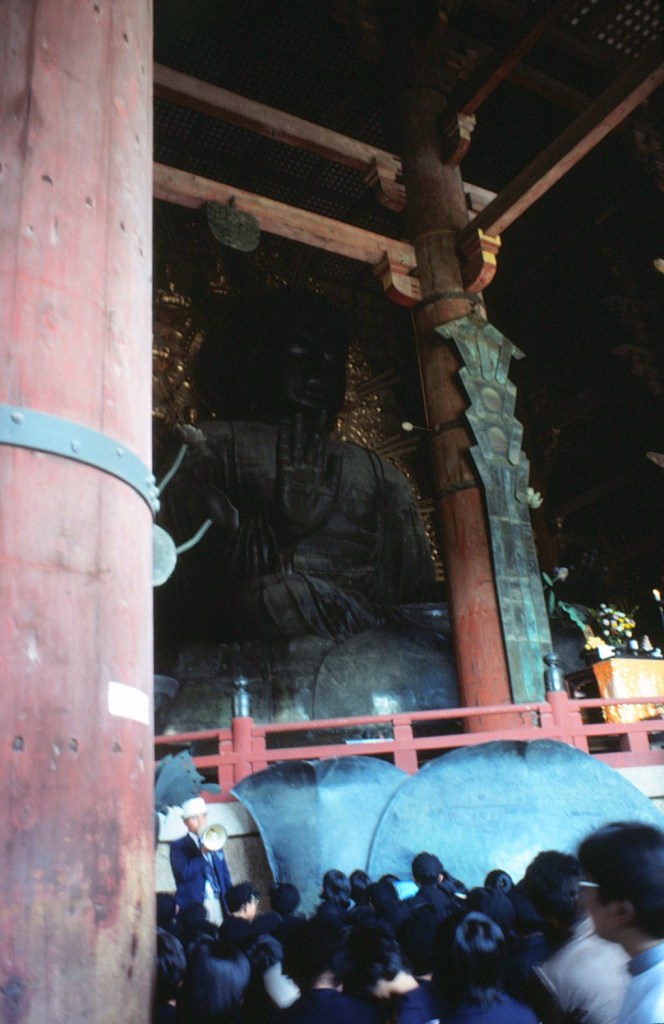
[The story of the Great Buddha in the following photos . . . ]

[Tōdai-ji (‘Eastern Great Temple’) is a Buddhist temple complex that was once one of the powerful Seven Great Temples, located in the city of Nara. Though it was originally founded in the year 738 CE, Todai-ji was not opened until the year 752 CE.  Its Great Buddha Hall (‘Daibutsuden’) houses the world’s largest bronze statue of the Buddha Vairocana, known in Japanese as ‘Daibutsu’. The temple also serves as the Japanese headquarters of the Kegon school of Buddhism. The temple is a listed UNESCO World Heritage Site as one of the “Historic Monuments of Ancient Nara”, together with seven other sites including temples, shrines and places in the city of Nara (Wikipedia).]

China’s influence was seen not only in the design of the city but also in grand buildings such as the Todaiji Temple, the largest wooden building in the world. ~  Kenneth Henshall

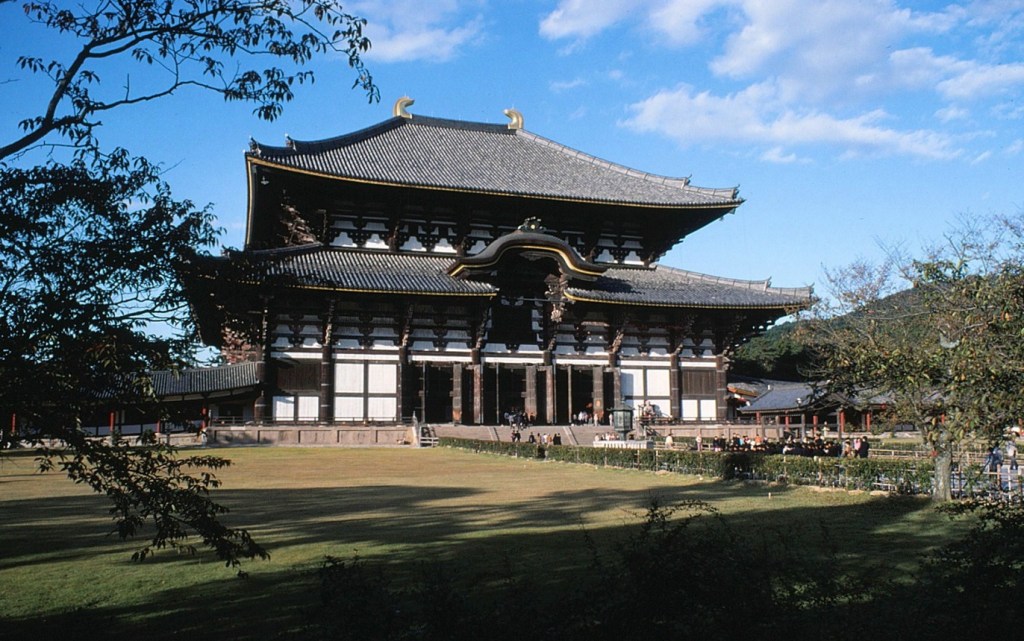
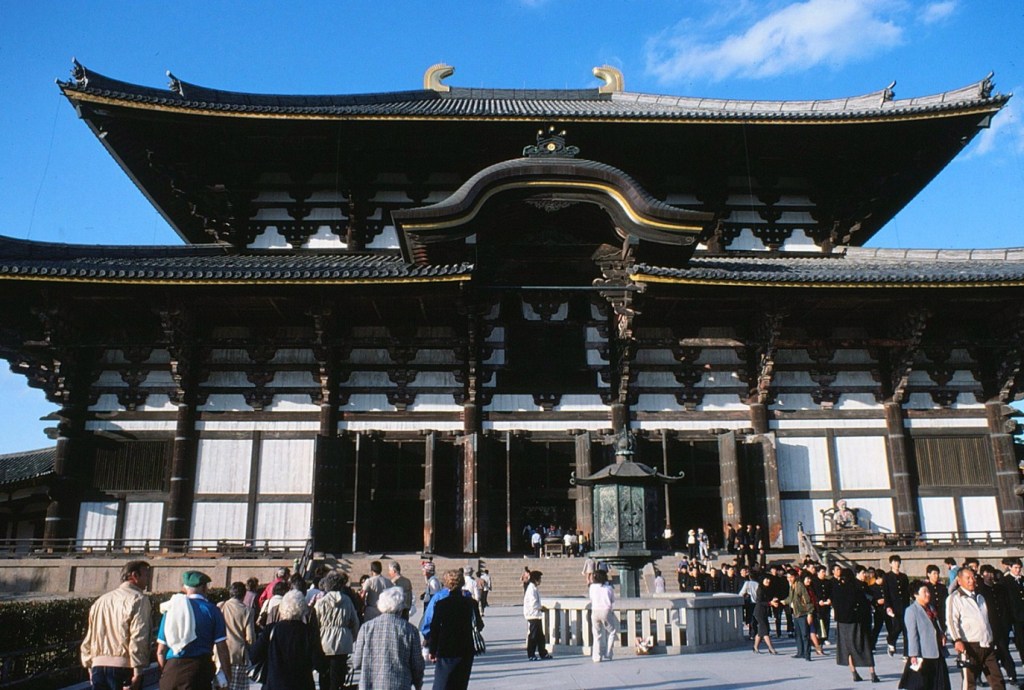
[The Great Buddha Hall (‘Daibutsuden’) has been rebuilt twice after fire. The current building was finished in 1709, and although immense—57 metres (187 ft) long, 50 metres (160 ft) wide and 49 metres (161 ft) high—it is actually 30% smaller than its predecessor, being reduced from 11 to 7 bays wide due to lack of funds. Until 1998, it was the world’s largest wooden building.  It has been surpassed by modern structures, such as the Japanese baseball stadium ‘Odate Jukai Dome’, amongst others. The Great Buddha statue has been recast several times for various reasons, including earthquake damage. The current hands of the statue were made in the Momoyama Period (1568–1615), and the head was made in the Edo period (1615–1867) (Wikipedia).]

[According to records kept by Tōdai-ji, more than 2,600,000 people in total helped construct the Great Buddha and its Hall; contributing rice, wood, metal, cloth, or labor; with 350,000 working directly on the statue’s construction.  The 16 m (52 ft) high statue was built through eight castings over three years, the head and neck being cast together as a separate element. The making of the statue was started first in Shigaraski. After enduring multiple fires and earthquakes, the construction was eventually resumed in Nara in 745, and the Buddha was finally completed in 751. A year later, in 752, the eye-opening ceremony was held with an attendance of 10,000 monks and 4,000 dancers to celebrate the completion of the Buddha. The temple gives the following dimensions for the statue: Height: 14.98 m (49 ft 2 in); Face: 5.33 m (17 ft 6 in); Eyes: 1.02 m (3 ft 4 in); Nose: 0.5 m (1 ft 8 in); Ears: 2.54 m (8 ft 4 in). The statue’s shoulders are 28 meters across and there are 960 six curls atop its head.The Birushana Buddha’s golden halo is 27 m (87 ft) in diameter with 16 images each 2.4 m (8 ft) tall. Recently, using x-rays, a human tooth, along with pearls, mirrors, swords, and jewels were discovered inside of the knee of the Great Buddha; these are believed to be the relics of Emperor Shomu. The statue weighs 500 tonnes (550 short tons) (Wikipedia).]

An obstacle which would frighten discreet men is nothing to determined women. They dare what men avoid, and sometimes they achieve an unusual success. ~  Ōgai Mori

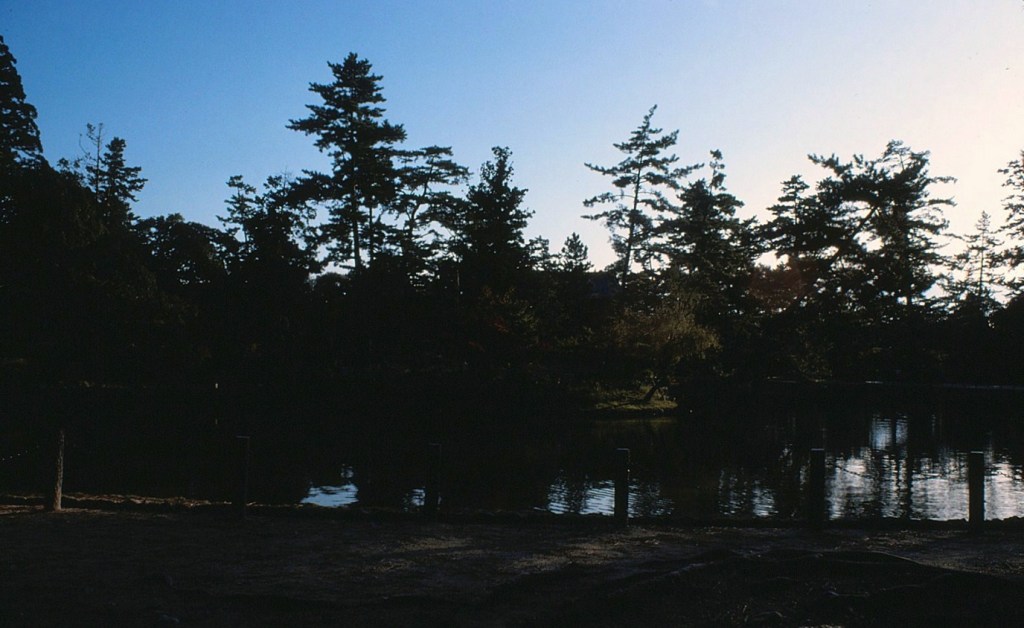
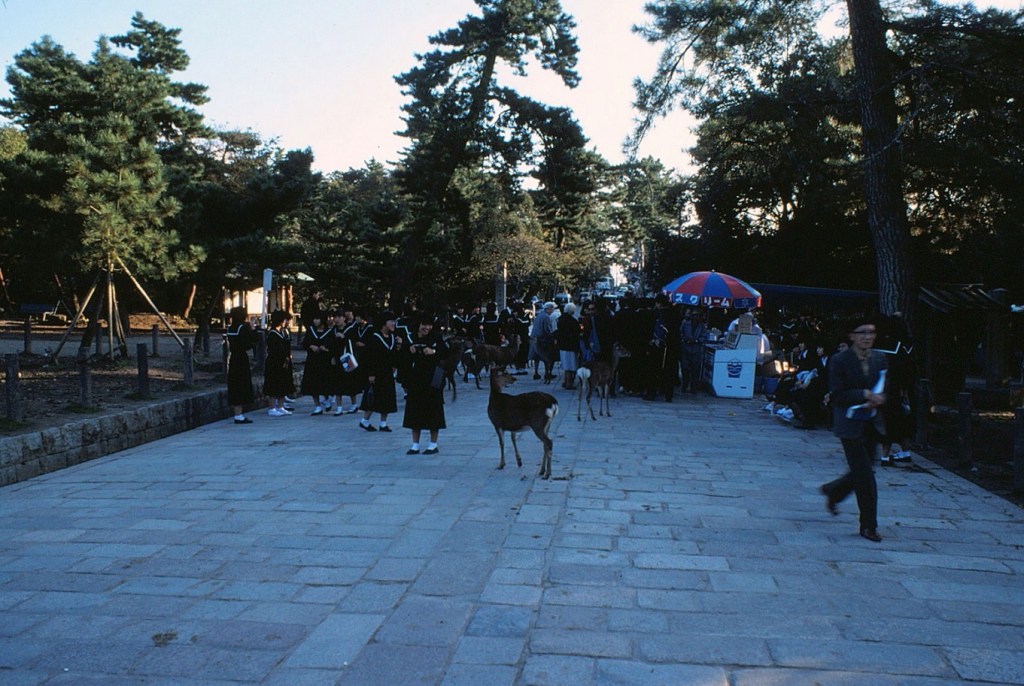
[Nara Park (Nara Kōen) is a public park located in the city of Nara, at the foot of Mount Wakakusa. Established in 1880 it is one of the oldest parks in Japan. The park is one of the “Places of Scenic Beauty” designated by MEXT. Over 1,200 wild sika deer freely roaming around in the park are also under designation of MEXT, classified as natural treasure. While the official size of the park is about 502 hectares (1,240 acres), the area including the grounds of Todai-ji, Kofuku-ji, and Kasuga Shrine, which are either on the edge or surrounded by Nara Park, is as large as 660 hectares (1,600 acres). While Nara Park is usually associated with the broad areas of the temples and the park proper, previously private gardens are now open to public. These gardens make use of the temple buildings as adjunct features of their landscapes. The park is home to the Nara National Museum and Todai-ji, where the largest wooden building in the world houses a 15-metre (50 ft) tall statue of Buddha (Wikipedia).]

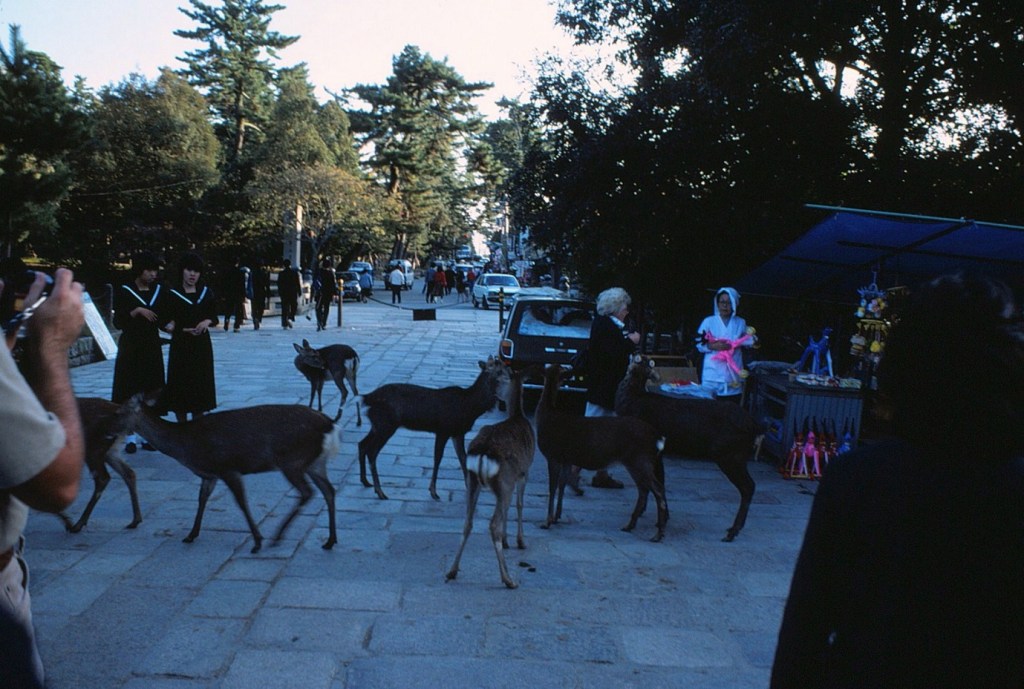
[Yup, you buy cookies and crackers on-site, and as you stroll along the deer politely come up and request such from you . . . ]

[Kasuga Taisha is Nara’s most celebrated shrine. It was established at the same time as the capital and is dedicated to the deity responsible for the protection of the city (japan-guide.com).]

[Center photo is our new guide who replaced our guy in the brown suit . . . ]

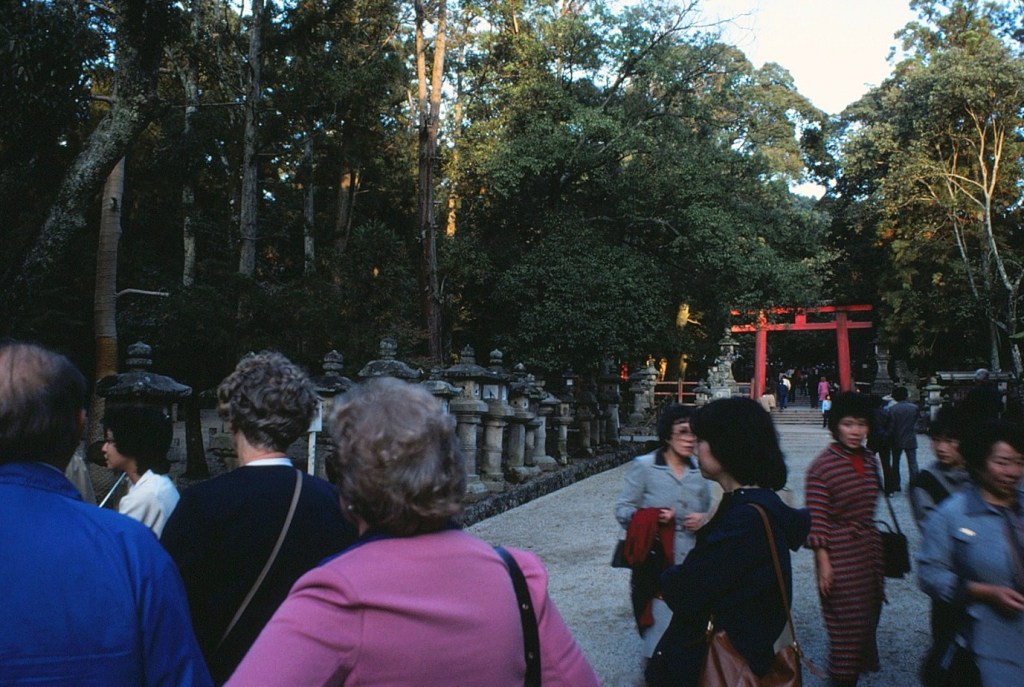
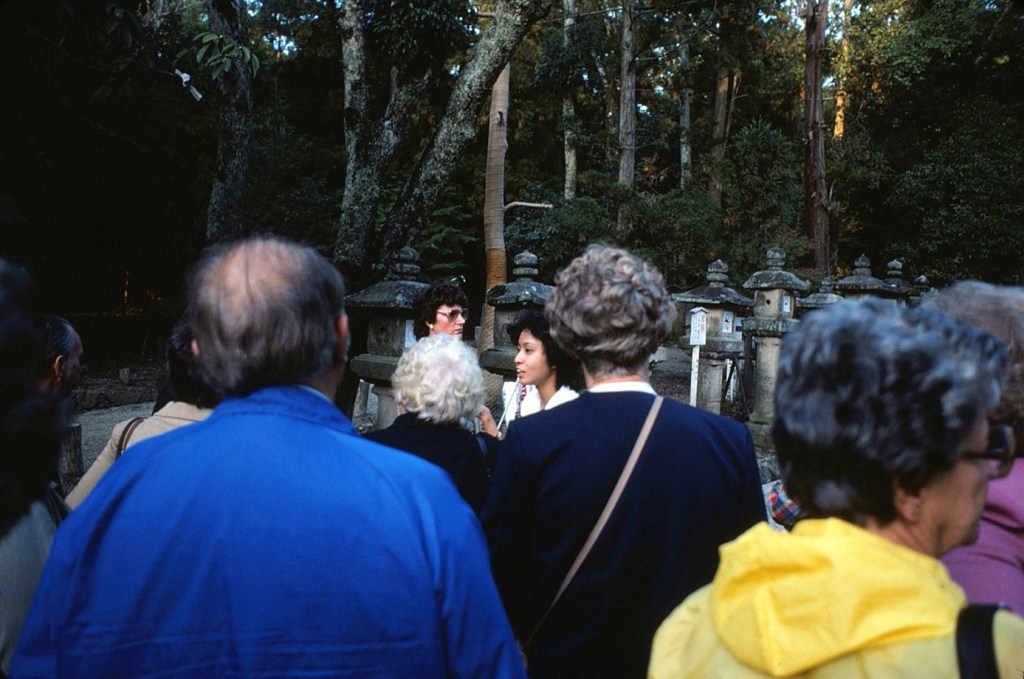
[The long path leading up to the shrine takes you through a fascinating landscape of woods interspersed with thousands of tall stone lanterns covered in moss and lichen (kanpai-japan.com). Marsha seems to be the lead member of group, based on my photo evidence . . . ]

[The Shinkansen, colloquially known in English as the bullet train, is a network of high-speed railway lines in Japan. Initially, it was built to connect distant Japanese regions with Tokyo, the capital, to aid economic growth and development. Beyond long-distance travel, some sections around the largest metropolitan areas are used as a commuter rail network. Over the Shinkansen’s 50-plus-year history, carrying over 10 billion passengers, there has been not a single passenger fatality or injury due to train accidents. Starting with the Tokaido Shinkansen (515.4 km, 320.3 mi) in 1964, the network has expanded to currently consist of 2,764.6 km (1,717.8 mi) of lines with maximum speeds of 240–320 km/h (150–200 mph).  The network presently links most major cities on the islands of Honshu and Kyushu, and Hakodate on northern island of Hokkaido, with an extension to Sapporo under construction and scheduled to commence in March 2031.  The maximum operating speed is 320 km/h (200 mph).  Test runs have reached 443 km/h (275 mph) for conventional rail in 1996, and up to a world record 603 km/h (375 mph) for SCMaglev trains in April 2015. The original Tōkaidō Shinkansen, connecting Tokyo, Nagoya, and Osaka, three of Japan’s largest cities, is one of the world’s busiest high-speed rail lines. In the one-year period preceding March 2017, it carried 159 million passengers, and since its opening more than five decades ago, it has transported more than 5.6 billion total passengers.  At peak times, the line carries up to 13 trains per hour in each direction with 16 cars each (1,323-seat capacity and occasionally additional standing passengers) with a minimum headway of three minutes between trains. Japan’s Shinkansen network had the highest annual passenger ridership (a maximum of 353 million in 2007) of any high-speed rail network until 2011, when the Chinese high-speed railway surpassed it at 370 million passengers annually, reaching over 1.7 billion annual passengers in 2017 (Wikipedia).]

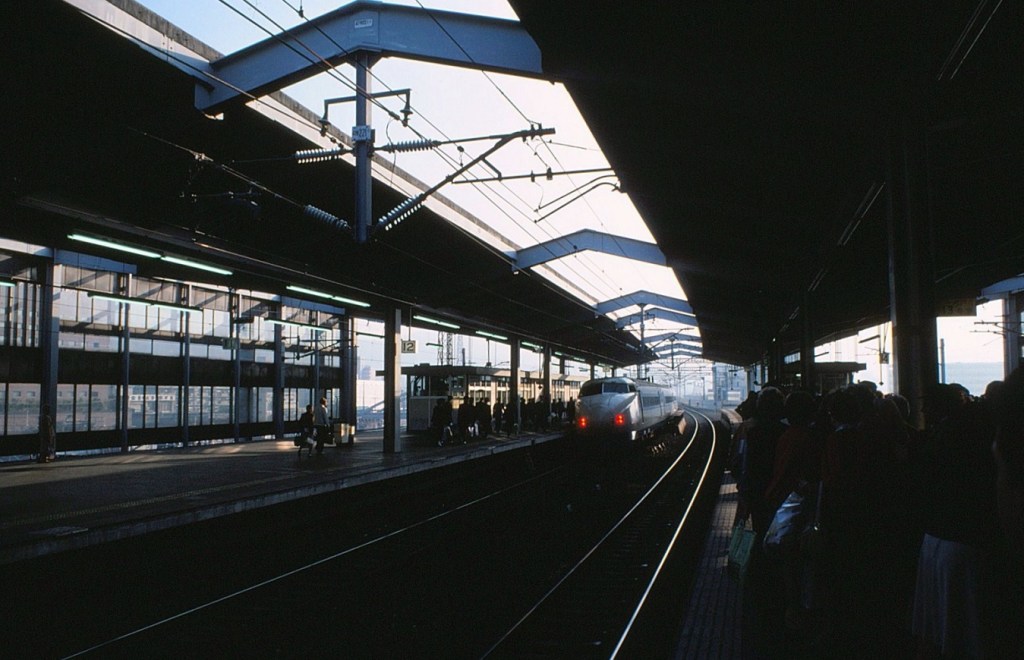
[12-car 200-1000 series sets with a maximum speed of 240 km/h (150 mph) which were introduced in November 1983 (Wikipedia). 37 years later, the U.S. still doesn’t have anything close to this??]

[Where the Shinkansen took us from Nara to Kyoto to Nagoya . . . ]

[Nagoya is the largest city in the Chūbu region of Japan. It is Japan’s fourth-largest incorporated city and the third-most-populous urban area. It is located on the Pacific coast on central Honshu. It is the capital of Aichi Prefecture and is one of Japan’s major ports along with those of Tokyo, Osaka, Kobe, Yokohama, Chiba, and Kitakyushu. It is also the center of Japan’s third-largest metropolitan region, known as the Chūkyō metropolitan area. 2,327,557 people lived in the city, part of Chūkyō Metropolitan Area’s 10.11 million people. It is also one of the 50 largest urban areas in the world (Wikipedia).]

[On a stroll through Meijo Park in Nagoya on the way to Nagoya Castle . . . ]

[There’s the castle in the distance . . . ]

[Green tea growth is trimmed in the form of a rolling sea . . . ]

Japan is the first nation in the world to accord ‘comic books’–originally a ‘humorous’ form of entertainment mainly for young people–nearly the same social status as novels and films. ~  Frederik L. Schodt

The pond garden is an intricate phenomenon coalescing the intent and will of various people of influence living at various times. ~  Norris Brock Johnson

No one will understand a Japanese garden until you’ve walked through one, and you hear the crunch underfoot, and you smell it, and you experience it over time. Now there’s no photograph or any movie that can give you that experience. ~ J. Carter Brown

[Nagoya Castle (Nagoya-jō) was constructed by the Owari Domain in 1620 during the Edo period. Nagoya Castle was the heart of one of the most important castle towns in Japan, Nagoya-juku, a post station on the Minoji road linking two of the important Edo Five Routes, the Tokaido and the Nakasendo. Nagoya Castle became the core of the modern Nagoya and ownership was transferred to the city in 1930. Nagoya Castle was destroyed in 1945 during the bombing of Nagoya in World War II and the reconstruction and repair of the castle has been undergoing since 1957. Meijō, another shortform way of pronouncing Nagoya Castle, is used for many Nagoya city institutions such as Maijo Park, the Meijo Line of the Nagoya Municipal Subway, and Meijo University, reflecting the cultural influence of this historic structure. The castle has also historically been called Kinjō, which means “Golden Castle” (Wikipedia).]

[An overview of Meijo Park and Nagoya environs . . . ]

The art of stone in a Japanese garden is that of placement. Its ideal does not deviate from that of nature. ~ Isamu Noguchi

In Japan, so many emoticons have been created that it’s reasonable to assume Japanese appreciate their convenience more than anyone else. ~ Morinosuke Kawaguchi

[Obviously a shot out of a window of a moving means of transportation . . . ]

[The rest of the photos on this post have water views, leading me to suspect they are all somewhere along Ise Bay which hosts Nagoya Port . . . ]

The art of life lies in a constant readjustment to our surroundings. ~  Kakuzo Okakura

As the lower parts of the Japanese houses and shops are open both before and behind, I had peeps of these pretty little gardens as I passed along the streets; and wherever I observed one better than the rest I did not fail to pay it a visit. ~ Robert Fortune

In Japanenese houses the interior melts into the gardens of the outside world. ~ Stephen Gardiner

For the casual viewer, Kurosawa’s films can be an exercise in endurance. ~ Jerry White

[Nagoya Port, located on the northern shore of Ise Bay, is the largest trading port in Japan (Wikipedia).]

There are so many other fun ways to dishonor the family name that buying girls’ underwear shouldn’t be one of them. ~  Rin Chupeco

What I learned: The 12-car, 150 mph Shinkansen was introduced in November 1983, which, coincidentally is when we were there. The Great Buddha Hall was the largest wooden building in the world when we were there . . .

Up Next: The completion of Japan 1983

Japan 1983 (Part 10)

November 17

The culture’s reverence for nature accentuates Kyoto’s innate beauty. Designs on fabric, pottery, lacquer, and folding screens depict swirling water, budding branches, and birds in flight. Delicate woodcuts and scrolls celebrate the moonlight, rain, and snow. Elegant restaurant dishes arrive with edible garnishes of seasonal flora. ~  Victoria Abbott Riccardi

Highlighting Kyoto. As I’ve said before (somewhere), my favorite city. I always wanted to go back to do this trip again, but I could never bring myself to do another trans-Pacific plane ride. Roy, on the other hand, made several trips back, and after his retirement to Hawaii he was half way there . . .

I told him there was one city that they must not bomb without my permission and that was Kyoto. ~ Henry L. Stimson

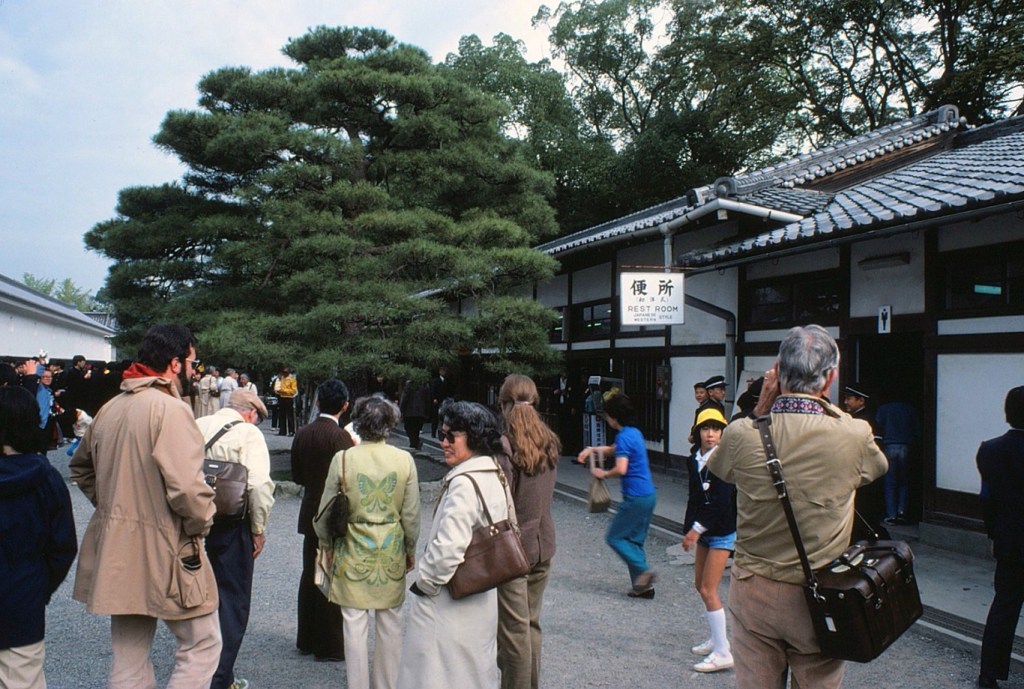
[A highlight of any foreign trip, of course, are the public rest rooms, especially when they’re well identified . . . ]

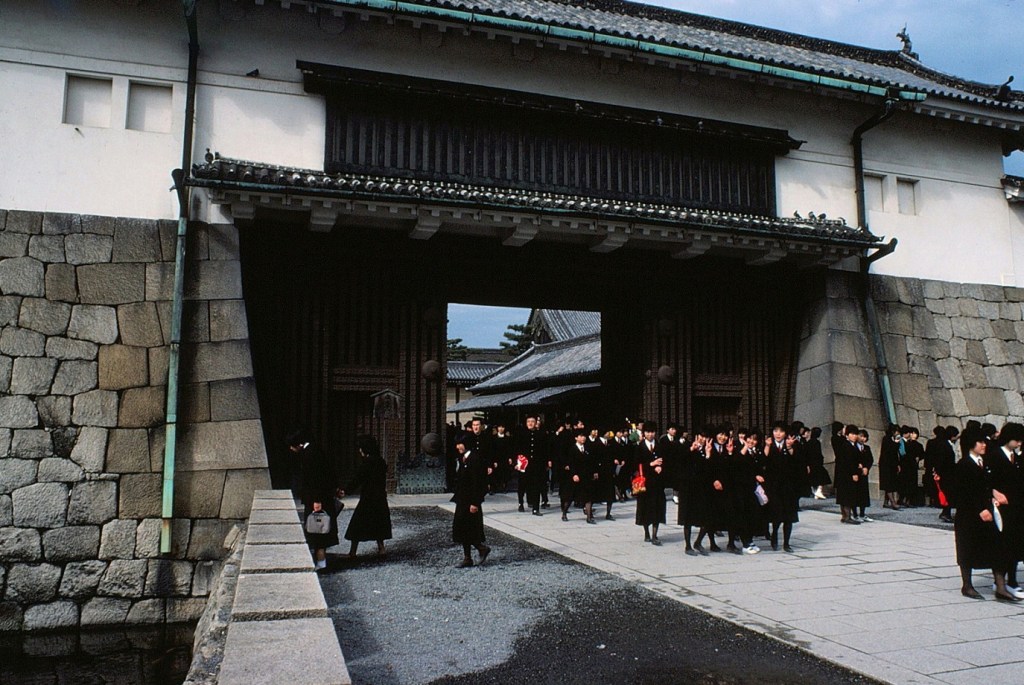
[Nijō Castle is a flatland castle in Kyoto. The castle consists of two concentric rings (Kuruwa) of fortifications, the Ninomaru Palace, the ruins of the Honmaru Palace, various support buildings and several gardens. The surface area of the castle is 275,000 square metres (27.5 ha; 68 acres), of which 8,000 square metres (86,000 sq ft) is occupied by buildings. It is one of the seventeen Historic Monuments of Ancient Kyoto which have been designated by UNESCO as a World Hertiage Site (Wikipedia).]

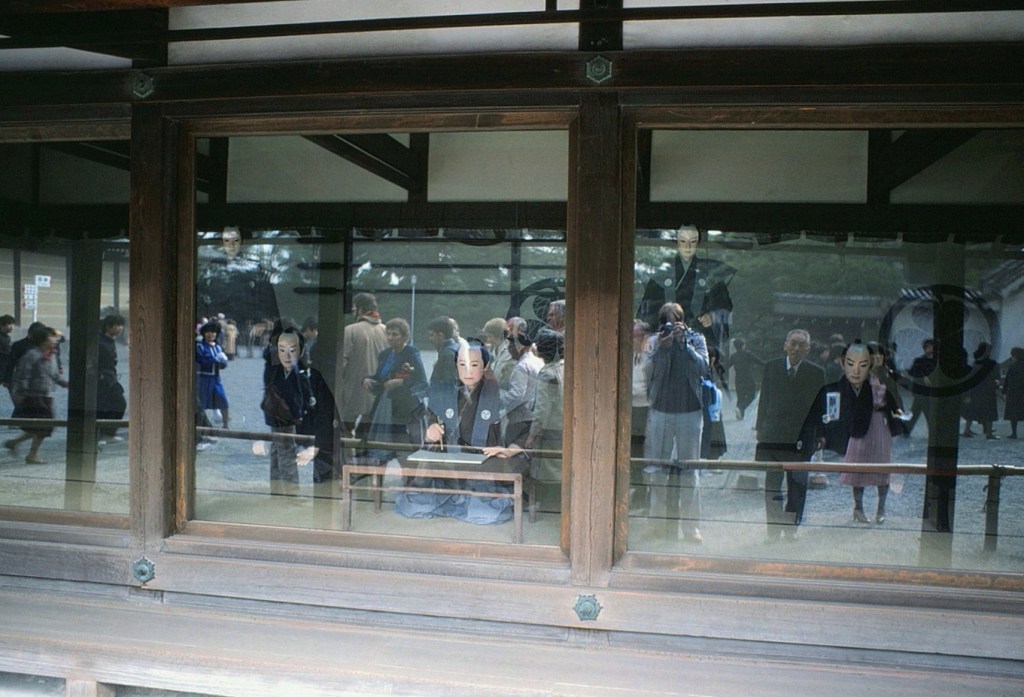
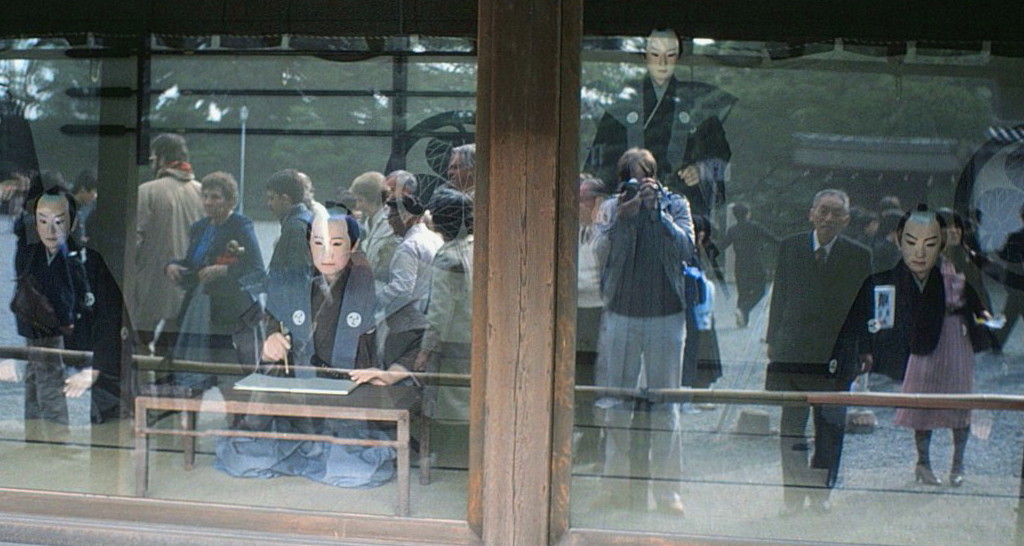
[The Ninomaru Palace in the castle was the residence and office of the shogun during his visits to Kyoto. And here he is. He was protected here by the “nightingale floors” (see 3 photos down) which I recall thinking at the time was something really cool . . . ]

[Now I remember. I invented the selfie 37 years ago . . . ]

[Heaven only knows what this is suppose to be . . . ]

[Ninomaru Palace of Nijo Castle is 3,300 square meters and consists of five connected separate buildings and is built almost entirely of Hinoki cypress. The decoration includes lavish quantities of gold leaft and elaborate wood carvings, intended to impress visitors with the power and wealth of the ‘shōguns’. The sliding doors and walls of each room are decorated with wall paintings by artists of the Kano school. The castle is an excellent example of social control manifested in architectural space. Low-ranking visitors were received in the outer regions of the Ninomaru, whereas high-ranking visitors were shown the more subtle inner chambers. Rather than attempt to conceal the entrances to the rooms for bodyguards (as was done in many castles), the Tokugawas chose to display them prominently. Thus, the construction lent itself to expressing intimidation and power to Edo-period visitors. The building houses several different reception chambers, offices and the living quarters of the shōgun, where only female attendants were allowed. One of the most striking features of the Ninomaru Palace are the “nightingale floors” (uguisubari) in the corridors that make a chirping sound when walked upon. Some of the rooms in the castle also contained special doors where the shogun’s bodyguard could sneak out to protect him (Wikipedia).]

[The pond of the Ninomaru Garden . . . ]

[And we tourists attack . . . ]

[The Heian Shrine is a Shinto shrine located in Sakyō-ku, Kyoto. The Shrine is ranked as a Beppyō Jinja (the top rank for shrines) by the Association of Shinto Shrines. It is listed as an important cultural property of Japan (Wikipedia).]

[Heian-jingū’s torii, one of the largest in Japan . . . ]

[Marsha on the Heian shrine grounds . . . ]

[The actual shrine grounds themselves are very spacious, with a wide open court at the center. The shrine’s main buildings are a partial replica of the original Imperial Palace from the Heian Period, built on a somewhat smaller scale than the original (japan-guide.com).]

[Tanabata is a celebration which occurs every year in Japan. It is associated with people of all ages making a wish, writing it on colorful strips of paper (tanzaku) and tying them to a bamboo tree. This tree may be at a shrine or simply tastefully put in your front garden (japan-forward.com).]

In the 18th century Japan had the world’s largest city, and world’s most literate population. ~  Kenneth Henshall

[This, and the following five photos, in the Heian shrine gardens . . . ]

I was not prepared for the feel of the noodles in my mouth, or the purity of the taste. I had been in Japan for almost a month, but I had never experiences anything like this. The noodles quivered as if they were alive, and leapt into my mouth where they vibrated as if playing inaudible music. ~  Ruth Reichl

Just beyond the gate, a neat yellow hole—someone pissed in the snow. ~  Kobayashi Issa

Regarding video games, Nintendo has had a huge influence on young people around the world. The company is in fact much older than many might imagine. It started in 1889 as a card company, exactly a 100 years before it produced the Gameboy. ~  Kenneth Henshall

News from Japan doesn’t travel and hardly ever gets reported abroad. It is almost as if Japan’s winds do not travel far. ~  Kanji Hanawa

The Heian court gave the world some of its finest early literature. For example, around 1004 the court lady Murasaki Shikibu wrote the world’s first novel, Genji Monogatari (Tale of Prince Genji). Many of its thousand pages reveal a life of exquisite refinement. ~  Kenneth Henshall

[The covered shopping arcades of downtown Kyoto. I’m not sure which is which but . . . ]

[One is likely Nishiki Market, where you’ll find dozens of food vendors selling mostly things that are considered typical “Kyoto” foods – pickled vegetables, tea, tofu – as well as an assortment of other seasonal goods and cookware (jackieoshiro.com) . . . ]

[Or at the end of the market, you’ll emerge into a covered shopping arcade. This street (Teramachi) and the street that runs parallel to it (Shinkyogoku) are the core of Kyoto’s shopping district. They span several blocks each and are filled with boutiques, cafes, restaurants, and souvenirs aplenty (jackieoshiro.com).] 

This lowly view of women was on reason why so many – if not most – samurai preferred homosexual relationships. ~  Kenneth Henshall

I think onstage nudity is disgusting, shameful, and damaging to all things American. But if I were 22 with a great body, it would be artistic, tasteful, patriotic, and a progressive religious experience. ~ Shelley Winters

[KYOTO . . . ]

[The general area from which the previous photo was taken . . . ]

[In the distance below, a cheerful beacon of 1960’s optimism, Kyoto Tower stands at 131 meters high from its base to the tip of its spire, and it is the tallest structure in Kyoto. As such it dominates the skyline and can be spotted from many of the sightseeing locations around the city. For a little over 50 years this curious structure has split opinion between those who see it as a symbol of modern Kyoto, and others who see it as a tacky and inappropriate folly (kyotostation.com).]

[Kiyomizu-dera, formally Otowa-san Kiyomizu-dera,  is a Buddhist temple in eastern Kyoto. The temple is part of the Historic Monuments of Ancient Kyoto (Kyoto, Uji and Otsu Cities) UNESCO World Heritage site. Kiyomizu-dera was founded in the early Heian period.  The temple was founded in 778, and its present buildings were constructed in 1633.  There is not a single nail used in the entire structure. It takes its name from the waterfall within the complex, which runs off the nearby hills.  Kiyomizu means clear water, or pure water. The main hall has a large veranda, supported by tall pillars, that juts out over the hillside and offers impressive views of the city. Large verandas and main halls were constructed at many popular sites during the Edo period to accommodate large numbers of pilgrims. In 2007, Kiyomizu-dera was one of 21 finalists for the New Seven Wonders of the World, but was not picked as one of the seven winning sites (Wikipedia).]

[This place was strikingly awesome and well due consideration as a wonder of the world . . . ]

[The temple complex includes several other shrines, among them the Jishu Shrine, dedicated to Okuninushi, a god of love and “good matches”.  Jishu Shrine possesses a pair of “love stones” placed 10 meters (30 feet) apart, which lonely visitors can try to walk between with their eyes closed. Success in reaching the other stone with their eyes closed implies that the pilgrim will find love, or true love.  One can be assisted in the crossing, but this is taken to mean that a go-between will be needed. The person’s romantic interest can assist them as well (Wikipedia).]

How much does he lack himself who must have many things? ~  Sen no Rikyū

Japan knows the horror of war and has suffered as no other nation under the cloud of nuclear disaster. Certainly Japan can stand strong for a world of peace. ~  Martin Luther King Jr.

[‘Otowa-no-taki,’ the waterfall where visitors drink for health, longevity, and success in studies (Wikipedia).]

Whereas, in the west, individuality and drive are considered positive qualities, they are not seen the same way, in Japan. In that country, if you are too much of a rugged individualist, it might actually indicate that you are a weak, unreliable character and that you are selfish, in a childish, willful kind of way. ~  Alexei Maxim Russell

Japanese are one of the most punctual people he had ever worked with. They could, he imagined, put the Germans to shame in their high expectation for timeliness. ~  Vann Chow

The peasant is the foundation of the state and must be governed with care. He must be allowed neither too much, nor too little, but just enough rice to live on and keep for seed in the following year. The remainder must be taken from him in tax. ~ Honda Masanobu

[Sayonara to Otowa-san Kiyomizu-dera]

I do not believe there is an atheist in the world who would bulldoze Mecca-or Chartres, York Minster or Notre Dame, the Shwe Dagon, the temples of Kyoto or, of course, the Buddhas of Bamiyan. ~ Richard Dawkins

I loved the quiet places in Kyoto, the places that held the world within a windless moment. Inside the temples, Nature held her breath. All longing was put to sleep in the stillness, and all was distilled into a clean simplicity.The smell of woodsmoke, the drift of incense; a procession of monks in black-and-gold robes, one of them giggling in a voice yet unbroken; a touch of autumn in the air, a sense of gathering rain. ~ Pico Iyer

Up Next: Part 11

Japan 1983 (Part 9)

November 16

Japan has somehow managed to achieve the ideal attitude to eating: an obsession with culinary pleasure that is actually conductive to health. ~  Bee Wilson

Johnny awoke with a start. He had had another nightmare. Oh, he’d had the standard nightmares through the years – falling from a high place, unable to run from the monster, or the bar had run out of malbec – but this one was the worst. He was in a cold, clammy sweat, thinking he was trending toward becoming a . . . Republican?

[I suspect we were in Shirahama . . . ]

[ISO . . . an ama?]

[In the above photo, we were obviously in a glass bottom boat somewhere in open water. Yet, this next photograph we were at our next hotel overlooking an oyster farm in Shirahama (I believe) . . . ]

[Shirahama Onsen area is considered one of Japan’s top three hot spring areas. It has a history dating back over 1300 years, but the town saw a boom in popularity as a hot spring destination from the early 1920s onwards (japanpropertycentral.com).]

[Shirahama, a beach destination . . . ]

I want to go to Japan. I feel like they love blonde girls. ~ Gigi Gorgeous

[Marsha, Roy, and Toku as we settle into another traditional Japanese dinner . . . ]

Maitake mushrooms are known in Japan as ‘the dancing mushroom.’ According to a Japanese legend, a group of Buddhist nuns and woodcutters met on a mountain trail, where they discovered a fruiting of maitake mushrooms emerging from the forest floor. Rejoicing at their discovery of this delicious mushroom, they danced to celebrate. ~ Paul Stamets

One glass of water doesn’t equal another. One may just appease the thirst, the other you may enjoy thoroughly. In Japan, people know about this difference. ~ Jil Sander

As far as food goes, I’m pretty easy. I love Japanese food. I loved meat loaf and mashed potatoes. I love spaghetti. I’m pretty easy. ~ Frank Oz

Sushi is something very exclusive. It is not like a McDonald’s, not like a hot dog, not like a French fry. It’s very high-class cooking in Japan. ~ Nobu Matsuhisa

[Hotel [K]oganoi (103 rooms) and the Shirahama Seaside Hotel (91 rooms) were both built in 1961. Despite having operating ratios of around 70% between April and August this year, the continued operation of the hotels has proven difficult due to their age and the fact that they were built to the old and out-dated earthquake codes. The company had considered retrofitting the buildings, but the 1 billion Yen (8.4 million USD) cost was considered too high. Both hotels will close at the end of March 2016 (japanpropertycentral.com).

Tempura-style batters were originally brought to Japan by Portuguese missionaries in the 16th century. ~ J. Kenji Lopez-Alt

[Did I mention before that Roy (i.e., Roy-san) became a real Nipponophile after this trip, turned his backyard into a Japanese garden, and developed a fine collection of bonsai trees (as below) . . . ]

[Bonsais on display . . . ]

[So typically Japanese, the staff from the hotel come out to say sayonara to tour groups . . . ]

[“Engetsuto” is a small island in Rinkai-ura Ocean in Shirahama-cho. The name “Engetsuto” means “Island of the full moon”, and is a nickname given to the island, inspired by the moon-like round hole in the center of the island. The island’s official name is “Takashima”. The island measures 130 meters (from south to north), 35 meters (from east to west), and 25 meters (in height). The hole measures 9 meters (in height) and 8 meters (in width) (thegate12.com).]

[You can closely experience the stunning steep coast at “Senjojiki”. Facing the Pacific Ocean, Senjojiki was denuded by raging waves and boasts a magnificent view. The rock of Senjojiki was formed about 1.8 million to 65 million years ago when the stratum was gradually eroded by the waves. This place took its current form over a long period of time, and boasts a superb view of nature (thegate12.com).]

[The sign above indicates this area is Yoshino-Kumano National Park . . . ]

One of the things that slaps you in the face when you arrive in Japan is their obsession with everything cute. ~ Stacey Dooley

King of the Mountain . . .

Ocean, n. A body of water occupying about two-thirds of a world made for man – who has no gills.  ~  Ambrose Bierce

I couldn’t imagine living in a state that didn’t reach the ocean. It was a giant reset button. You could go to the edge of the land and see infinity and feel renewed. ~ Avery Sawyer 

The sea, once it casts its spell, holds one in its net of wonder forever. ~ Jacques Cousteau

[Looking very much like the north coast of Okinawa . . . ]

What would an ocean be without a monster lurking in the dark? It would be like sleep without dreams. ~ Werner Herzog

[A Shirahama overlook . . . ]

[Likely just a pan to the right . . . ]

Sayonara, Shirahama!

[Either the bus or train station – who can recall . . . ]

[On the road again . . . ]

[Little did I realize at the time, but we were on the road to . . . ]

[What would become my favorite city – Kyoto . . . ]

[Kinkaku-ji (literally “Temple of the Golden Pavilion”), officially named Rokuon-ji (literally “Deer Garden Temple”), is a Zen Buddhist temple in Kyoto.  It is one of the most popular buildings in Kyoto, attracting many visitors annually. It is designated as a National Special Historic Site, a National Special Landscape and is one of 17 locations making up the Historic Monuments of Ancient Kyoto which are World Heritage Sites. The name Kinkaku is derived from the gold leaf that the pavilion is covered in. Gold was an important addition to the pavilion because of its underlying meaning. The gold employed was intended to mitigate and purify any pollution or negative thoughts and feelings towards death. Other than the symbolic meaning behind the gold leaf, the Muromachi period heavily relied on visual excesses.  With the focus on the Golden Pavilion, the way that the structure is mainly covered in that material creates an impression that stands out because of the sunlight reflecting and the effect the reflection creates on the pond. (Wikipedia).]

[Unfortunately, we had a cloudy day. So . . . ]

[I borrowed one off the internet so you could see it in the sunshine . . . ]

[The Ship of Pine of Kyoto (with lattice work supporting the prow): Kyoto was the capitol of Japan from A.D. 794to 1185. Even after the government moved first to Kamakura and then Tokyo, Kyoto remained important to Japanese society for its many important Buddhist temples which are still in active use and frequently visited by foreign tourists. The most well known of these is Kinkakuji Temple, also known as the Golden Temple because of the stunning metallic-yellow color of its main shrine. A small pond acts as mirror in front of the temple, creating an added effect and rocks are positioned deliberately to create a seacoast effect. This coastal imagery is further enhanced by the nearby Ship Pine, a white pine, known in Japanese as the “Rikushu-no-matsu”, and is one of three famous pines in Kyoto. This tree was originally a bonsai trained in the shape of a ship, and belonged to the Shogun, or military ruler, Ashikaga, who was a great patron of the Temple (arnoldia.arboretum.harvard.edu/).]

[I suspect the rest of these photos are in the Golden Pagoda complex . . . ]

Psychologically, Japanese women depend largely on each other. In their sex-segregated society, they could be criticized for living in a female ghetto, and yet they have what some American feminists are trying to build, a ”women’s culture” with its own customs, values and even language. ~  Kittredge Cherry

While he mused on the effect of the flowing sands, he was seized from time to time by hallucinations in which he himself began to move with the flow. ~  Kōbō Abe

Life itself is your teacher, and you are in a state of constant learning. ~ Bruce Lee

The concept of “delicious” was born in Japan in 1908 when a chemist called Ikeda discovered a “fifth taste” called umami that was neither bitter nor salty nor sweet nor sour but something more wonderful and compelling than any of these. ~ Bee Wilson

Up Next: Part 10 . . .

Japan 1983 (Part 8)

November 11

Japan is the only country I know where a flower can bring an entire nation to a state of near-sexual excitement. ~ Karen Muller

Continuing our misadventures from 37 years ago, you’ve probably noted there seems to be no logical date breaks between the blog “parts.” And that would be because there isn’t. These photos were taken back in the magical days of film, so each “part” consists of an entire roll of film. And the end of a roll, requiring insertion of a new roll, can happen any time during a day. Thus, absent a written record, the photos are undated – the only thing I know for sure (I think) is that the trip occurred in November 1983 . . .

[With this post’s lead-in in mind, I believe this is at the Todaya Ryokan on Toba Bay, where we ended the last post . . . ]

In Japanese culture, there is a belief that God is everywhere – in mountains, trees, rocks, even in our sympathy for robots or Hello Kitty toys. ~ Ryuichi Sakamoto

There are so many more people in Tokyo than in New York, but it’s pristine. It’s so organized, and yet the address system is in complete chaos. ~ Nick Wooster

[And if this is not a view of the city of Toba from our ryokan, then I have no idea where we were . . . ]

Here in Tokyo they’re not just hard working but almost violently cheerful. Down at the Peacock, the change flows like tap water. The women behind the registers bow to you, and I don’t mean that they lower their heads a little, the way you might if passing someone on the street. These cashiers press their hands together and bend from the waist. Then they say what sounds to me like “We, the people of this store, worship you as we might a god. ~ David Sedaris

[Oh, and a rare beautiful sunny day accentuating the surrounding scenery . . . ]

The whole of Japan is a pure invention. There is no such country, there are no such people. The Japanese people are simply a mode of style, an exquisite fancy of art. ~ Oscar Wilde

What a strange thing! To be alive beneath cherry blossoms. ~ Kobayashi Issa

[And now, my most favorite experience of the entire trip . . . ]

[Presenting: Kumano Nachi Taisha]

[Kumano Nachi Taisha is a Shinto shrine and part of the UNESCO-designated World Heritage Sacred Sites and Pilgrimage Routes in the Kii Mountain Range. The Kumano Kodo route connects it to other sites under the same classification, which are primarily located in Wakayama Prefecture. The four sites on the route, classified as pilgrimage destinations and World Heritage Sites, are: 1) Nachi Taisha; 2) Hongu Taisha; 3) Hayatama Taisha; 4) Koya-san. This classification is based mostly in Japanese history, as pilgrims would travel to all three sites to complete their pilgrimage. Kumano Nachi Taisha is an example of Buddhist and Shinto syncretism (Shinbutsu shugo) nestled in the Kii Mountains, near Kii Katsuura. Cedar forests surround the site. The Nachi Waterfall, worshiped at the Hiryū Shrine near Kumano Nachi Taisha, is believed to be inhabited by a ‘kami’ called Hiryū Gongen.  Also, there is a sacred tree at this site, the Sacred Camphor Tree, located between the Nachi Shrine (heiden) and Seigantoji Temple. It is 850 years old and is said to have been planted by Taira-no-Shigemori (1138-1179). The straw rope (‘shimenawa’) and paper flags show that this tree has been sanctified as a ‘kami’. The tree is alive with moss and ferns and other small plants growing on its ancient limbs. It is possible to enter the tree, where there is a small altar for making offerings. Nachi-no-Hi Matsuri Fire Festival, performed on July 14, is the major festival of Kumano Nachi Taisha. It is a fire festival in which six-meter-high portable shrines symbolically representing the purification of the waterfall with the fires from oversized torches is laboriously carried by men dressed in white (Wikipedia).]

[Kumano Nachi Taisha is one of the three Kumano shrines, situated a few kilometers inland from the coastal hot spring resort of Katsuura. The shrine is part of a large complex of neighboring religious sites that exemplify the fusion of Buddhist and Shinto influences that is particular to the Kumano region. The site also boasts the tallest waterfall in Japan. The veneration of the Kumano shrines as holy sites of Shintoism predates Buddhism’s introduction to Japan in the mid 6th century. Once Buddhism arrived in Kumano it took root quickly, and rather than competing with the indigenous religion for religious authority, it began a long process of harmonious mixing. A product of this congenial relationship can be seen at Nachi Taisha. Directly beside the eminent shrine is the Buddhist temple Seigantoji. In fact, for most of their history the buildings were not even under separate control and functioned as one religious institution. The buildings of both the shrine and the temple are impressive, and among the buildings of Seigantoji there is a three-story pagoda (japan-guide.com).]

[A short distance from Seigantoji and Nachi Taisha is the 133 meter waterfall Nachi no Taki. The tallest (single-tiered) waterfall in Japan, it was the original religious site in the area. Before the development of organized religious doctrine, Nachi no Taki was venerated by the earliest Japanese people. Even today, visitors will be impressed by the natural power and beauty of the falls (japan-guide.com.]

[Like Hongu Taisha and Hayatama Taisha, Nachi Taisha was one of the main destinations of the Kumano Kodo pilgrimage routes. For travelers who want to experience the trails but are impeded by time constraints, a hike up the Daimon-zaka is a good option. The route, paved with stone and lined with massive evergreens, leads 600 meters up to the gates of Nachi Taisha (japan-guide.com).]

[This whole place was just a wondrous assault on all the senses . . . ]

[You may even run into dazzled American tourists here . . . ]

[Yeah, like that one . . . ]

[In the Kii Mountains . . . ]

[The falls, from a distance . . . ]

[To this day, still one of my all-time favorite shots . . . ]

[Seiganto-ji is a Tendai Buddhist temple founded in the early 5th century. Legend holds that a Buddhist priest from India drifted ashore and experienced a revelation of Kannon, the Buddhist deity of mercy. Seiganto-ji Temple is also the first sacred place of “Saigokujunrei”, or pilgrimage to 33 Kannons which started in 1161 (tb-kumano.jp).]

There are two ways of spreading light: to be the candle or the mirror that reflects it. ~ Edith Wharton

[This place is all about vertical . . . ]

[The Seigantoj three-story pagoda . . . ]

[The difference between Shintoism and Buddhism is simple; they are two very distinct religions. Shintoism means “the way of the gods”, and is a polytheistic system with thousands of ‘kami ‘deities. The kami are deities of nature, such as the sun, the sea, and even rice. Buddhism originated in India and is a religion based on the teaching of the Buddha and the hope of achieving enlightenment by breaking the cycle of reincarnations. It was imported to Japan from China in the sixth century (japan-experience.com).]

[Daimon-zaka (Kumano Nachi Taisha Area) is an excellent short walk on the Kumano Kodo pilgrimage route. The actual staircase is about 600 meters long with 267 stairs. At the end of the slope is the impressive Meitosugi – “husband and wife cedar trees”, whose roots are entwined beneath the path (tb-kumano.jp/).]

[Roy coming down some of those stairs . . . ]

[Tourist commerce . . . ]

[Obviously, we came down out of the mountains – this area is called “the shore” . . . ]

[Roy appears to be venturing out at low tide . . . ]

It’s a total myth that good sashimi comes directly from sea to sushi counter. The reality is that raw fish, especially in the finest Japanese restaurants, are aged. ~ Johannes Pong

[The sashimi, close up . . . ]

[This appears to not be sashimi (yet) . . . ]

I know I’ll never find another ewe . . .

The method (of learning Japanese) recommended by experts is to be born as a Japanese baby and raised by a Japanese family, in Japan. And even then it’s not easy. ~ Dave Barry

Japan is not a Western democracy. The Japanese have kept their traditions, culture and heritage, but they have joined the community of free nations. ~ Natan Sharansky

[Overly fresh sashimi . . . ]

[Tourists – whadya gonna do?]

One night in Tokyo we watched two Japanese businessmen saying good-night to each other after what had clearly been a long night of drinking, a major participant sport in Japan. These men were totally snockered, having reached the stage of inebriation wherein every air molecule that struck caused them to wobble slightly, but they still managed to behave more formally than Americans do at funerals. ~ Dave Barry

Up Next: Part 9

Japan 1983 (Part 7)

November 9

Well, you live and learn. Then, of course, you die and forget it all. ~ Noel Coward

After the 20 Magical Musical Tour postings and some sort of national election, it’s time to return to 1983 Japan. As you may recall, I could find no documentation of this trip and have to recall these photos from memory (unlikely) or extensive Google and Wikipedia searches. The “extensive” part is what cools my jets about delving into this again . . .

[When last we left you we were at the Ise Grand Shrine (upper right on the map) . . . ]

[And I think we’re still at the Grand Shrine here, having a walkabout . . . ]

Teaism is a cult founded on the adoration of the beautiful among the sordid facts of everyday existence. ~ Kakuzo Okahura

[The Inner Shrine (Naikū) is one of the two main shrines making up the Ise Shrines in Ise City. Formally known as Kotai Jingu, the Inner Shrine enshrines Shinto’s most venerated deity, the Sun Goddess (Amaterasu Omikami), and is considered Japan’s most sacred shrine. The Inner Shrine is believed to have been established over 2000 years ago. Its main buildings resemble ancient rice granaries and are built in an architectural style that shows almost no influence from the Asian mainland because they predate the introduction of Buddhism. Both, the Inner and Outer Shrine, are rebuilt from scratch every 20 years according to an ancient Shinto tradition. The 62nd rebuilding was completed in 2013. The 63rd rebuilding will take place in 2033 (japan-guide.com/e/e4300.html).]

[A typical visit to the Inner Shrine takes between 60 and 90 minutes and starts from the Uji Bridge, an approximately 100 meter long, wooden bridge across the Isuzugawa River. The bridge has two large torii gates, one at each end, which are made from the former shrine building’s main pillars. The shrine grounds fascinate through their simplicity, as visitors encounter little more than gravel-covered walkways and wooden, barely painted shrine structures, surrounded by a serene forest (japan-guide.com/e/e4300.html).]

I thought that I would never see, a tree this much larger than me . . .

If your computer speaks English, it was probably made in Japan. ~ Alan Perlis 

[Because of following pictures, I have every reason to believe this is a Toba Bay beach . . . ]

[The Toba Bay area, just east of Ise, is important for . . . ]

[This I remember for reasons unknown? Meoto Iwa (or the Married Couple Rocks) are two rocky stacks in the sea off Futami, Mie. They are joined by a ‘shimenawa’ (a heavy rope of rice straw) and are considered sacred by worshipers at the neighboring Futami Okitama Shrine (Futami Okitama Jinja). According to Shinto, the rocks represent the union of the creator of ‘kami’, Izanagi, and Izanami. The rocks, therefore, celebrate the union in marriage of man and woman. The rope, which weighs over a ton, must be replaced several times a year in a special ceremony. The larger rock, said to be male, has a small torii at its peak. At dawn during the summer, the sun appears to rise between the two rocks.  Mount Fuji is visible in the distance. At low tide, the rocks are not separated by water. Okitama Shrine is dedicated to Sarutahiko Okami and imperial food goddess Ukanomitama. There are numerous statues of frogs around the shrine. The shrine and the two rocks are near the Grand Shrine of Ise, the most important location of purification in Shinto (Wikipedia).]

[And a great site for group tour bus photos . . . ]

[Mikimoto Kokichi Statue located in Toba . . . ]

[The Mikimoto Pearl Island (Mikimoto Shinjujima) is an excellent museum about pearls, pearl cultivation and Mikimoto Kokichi, the pioneer who first succeeded in cultivating pearls. The island is located in the Bay of Toba, accessible via a bridge. Mikimoto Kokichi was born in Toba in 1858 and became the first person to successfully cultivate pearls in the year 1893. He opened the first Mikimoto Pearl Store in 1899. The Mikimoto Kokichi Memorial Hall introduces his life story. Also located on the island, the Pearl Museum provides detailed explanations about pearls and the cultivation of pearls in Japanese and English. In the adjacent Pearl Plaza you can view and purchase a wide variety of pearl jewelry (www.japan-guide.com/).]

[Sorting by size, color, etc., etc. Why yes, I did buy some pearl necklaces for the folks back home – and the Super now wears the one I bought for mom . . . ]

[The Mikimoto Pearl Island also offers hourly performances by female pearl divers, known as ‘ama’ (lit. “sea women”), who have traditionally been planting and harvesting the oysters (and other seafood) (www.japan-guide.com) . . . ]

[Japanese tradition holds that the practice of ‘ama’ may be 2,000 years old.  Traditionally, and even as recently as the 1960s, ‘ama’ dived wearing only a loincloth. Even in modern times, ‘ama’ dive without scuba gear or air tanks, making them a traditional sort of free-diver. Records of the female pearl divers, or ‘ama’, date back as early as 927 AD in Japan’s Heian period. Early ama were known to dive for seafood and were honored with the task of retrieving abalone for shrines and imperial emperors. Ama traditionally wear white as it was believed to ward off sharks. Early divers wore only a loin cloth but in the 20th century the divers adopted an all-white sheer diving uniform in order to be more presentable while diving.  Pearl diving ama were considered rare in the early years of diving. However, Mikimoto Kokichi’s discovery and production of the culture pearl in 1893 produced a great demand for ama. He established the Mikimoto Pearl Island in Toba and used the ama’s findings to grow his business internationally. Nowadays, the pearl diving ama are viewed as a tourist attraction at Mikimoto Pearl island.  The number of ama continue to dwindle as this ancient technique becomes less and less practiced due to disinterest in the new generation of women and the dwindling demand for the diving women. In the 1940s, 6000 ama were reported active along the coasts of Japan while today ama practice at numbers more along the scale of 60 or 70 divers in a generation (Wikipedia).]

[We were advised on this trip that after much experimentation Mikimoto determined that broken clam shells from the Mississippi River provided the best irritant for the oysters to produce the best pearls . . . ]

So, bottoms up!

[I believe this is a green tea field . . . ]

[And then it happened. The next several pictures are of a river boat ride. And though I well remember the ride, I cannot find any information about it – the whys and wherefores – even after hours of scouring the internet . . . ]

[A Minnesota guess would be fishermen . . . ]

[A twin boat to the one we were in . . . ]

You cannot call yourself a true geisha until you can stop a man in his tracks with a single look. ~ Arthur Golden

[Shore lunch?]

[The sun roof was open . . . ]

In Japanese we have a word for those feelings that are too deep for words: yugen. Yugen gives us a profound sense of the beauty and mystery of the universe. ~ Dr. Qing Li

[Roy popped out for a photo op . . . ]

Living in a world such as this is like dancing on a live volcano. ~  Kentetsu Takamori

Hatred of domestic work is a natural and admirable result of civilization. ~ Rebecca West

Somewhere, something incredible is waiting to be known. ~ Carl Sagan

He is not only dull himself; he is the cause of dullness in others. ~ Samuel Johnson

[A group photo op not unlike at Wedded Rocks . . . ]

I’ve just learned about his illness. Let’s hope it’s nothing trivial. ~ Irvin S. Cobb

[Everything is f-stops and shutter speeds . . . ]

[On the road again looking for a place to rest our heads . . . ]

[And here we are . . . ]

[I believe we are in the Todaya Ryokan in the Toba Bay area . . . ]

[But don’t hold me to it . . . ]

[Remember rotary dial phones?]

[Highlighting Ama divers, women of the sea . . . ]

Experience is a good teacher, but she sends in terrific bills. ~ Minna Antrim

Up Next: Continuing Japan 1983

A Complete Abridged History of Music (Part 20)*

November 4

* In the greater Alexandria, Minnesota, standard metropolitan statistical area

There are two means of refuge from the misery of life — music and cats. ~  Albert Schweitzer

Well, boys and girls, we have reached the end of our 20-year sentimental journey down the musical memory lane. Who’da thunk that this last year would occur in the midst of a 100-year pandemic. Our last venture to an indoor venue occurred last March, and we were probably pushing it a bit at the time. Who knows when we’ll go inside again, as the cold weather season is soon upon us. I didn’t realize until I got into this that 2013 and 2014 were by far our most active years of cub reporting. Coverage has been gradually slipping since then in conjunction with my bodily mental and physical slippage. I find myself going to bed at 8:00 pm and waking at 2:00 am. There is not a great need for cub reporting at 9:00 am, when my battery is fully charged. So finally, and at last, I give you what was available in 2020 . . .

I had a boyfriend who told me I’d never succeed, never be nominated for a Grammy, never have a hit song, and that he hoped I’d fail. I said to him, ‘Someday, when we’re not together, you won’t be able to order a cup of coffee at the fucking deli without hearing or seeing me.’ ~  Lady Gaga

Josie Nelson @ CCW, January 2020

Anthony Miltich @ CCW, March 2020

Cheese Bots @ Garden Bar, March 2020 THE LAST INDOOR EVENT BEFORE PANDEMIC PROTOCOLS

Josie Nelson @ CCW, June 2020

Salty Dogs @ CCW, June 2020

Terry Kennedy & Bill Riggs @ Garden Bar, June 2020

Anthony Miltich @ Lure Lakebar, July 2020

Farewell Angelina @ TLHD, July 2020

(Lauren Lucas, Lisa Torres, Nicole Witt and Andrea Young (may not be in that order here) )

Love at a Distance (Carson Rose Schneider, Siena Forest, Luke Williams & David Walton) @ TLHD, July 2020

Tuesday Night Club (Terry Kennedy, Bill Riggs, Al Lieffort) @ Garden Bar, August 2020

Bill Riggs

Dan Chouinard @ TLHD, August 2020

Kevin Kling @ TLHD, August 2020

Elsa Lee @ CCW, August 2020

Erik Schultz @ CCW, August 2020

Her Crooked Heart (Hilary James & Rachel Ries) @ TLHD, September 2020

James Case (w/ Jimmy Peterson & Casey Gooby) @ TLHD, September 2020

King Pari (Cameron Kinghorn & Joe Paris Christensen) @ TLHD, September 2020

Debbie Duncan @ TLHD, September 2020

Judi Vinar @ TLHD, September 2020

Lori Dokken @ TLHD, September 2020

Patty Peterson @ TLHD, September 2020

Rachel Holder @ TLHD, September 2020

Lori, Patty, Debbie, Rachel & Judi @ TLHD, September 2020

Terry Kennedy, Bill Riggs & Al Lieffort @ Garden Bar, September 2020

Terry & Bill, same time & place . . .

Anthony Miltich @ CCW, September 2020

Terry Kennedy, Bill Riggs & Jim Faber @ Garden Bar, September 2020

Alexandria High School Marching Band on Constitution Avenue, Washington, D.C., 1992

[The Alex band was recognized as one of the best in the country at the time and was thus rewarded as the final performers in parade. I was living in Arlington, Virginia, at the time, so I consider these my first Alex music photos.]

Goodbye, Goodbye
Goodbye, Goodbye
Goodbye, Goodbye
My love, goodbye

If I should ever die, God forbid, let this be my epitaph: THE ONLY PROOF HE NEEDED FOR THE EXISTENCE OF GOD WAS MUSIC. ~  Kurt Vonnegut

Up Next: Back to 1983 Japan?